3 months ago
68
3 months ago
68
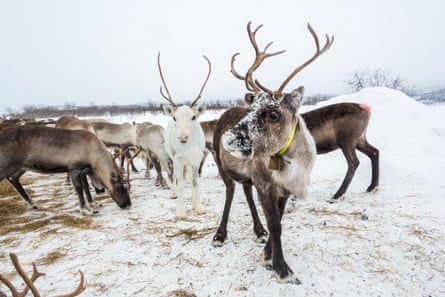
Juha Kujala no longer knows how many reindeer will return to his farm from the forest each December. The 54-year-old herder releases his animals into the wilderness on the 830-mile Finnish-Russian border each spring to grow fat on lichens, grass and mushrooms, just as his ancestors have done for generations.
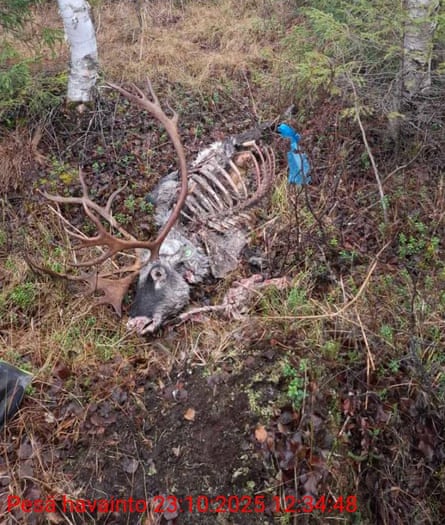
But since 2022, grisly discoveries of reindeer skeletons on the forest floor have disrupted this ancient way of life. The culprits, according to Kujala: wolves from Russia.
Oblivious to the tensions between the two countries sparked by Moscow’s invasion of Ukraine, large animals such as wolves and bears move freely across the heavily forested frontier. Most go unnoticed, but on the Finnish side, a record level of wolf attacks on reindeer last year has sparked concern among some herders.
They suspect that Russian wolf numbers have exploded after hunters were sent to the frontline in Ukraine, driving the predators to search for new territory in Finland.
“The last year has been the worst ever for wolf attacks in this area. The reindeer are an easy catch for them,” says Kujala, whose reindeer are spending the winter at his farm near Kuusamo.
“You can see the signs that it is wolves: they go for the throat and the legs. When you’ve seen enough dead ones, you can tell.
“My home is 38km from the Russian border. When it snows, you can see the tracks coming from their side,” he adds.
A record 2,124 reindeer were killed by wolves in 2025, according to the Reindeer Herders’ Association of Finland, which says those found are likely to be a fraction of the true total. Many share photos of the skeletons they find in the forests, which have often been chewed clean to the bone.
Despite the herders’ suspicions about Russian wolves being to blame, the authorities say it is hard to be definitive about the reasons behind the jump in predation.
There is almost no contact across the border between Finland and Russia, and it is impossible to get answers to basic questions from the Russians about what might be behind the rise in attacks. Finnish herders say they are no longer able to collect reindeer that have crossed the border, which was commonplace before Russia’s invasion of Ukraine.
Until last June, the wolf was a strictly protected species in the EU after it was nearly hunted to extinction in many countries. But its conservation level was downgraded after numbers almost doubled across Europe from 11,193 to 20,300 between 2012 and 2023. Roughly 65,500 livestock a year are thought to be killed by the predators, prompting some EU states to increase culling.
Finland lifted its ban on wolf hunting at the start of 2026, instead implementing a hunting quota system to limit population growth.
Ilpo Kojola, a wolf specialist with Finland’s Natural Resources Institute, says: “The wolf is a species that can increase rapidly. They are usually pretty limited by hunting in Russia so that’s why it is possible that the war in Ukraine has had some role in the change.
“But it’s impossible to be conclusive because, of course, there could be some other reason that we do not have solid evidence for.”
The Finnish wolf population was about 430 in spring last year, according to official statistics, and is part of the same subspecies as those in Russia, which is home to an estimated 60,000.
Kojola says there is a precedent for the rapid increase in Russia’s wolf population when, during the second world war, numbers doubled after millions of men were sent to fight against Nazi Germany on the Soviet Union’s western front. There was another spike when the USSR collapsed.
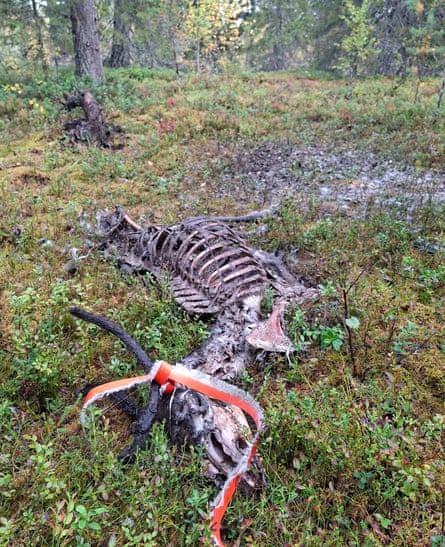
“We don’t know how big a role the soldiers stationed at garrisons on the border played in wolf hunting in the area. But the increase in attacks is close timing with the war in Ukraine,” he says.
Mia Valtonen, a senior scientist with the Natural Resources Institute, is responsible for the genetic testing of wolves shot to control populations. She says a majority of the wolves shot in Finland in recent years do not appear to be from the country, but researchers cannot be certain as a genetic record of their entire wolf population has not yet been completed.
“We cannot say for sure that most of these wolves come from Russia. It’s likely, but we cannot say it for sure,” she says.
Kujala and other herders who regularly find dead reindeer in the forest dismiss the scientific caution, calling for greater protection from attacks.
“We do not hate the wolves but we need balance,” Kujala says. “The reindeer spend most of their time out in nature. Around my farm, there is a big 50km section for them to roam in. It’s impossible to protect them all the time.
“We need them healthy and strong. This is our life, it’s our job, it’s how we live. It’s been like this for hundreds of years.”
Find more age of extinction coverage here, and follow the biodiversity reporters Phoebe Weston and Patrick Greenfield in the Guardian app for more nature coverage