3 hours ago
16
3 hours ago
16
As Art Garfunkel is keen to point out, “I am a singer – there, use that as the title of your article” – but he was never just a singer. “I’ve been an actor. I am a writer,” he continues. “I’ve walked across countries, taken freighters across oceans. I’ve read the dictionary. I’ve read two books a month for 60 years: Darwin, Herodotus, Balzac, Proust, Tolstoy. I’ve taught maths. I have two great kids and I’m a grandfather, but it always does seem to come back to the singing.”
Which is understandable, given that in Simon and Garfunkel (with songwriter Paul Simon) he sold more albums than any other pop duo in history. Garfunkel’s oft-called “angelic” tones powered classic chart-toppers including The Sound of Silence and Bridge Over Troubled Water, and he became a successful solo artist. However, until a year ago, he was hardly singing at all and hadn’t toured since 2019. “I found myself lying on a pillow in a dream state, thinking about the meaning of being alive,” he reveals. “What is my day? What am I supposed to do with myself?”
He realised that the two things that had made him happiest were meeting his wife, Kathryn, in 1985, and singing, especially the point during a show when “it becomes effortless, and you reach this high point of pure joy”. So a friend who worked at an art gallery north of New York suggested he might try singing and telling stories to an audience of 60 people, and see how it felt. “It worked,” Garfunkel enthuses. “After three nights, I thought: I’ll get back to doing this.”
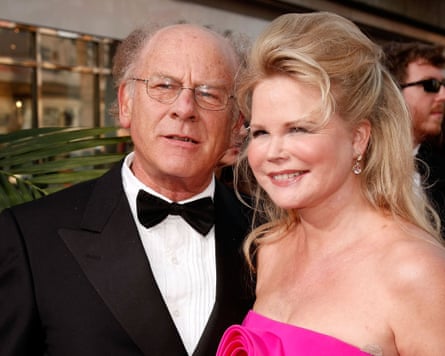
Thus, at the age of 84, the polymath is back on the road – he comes to the UK in October – and “singing much more than I have done in two decades”. He made the album Father and Son with his son Art Jr two years ago, and even sang Bridge Over Troubled Water shortly before speaking to me. “In the bathtub at the hotel,” he chuckles, “because there’s reverb, and I sang it as good as I ever sang it in the 60s.”
His most recent release is Authorship, a track on a compilation created by the technology company Eleven Labs, which has created an AI model for generating “original compositions” in collaboration with artists. Authorship features a spoken excerpt from Garfunkel’s 2017 memoir What Is It All But Luminous over an AI-generated piano backing. Not that he seems to have had too much involvement with the technology. “I think my new management like my writing and wanted to do something with it,” he explains. “I’m the only person left in America without a computer or the internet.”
So we’re speaking on a crackly phone line, which gives his dulcet tones an otherworldly quality as he talks about the first time he sang, aged five, in 1946. “I used to sing along to the radio,” he remembers. “Then one day I walked out of kindergarten – the stairwell had lovely reverb – and started singing to myself. I had goosebumps because my voice was pretty. I was having more fun than I’d ever known and I realised: I’m a singer.”
Garfunkel gave his first public performance in a talent show in fourth grade. Simon, who was in his year at the same school, was watching. The pair soon became “really tight, laughing all the time”, recording their harmonies in the Garfunkels’ basement in Queens, New York, on a wire recorder. “This is before tape,” he says. “We’d record our harmonies and then put another layer on top. We were very young, but learning to produce.”
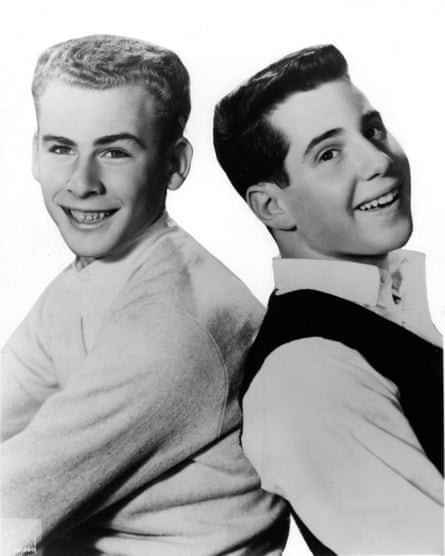
Aged 16, in 1957, they had their first hit as Tom & Jerry with Hey, Schoolgirl and performed on American Bandstand. “We followed Jerry Lee Lewis, who did Great Balls of Fire,” Garfunkel remembers. “He was a wild man. I remember going to the urinal before going on. One of the dancers asked: ‘Who have we got on today?’ And someone else said: ‘Some jerks calling themselves Tom & Jerry.’ I just stood there, saying nothing.”
Tom & Jerry didn’t last and Garfunkel returned to education, where he attained a BA and an MA, and worked towards a mathematics PhD: “I’d have had to go into the army if I hadn’t stayed in college, so that’s what kept me.” However, Simon and Garfunkel had the last laugh when The Sound of Silence rocketed up the charts. “I watched it climb from No 91. When it got to No 5, I called Paul” – who was touring English folk clubs at the time. “‘Paul, the thing we’ve wanted all our lives has happened. You gotta come home.’ The next week we jumped to No 1.”
It was the first of many chart-toppers. By his own admission, Garfunkel found the 1960s “wonderful”. He remembers “social evenings with each of the four Beatles. George Harrison took me to his castle, which had a four-storey papier-mache model of the Alps in the back yard. I think the person he’d bought the place from was a bit eccentric.” Garfunkel was also “a workaholic who lived in the studio”, where he laid down an astonishing 300 takes for Bridge Over Troubled Water. “Whatever you do, you gotta do it well,” he shrugs. “Why not try to be the best in the world, just for the fun of it?”
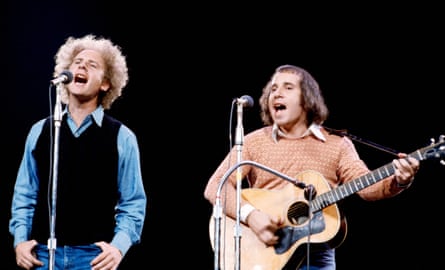
However, by 1970 the duo hit troubled waters themselves. In his memoir, Garfunkel admits that he never really forgave Simon for making a single without him in 1958. Conversely, in Alex Gibney’s 2023 documentary In Restless Dreams, Simon confesses to a “Freudian trauma” about Garfunkel’s vocals: “My mother said: ‘You have a good voice, but Arthur has a fine voice.’”
In 1967, the pair had been working on the soundtrack to The Graduate – which included Mrs Robinson, their second US No 1 – when the film’s director, Mike Nichols, drove up to Garfunkel’s lodgings in a limo, handed him a script for the satirical war comedy Catch-22 and said: “Read this. I see you as an actor, as Lt Nately.”
“I’d never acted and was so nervous,” Garfunkel recalls. “But Mike was maybe the most interesting man I ever met and made me feel good, like: ‘At last someone is treating me like the bright fellow I am.’ I was worried about how it would work out socially with all these big, real actors: Alan Arkin, Orson Welles, Jon Voight. But I flew down to Mexico and did a good enough job for Mike to want me to star in his next film, Carnal Knowledge [1971], with Jack Nicholson and Candice Bergen. Jack’s terrific. We still speak from time to time.”
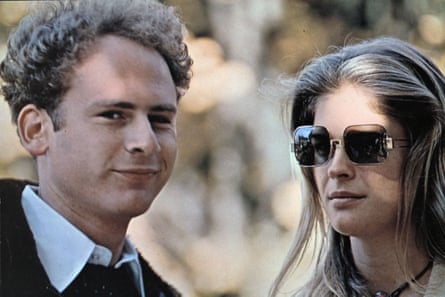
As with music, Garfunkel gave acting “my full concentration, really quite extreme at times”, but Simon grew frustrated with his absences and the duo never recorded together again. After the split Garfunkel became, of all things, a maths teacher.
“I wanted to drop out and be normal and live life,” he explains. So he moved to small-town Litchfield, Connecticut, “and I got a job. On the first day of class I told them: I know you all think you’re meeting a celebrity, and I can relate to that, but I want to teach you geometry.” He made a pact that on the last day of term they could ask him anything they wanted, but admits: “I wasn’t very good [at teaching maths]. I know my stuff but I couldn’t motivate them. I didn’t know how to get people to care.”
So after six months he left, soon afterwards marrying his first wife, Linda Grossman (they divorced in 1975). He spent the rest of the 70s acting and making “three nice albums”: Angel Clare, Breakaway and Watermark. He notched up the UK’s bestselling single of 1979 with Bright Eyes, the theme from the film Watership Down, but the decade ended with a bump.
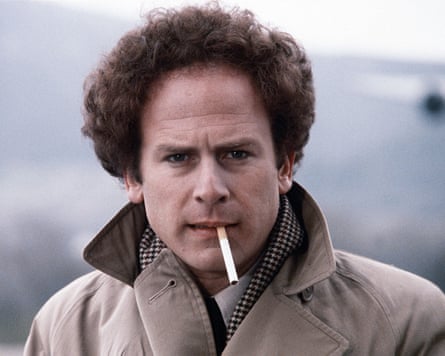
The same year, he starred in Bad Timing, director Nic Roeg’s dark psychological drama in which a troubled young woman kills herself. While Garfunkel was filming in Vienna, Laurie Bird, his partner since 1975 and who is on two of his album covers, took a fatal overdose of Valium in his apartment in New York, aged 25. Even now, 47 years later, he finds this difficult to talk about. “Do I have to revisit it, Dave? My worst year?” But eventually he says: “I don’t know how to describe her other than that she was quiet, into herself, beautiful. I was in love with her. It took me years to get over that.”
For several years, he walked away from music – literally. In 1982, in Japan, he “hatched the idea of leaving my old life behind and walking across the country. I stashed my stuff and started walking. Twelve miles later I looked for a place to stay. It’s crazy, but I was walking something off.”
He subsequently walked across the US and Europe, beginning “across Central Park and my alma mater, Columbia University, and up the George Washington Bridge. In Europe, I started in western Ireland at Shannon airport, crossed Ireland in eight days and took a ferry to south-west Wales. I passed Dylan Thomas’s house, came to England and then crossed the Channel.” He chuckles. “You know, I’m the son of a travelling salesman. He sold winter coats.”
In the Appalachian mountains, Garfunkel sang to cows: “They heard me singing, and just walked down the hill.” Wonderfully, when he was stopped by cops in Wyoming, he recited Thomas Jefferson’s Declaration of Independence. “They rolled down the window,” he says. “You know that tone of voice they have: ‘What are you doing, sir?’ I found myself saying: ‘Every American has the right to life, liberty and the pursuit of happiness. So I am in the pursuit of happiness, officer.’ And they said: ‘Uh, we were just checking, sir. You get strange folk out here.’” Eventually, he walked off the dark clouds: he married Kathryn Cermak, a model, singer and actor, in 1988 and returned to music.
There have been sporadic reunions with Simon – most famously at New York’s Central Park in 1981, where they sang to half a million people – but they last toured in 2010 and then stopped speaking. Then, in 2025, Garfunkel revealed that they’d had dinner, hugs, he’d ended up in tears and they’d made plans to meet again.
“That was about a year ago and I haven’t seen him in the last year,” he says. But he is curious to hear about his old friend’s recent tour: “Did he speak much? How many musicians did he have?” However, he doesn’t wish to discuss the seemingly unlikely prospect of another tour together. “You know what I think is more interesting? Walking from western Ireland to Istanbul,” he says. “But yes, we got together. Who knows what the future will bring? Life is a surprise. I don’t know what happens next month. I don’t know what happens after we die.”
Garfunkel frets about big issues, such as global heating, the human race and those in power. “I don’t like America’s position at all,” he says. “I’m not aboard, and I’m thinking of leaving the country, frankly. It’s real that the planet is getting warmer, that the water’s rising, that so many people are starving. When Donald Trump took over Venezuela, are those the new rules? Just take over a country and run it? It’s shocking, and you think: how on earth are we gonna change the presidency? But Trump won’t last for ever. So we’ve got to hope.”
Meanwhile, two months short of his 85th birthday, he still has things he’d love to do: “Sail around the world, see India and China, sing in South America.” But, he says pointedly, “I don’t wanna go into space.”
“I hope I come across as philosophical,” he concludes. “I’m a thinker, a book reader, a walker, but mostly I’m a singer. I’m always very nervous, behind the curtain. Then I walk out and hear the applause and I flip from fear to confidence right there.”