3 months ago
66
3 months ago
66
Zohran Mamdani was sworn into office as New York’s 111th mayor at the stroke of midnight, the first Muslim mayor as well as the first to take office as a Democrat bearing the credentials of a democratic socialist.
The 34-year-old was sworn in by Letitia James, the state attorney general, in a disused subway station beneath city hall that acts as turnaround for the local 5 train, to be followed by a first-of-its-kind public block party along Broadway’s “Canyon of Heroes”.
“I cannot wait to see everyone tomorrow as we begin our term,” Mamdani said from a wide subway staircase. “This is truly the honor and the privilege of a lifetime.”
Mamdani said last year that he campaigned “in poetry”, that is with a sense of idealism, but would govern “in prose”, that is with practicality. Now the job of governing begins, and navigating the politically complex terrain of America’s largest city where ideological principles may not smoothly translate to effective governance.
Mamdani and his transition team have appointed more than 400 New Yorkers to serve as advisers on personnel and policy. The overriding theme is to deliver on the mayor’s affordability, or economic rights, agenda. Mamdani’s platform, according to his website, is built off the premise that “New York is too expensive. Zohran will lower costs and make life easier.”
Freeze the rent
The mayor’s campaign noted that 2m New Yorkers live in rent stabilized apartments and “these homes should be the bedrock of economic security for the city’s working class”. He has promised to freeze rent increases, but he does not have direct power to do that and must get around a rent guidelines board that does.
Mamdani has also pledged to triple the city’s production of “permanently affordable, union-built, rent-stabilized homes” – constructing 200,000 new units over the next decade – and crack down on negligent landlords.
Mamdani says every New Yorker deserves to be safe and that requires “creating economic stability, dignified work, and well-resourced neighborhoods”. A newly formed Department of Community Safety will be assigned “to prevent violence before it happens by taking a public health approach to safety”. In practice, that may mean sending civilian mental health workers – not the police or fire department – to intervene in mental health crises.
Affordability
Mamdani proposes that municipal grocery stores, using city-owned buildings and selling at wholesale prices, would help defray rising grocery costs. He estimates that one in five New Yorkers struggle to afford public transport. He plans to eliminate bus fares on every city bus and build new bus lanes to make them faster. He also plans to clamp down on misleading advertising and predatory contracts, and ban all hidden fees. At his inauguration, Mamdani appointed veteran city planner Mike Flynn as the new transportation secretary for New York.
Early childhood and education
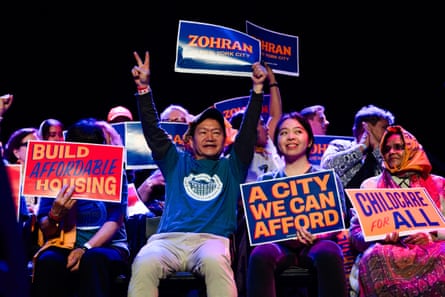
Mamdani says the biggest cost for working New Yorkers after rent is childcare costs, and it is driving families with children from the city. He proposes free childcare for every New Yorker aged six weeks to five years. With 125,000 babies born yearly in the city, new mothers will get “a collection of essential goods and resources, free of charge, including items like diapers, baby wipes, nursing pads, post-partum pads, swaddles, and books”. He also plans to finance an expansion of K12 childhood education services.
Paying for it
The cost of Mamdani’s program is put at $10bn a year. But the city is essentially a vassal of the state and there is no guarantee the state government will agree. Mamdani plans to raise the top corporate tax rate from 7.25% to 11.5% – a hike that he estimates will raise $5bn a year. He also plans to raise personal income taxes on the top 1% of earners, or about 34,000 households earning over $1m a year, by 2%. Mamdani estimates that will raise an additional $4bn.
Raising the minimum wage
Mamdani says he plans to champion a new city law to bring the minimum wage to $30 an hour by 2030. “In the world’s richest city, making the minimum wage shouldn’t mean living in poverty,” his manifesto argues. “But that’s exactly what it means for working people today.”
Trump-proofing NYC
Mamdani, despite his surprisingly festive meeting with Donald Trump at the White House in November, claims the president “is tearing at the fabric of New York City”. He plans to “fight Trump’s attempts to gouge the working class”, strengthen the city’s sanctuary city apparatus, get Immigration and Customs Enforcement (ICE) out of city facilities, end any ICE cooperation and boost immigration legal services to an estimated 400,000 New Yorkers who are at risk of deportation.