3 months ago
90
3 months ago
90
Eder Sarabia wasn’t out there to see the tightest, tensest battle there has ever been end with liberation at last, but his mum and dad were and he wasn’t far away. Suspended for the final night of a season like no other, Elche’s coach was hidden down in the dressing room instead, watching the game that he knew was “us or them” on a TV set perched precariously upon a metal crate. There, as staff ran in and out delivering messages until it was his turn to set off on a sprint, he saw the match that defined five teams’ fate finish 1-1. Mobile in hand, alerts beeping, most of all he saw suffering. “Terrible, terrible, terrible,” he called it later, but by then at least it was done. Elche were safe. Their opponents, Girona, were down. Real Mallorca, like Real Oviedo, were going with them.
“Crazy, crazy day, crazy match, a lot of emotions: this league was really crazy,” Sarabia said. He had spent much of it surrounded by clothes on hooks and flags taped to walls; like everyone else, he had also spent it, he said, “on the edge of the precipice”. From the visitors’ dressing room at Montilivi, he had seen Álvaro Rodríguez score the kind of goal that wins cups in cartoons, tearfully dedicating it to his late dad, and Arnau Martínez equalise. He had seen cameras zoom in on his parents in the stands and wondered how Manu, a former footballer who doesn’t so much watch games as broadcast them, looked so calm when they were a goal from losing it all. He had seen Thomas Lemar hit Elche’s bar, “+7” appear on the screen, and his goalkeeper catch a cross on 95.55, Matías Dituro triumphantly holding the ball like Rafiki on Pride Rock, but it still wasn’t over.
In the 97th minute of the 38th game, he heard the owner come in and say it’s done and heard himself say: no, they’ve got a free-kick. He saw Girona’s goalkeeper going up for it too. What he couldn’t see yet, not from there, was his subs celebrating on the touchline where he should have been and his assistant Jon López was instead. The players had voted not to know about other games, but now they knew. Christian Bragarnik was right: final whistles had gone elsewhere and Elche were safe now whatever happened, a last, desperate thought going round the ground, the minds of Girona fans: they could let us score now. On the screen though, Miguel Sesma Espinosa blew and Sarabia dashed out the door, down the stairs, along the tunnel and right up the ramp, running across the grass towards his team, celebrating survival.
Newly promoted, it had taken a points record: never before had Elche reached the 42 they had going into week 38. That total would have been enough to survive every year for the last 14 and much more than enough in most of them, but not this time so it had taken them until the final day too. Now a 1-1 draw at Girona, who started and ended the day just two points behind, put them on 43 and in primera for another year.
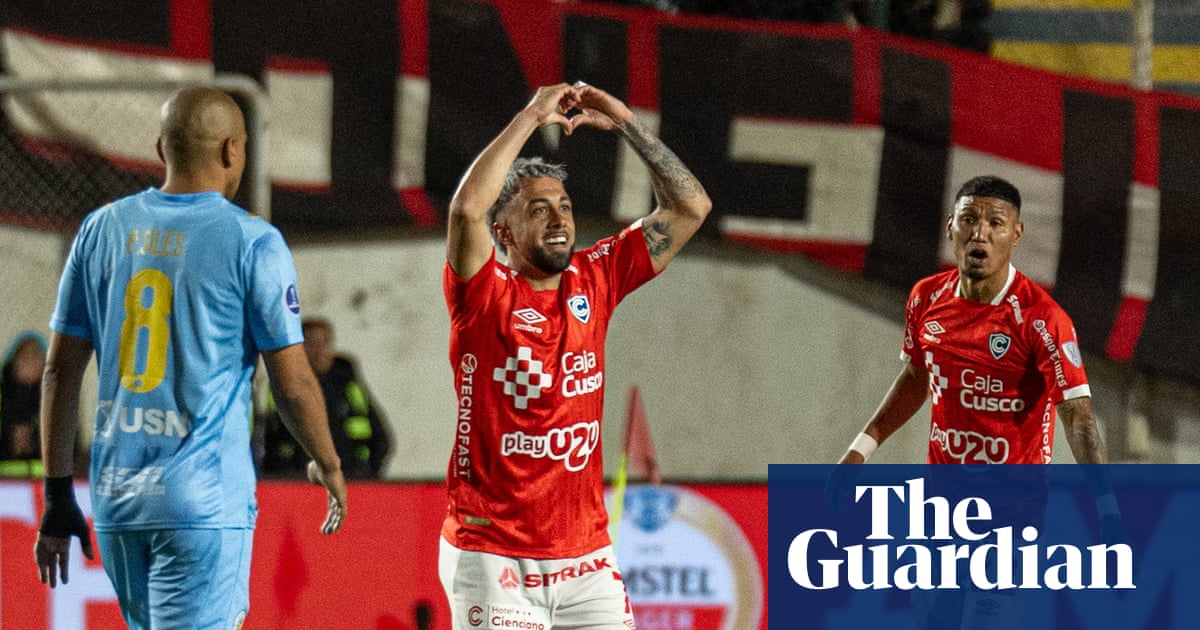
When Sarabia reached the corner, hugging everyone en route, the players and staff were leaping about before the 306 fans hammering against one of those Perspex screens like a bunch of Benjamin Braddocks. Some 612km down the coast, more supporters poured into the streets, where they would wait there until the team turned up at 3am. The league had blocked requests for a giant screen to show the game in Plaça de Baix but they couldn’t stop this. They had earned it: all year, and all night.
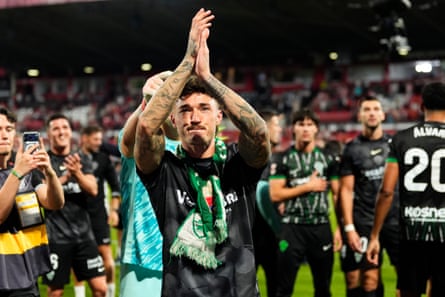
“This was like a Champions League final,” said midfielder Gonzalo Villar. “If you lose or draw, you stay up. If you lose, you can go down. It is the worst thing I’ve been through, especially when they hit the bar. I think this will be one of the best parties ever, 100%.”
Yet it might not even have been the best party of the night; it certainly wasn’t the only one. Likened by Sevilla manager Luis García to the Marx Brothers scene in which 17 people squeeze into a two-berth cabin on a cruise ship, the fight against relegation has never been more crowded or more costly. As late as week 37, nine teams could accompany Oviedo in segunda and while Sevilla, Espanyol, Valencia and Alavés escaped, there were still two places to fill and five teams who could fill them when week 38 began.
Mallorca were 19th on 39 points, Girona a place above them on 40, both in the relegation zone. Just above them were Elche, Osasuna and Levante all on 42. Mallorca, the only one of the five not to have their fate in their own hands, were playing relegated Oviedo at home. Levante went to Betis. And Osasuna to Europe-chasing Getafe at the Coliseum, while Girona were at home against Elche, who had only won once away. All of those were played at the same time and in the probable event of a tie, head-to-head records, would decide; in the very plausible event of a three- or four-way tie, a mini-league of results between those clubs would.
All of which meant that there were some scenarios in which survival meant needing your relegation rivals to win. And that although when it came to it, the final day, started, ended and entirely played out with Mallorca and Girona in the relegation zone, no one felt safe until the whistle went. Levante went from 1-0 down to 1-1, then 2-1 down with 20 minutes left. Mallorca defeated Oviedo, their 3-0 victory the only game decided before the whistle. And with an hour gone at Getafe, Osasuna went a goal down, eventually losing 1-0. At Montilivi, Girona soon responded to Elche’s 39th-minute opener with Arnau Martínez’s equaliser on 48 minutes giving them a half to rescue themselves … and others.
Mallorca, who had needed four results to go their way now only needed a goal to. The miracle was on: for 10 second-half minutes a Girona goal wouldn’t just have taken them out of the relegation zone; it would have taken Mallorca out too. For the rest of it, a single goal there would have pulled them clear and pushed Osasuna in, Elche’s destiny no longer in their own hands. When Lemar’s shot hit the bar that scenario was on, 4.5 inches all that prevented it. Which is why, as Sarabia watched on television from just a few metres away, 701km west, Osasuna’s players were watching too. They saw out their season engulfed by a pitch invasion, red-shirted footballers drowning in a sea of Getafe blue, desperately pressing earphones against their heads, gathered around phones and iPads until the final whistle when they were liberated too, left crying and hugging each other, celebrating in with the Getafe fans.
In the end, those 42 had been enough to survive. Just. They were enough for Levante too, but not Mallorca, a three-way tie sending them down. Above them, Elche survived on 43, a superb start to the season giving way to a run where they didn’t win for 11 weeks but the side recovering in time. Below them, Girona went down on 41, the illusion of safety partly what ensured that they weren’t safe at all, being too good for relegation part of the reason they were not good enough to avoid it. Injury and ill-fortune had hit them hard too and three points from 21, a late collapse reminiscent of their fall in 2019, means the team that played PSG, Liverpool, Milan and Arsenal last year will play Ceuta, Andorra, Albacete and Real Sociedad B next.
La Liga final weekend scores
ShowSaturday Alavés 1-2 Rayo Vallecano, Celta Vigo 1-0 Sevilla, Espanyol 1-1 Real Sociedad, Getafe 1-0 Osasuna, Girona 1-1 Elche, Mallorca 3-0 Real Oviedo, Real Betis 2-1 Levante, Real Madrid 4-2 Athletic Club, Valencia 3-1 Barcelona
Sunday Villarreal 5-1 Atlético Madrid
The contrast was cruel. At full-time, as Elche’s players and their coach started running, Girona’s just collapsed. Heads hid beneath towels and tops, bodies heaving. Fans cried, staring into space: this wasn’t supposed to happen. In one corner, Elche’s players celebrated with their supporters; at the other end Girona’s made their way, much more slowly, towards their own. Some were angry, shouting abuse. Most just stood in silence, broken. Most of the players did too. “We have given everything,” Portu promised them, but there was nothing they could really say, just put their hands up: sorry. And that didn’t cut it. “This hurts,” Girona coach Míchel said. “Football has been cruel. You look for someone to blame and that’s me; I’m responsible.”
“It’s difficult: it was Girona or us,” Sarabia said. Going past the dressing room where he had spent his evening and which was fuller now, music blaring out, drinks being thrown about to the sound of Freed from Desire and La Morocha, past where his parents waited, he headed along the narrow corridor lined with shirts to the press conference, sweating and exhausted but fulfilled, he and his team’s first season in primera ending with history made. As he spoke, Míchel, the manager who took Girona to places no one ever imagined, competing for the league title and qualifying for the Champions League, stood outside, head down and all alone in a whitewashed, windowless room, waiting and listening to the applause behind the wall.
“Coaches, pfff … we have a big responsibility: I felt it, Sarabia said. “There are thousands and thousands of people behind a football team and we’re the ones responsible for them. Football is inexplicable: it takes you through emotional states that don’t make sense: a goal can be the difference between glory or being sunk. There is no sport like this and this career has its bad moments but this is for the people, the city, the badge, the families, those who have been raised on this club, and tonight we have to enjoy it; this belongs to everyone.”