2 months ago
50
2 months ago
50
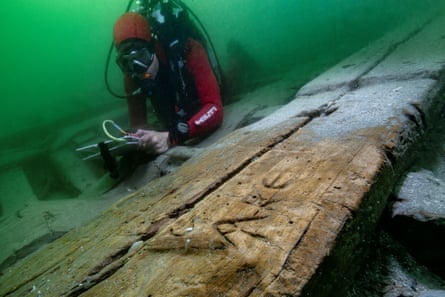
An ancient Egyptian pleasure boat that matches a description by the first-century Greek historian Strabo has been discovered off the coast of Alexandria, to the excitement of archaeologists.
With its palaces, temples and the 130 metre-high Pharos lighthouse – one of the seven wonders of the ancient world – Alexandria had been one of the most magnificent cities in antiquity. The pleasure boat, which dates from the first half of the first century, was 35 metres long and constructed to hold a central pavilion with a luxuriously decorated cabin.
It was discovered off the submerged island of Antirhodos, which was part of ancient Alexandria’s Portus Magnus (great port).
Strabo had visited the Egyptian city around 29-25BC and wrote of such boats: “These vessels are luxuriously fitted out and used by the royal court for excursions; and the crowd of revellers who go down from Alexandria by the canal to the public festivals; for every day and every night is crowded with people on the boats who play the flute and dance without restraint and with extreme licentiousness.”
The excavations were conducted by the European Institute for Underwater Archaeology (IEASM) under the direction of Franck Goddio, a visiting professor in maritime archaeology at the University of Oxford.
He told the Guardian: “It’s extremely exciting because it’s the first time ever that such a boat has been discovered in Egypt … Those boats were mentioned by different ancient authors, like Strabo, and they were also represented in some iconography – for example in the Palestrina mosaic, where you see such a boat of a much smaller size with noblemen hunting hippopotamuses. But [an actual boat] has never been discovered before.”
While that mosaic depicts perhaps a 15-metre boat, this one is far larger, judging by its well-preserved timbers, which also span a breadth of about 7 metres. It may have required more than 20 rowers.
It had been lying only 7 metres under the water and 1.5 metres under the sediment. Goddio’s initial assumption was that there were two ships on top of one another “because the construction type was so strange”. He added: “The bow is flat … and the stern is round … to be able to navigate in very shallow water.”
Goddio’s most ambitious projects have been conducted off the coast of Egypt, in Alexandria’s eastern harbour and in the Bay of Abu Qir. In partnership with Egypt’s Ministry for Antiquities, he has explored a vast area since 1992.
In 2000, the ancient city of Thonis-Heracleion and parts of the city of Canopus were discovered in the Bay of Abu Qir – one of the greatest archaeological finds of recent times. Two colossal statues of a Ptolemaic queen and king are among spectacular treasures that have been retrieved so far.
In 2019, Goddio and his team found a wreck in the waters around Thonis-Heracleion, whose unusual details matched the description of another ancient Greek historian, Herodotus.
The latest discovery lies less than 50 metres from the site of the Temple of Isis, which Goddio has been excavating. He believes the boat could have sunk during the catastrophic destruction of this temple around AD50.
After a series of earthquakes and tidal waves, the Portus Magnus and parts of the ancient coastline sank beneath the sea, engulfing palaces and other buildings.
Another theory is that the boat could have been a sacred barge attached to the temple. Goddio said: “It could have … [been] part of the naval ceremony of the navigatio iside, when a procession celebrating [the goddess] Isis encountered a richly decorated vessel – the Navigium – which embodied the solar barque of Isis, mistress of the sea.”
Graffiti in Greek was found on the central carling and is yet to be deciphered.
Although research into the wreck is still at an early stage, it promises to reveal new insights into “life, religion, luxury and pleasure on the waterways of early Roman Egypt”, Goddio said.
The latest scientific results of excavations on the temple of Isis have recently been published by the Oxford Centre for Maritime Archaeology.
Prof Damian Robinson, the centre’s director, said of the new discovery: “It’s a type of ship that’s never been found before. While we can read about cabin-boats in ancient texts and see them in the artistic record, it’s phenomenal to have the archaeological correlate.”
The wreck will remain on the seabed. Goddio said: “We are following the regulation of Unesco, which considers that it is better to [leave] the remains underwater.”
Only a tiny percentage of the area has been explored. Excavations are due to resume.