2 months ago
45
2 months ago
45
Keir Starmer has said it is “frankly beyond belief” that resident doctors would strike during the NHS’s worst moment since the pandemic, in remarks that risk inflaming tensions with medics.
Writing for the Guardian, the prime minister made an outspoken attack on the strikes planned for 17-22 December for placing “the NHS and patients who need it in grave danger”.
Starmer’s intervention comes a day after Wes Streeting argued the strikes could overwhelm the NHS, increasing pressure on resident doctors to accept his offer of more training places, but no extra money.
The British Medical Association has said the government’s offer will not fix the workforce crisis, with the deputy chair of its resident doctors’ committee, Dr Shivam Sharma, saying he found it “difficult to see members accepting this offer”. An indicative online ballot of resident doctors, formerly known as junior doctors, is due to close on Monday morning.
“I am a Labour prime minister, who believes in workers’ right to strike,” said Starmer. “But let’s be clear when it comes to the strikes planned by resident doctors next week. They should not happen. They are reckless.”
The prime minister added: “Right now, resident doctors’ colleagues will be cancelling operations, cancelling their Christmas leave and preparing for this coming storm. The idea that strikes could still take place in this context is frankly beyond belief.”
With the NHS saying it is facing a “worst-case scenario” with an unprecedented wave of super flu, Streeting, the heath secretary, has cautioned that the strikes could be the Jenga piece that causes collapse.
Doctors and charities also said on Friday they were growing increasingly concerned about hospitalisations among older people in particular, even though case numbers are highest among the young.
Tony O’Sullivan, a co-chair of the Keep Our NHS Public campaign group, said it was “the height of irresponsible behaviour” for the government to “go to war with doctors and the BMA amidst the flu epidemic”.
“The government cannot pretend that they had no warning, that they didn’t see it coming,” he said.
YouGov polling conducted on Friday found that a third of people surveyed either “strongly support” or “somewhat support” resident doctors going on strike, against 58% who either “somewhat oppose” or “strongly oppose” it.
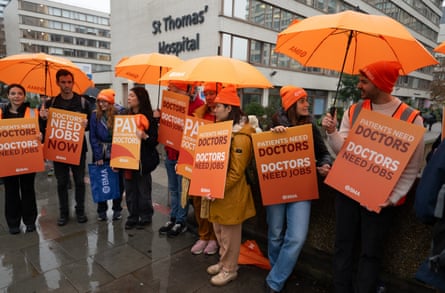
In his piece for the Guardian, Starmer said he was still hopeful that the strikes could be averted through the “good deal” on offer, saying his message to doctors was “simple – take it”.
“The ‘super flu’ epidemic now sweeping the country is the NHS’s most precarious moment since the pandemic,” he said. “Last week, an average of 2,660 hospital beds each day were occupied by flu patients – up 55% on the week before and much higher than this time last year. And the epidemic is still growing.
“Having lived through a pandemic, we all know what this means. It means a battle. On hospital wards across the country, NHS staff will now be working around the clock to make sure patients get the care they need and the NHS stays above water.”
Internal projections suggest between 5,000 and 8,000 flu patients could be in hospital next week, which could top the previous highest record of 5,400. At this point in 2024, the figure was 1,861. In 2023, it was 402.
Antonia Ho, a professor of infectious diseases at the University of Glasgow’s Centre for Virus Research and an honorary consultant at NHS Greater Glasgow and Clyde and NHS Lanarkshire, said: “Although the highest case numbers are in those aged five to 14 and 15 to 44, the steepest rise in hospitalisation is in older age groups, aged over 75, who are most vulnerable to flu complications and poor outcome[s].”
At the same time, almost three in 10 people aged over 65 are still not vaccinated against the flu, with the rate standing at 71.7%, according to the UK Health Security Agency.
Caroline Abrahams, the charity director at Age UK, said: “Australia has just had its worst flu season ever and that’s a powerful warning to us here in the UK to take care and get vaccinated if we can.
“Sometimes we talk about ‘having the flu’ when really, it’s just a cold, but the influenza or flu virus that’s circulating here now is a much more serious health threat than that, especially if we are older, have underlying health conditions or compromised immunity.”
Abrahams said the rapid rise in flu cases was “alarming”, particularly because older people were not able to fight off seasonal viruses and infections as easily as others.
“This means flu can lead to complications and the need for admission to hospital in severe cases. Older people in poor health can deteriorate rapidly if they are left untreated, so early recognition is vital.”
Abrahams expressed hope that resident doctors would drop their plans to strike for five days from 7am on 17 December.
“This winter looks like being an especially worrying one for many older people since along with the upsurge in flu there is the possibility of another strike by resident doctors next week – the last thing anyone in ill health needs.
“Against this miserable context we hope and pray that the resident doctors decide not to exercise their right to withdraw their labour and that the revised deal offered by the government brings about a permanent end to a dispute that’s been going on for far too long,” she said.
Flu outbreaks are hitting pupil attendance and school staffing, a union said on Friday, after a number of schools were disrupted by illness.
Paul Whiteman, the general secretary of the school leaders’ union NAHT, said: “We have seen flu outbreaks in schools having an impact on both pupil attendance and staffing levels.” Schools would do what they could to reduce the risk of infection spreading, he added, and closing was a last resort, though there had been “some isolated cases”.