2 months ago
92
2 months ago
92
The past folds into the present in this very fine debut feature from Canadian film-maker Sophy Romvari, which has grown in my mind on a second viewing, having first come across it at last year’s Locarno film festival. It is an autobiographical, in fact autofictional, movie imbued with a kind of quietism, a refusal to amplify its real-life drama and tragedy. It doesn’t orchestrate its agony in the Hollywood style but almost confides it to the viewer, intimately and sotto voce.
Sombre and painful, complex yet unshowy, Blue Heron is built metatextually on two levels that boldly collapse into each other in a very striking final coup de cinéma, yet Romvari’s sophistication doesn’t stop this being subtly moving. The subject is her own childhood and her relationship with her deeply troubled older brother; it is developed from her award-winning 2020 short film on the subject, entitled Still Processing, whose existence is now unselfconsciously built into this new work.
It is the mid-90s and a little girl called Sasha (Eylul Guven), about 7 or 8 years old, lives with her two brothers and older teen half-brother Jeremy (Edik Beddoes) on Vancouver Island. They have just arrived at their new house, having previously moved around a lot for reasons we shall soon learn. Their mum and dad, played by Iringó Réti and Ádám Tompa, are Hungarian and switch to the mother tongue when they don’t want the kids to know what they are saying.
Emotionally, they are all at breaking point. Jeremy is deeply troubled, with a behavioural condition that one child psychiatrist identifies as oppositional defiant disorder, which means he refuses to cooperate with his parents’ increasingly desperate requests. He behaves destructively and dangerously, threatening to burn the house down, and is often brought home by the police in handcuffs.
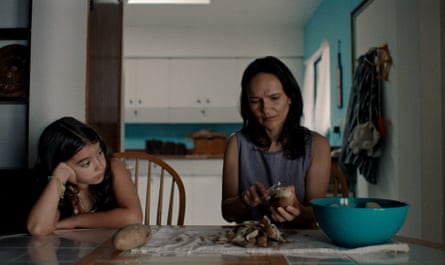
The resulting family dysfunction is insidiously gendered; Sasha is upset by Jeremy’s behaviour in a way that her brothers aren’t, and their mother is furious that she has to be the bad cop. She is the one who has to discipline Jeremy and generally deal with him while her husband retreats into his work, and she perhaps resents the unspoken assumption that Jeremy is her burden because he is her son from a previous relationship. What has caused Jeremy’s condition? It is a baffling, insoluble mystery that wounds Sasha as a child and even more so as an adult – a film-maker played in flashforward scenes by New York writer and comic Amy Zimmer. She is seen videoing a quasi-fictional panel of social workers discussing Jeremy as a cold case.
What is the meaning of Jeremy’s disruption? Does it make sense to wonder about its cause or should we instead be focusing on what Jeremy has caused in other people? Edik Beddoes plays him with a disquietingly opaque, smug smirk; does it mask a deep fear and unhappiness? Or does it mask nothing at all? What is so painful for Sacha, and surely for the film-maker herself, is that she has to negotiate her feelings of hurt and even rage at Jeremy for causing this lasting unhappiness – and conversely her hurt and rage on his behalf, at the society and social services that did not provide enough support, and a universe that suddenly, inexplicably afflicted him and the whole family with this terrible trauma. An intelligent, valuable piece of film-making.