2 months ago
73
2 months ago
73
If bread is the main staple of Lebanese cooking, grains and legumes are next, and there is hardly a meal without one or the other. Bulgur wheat is the preferred grain, especially for rural communities of all confessions; in the old days, they grew their own wheat to make it, harvesting, threshing and parboiling the wheat before drying it in the sun and sending it to the local mill to be ground into fine and coarse grades to last the household until the next harvest. In fact, given the sheer number of recipes across the country, I could have easily devoted a whole book to Lebanese recipes for grains alone.
Green bulgur wheat ‘risotto’ (AKA mafrükeh; pictured top)
An interesting dish from Deir Intar down south, where bulgur wheat is often cooked with greens and tomato sauce. It’s a dish I had never come across before, and the addition of spring onions and herbs makes for a fresher, more intriguing combination. It’s served like tabbüleh – a kind of cooked tabbüleh, as it were – and is traditionally scooped up with raw cabbage leaves or, when in season, fresh vine leaves.
Soak 30 min
Prep 15 min
Cook 20 min
Serves 4-6
80ml extra-virgin olive oil
250g coarse bulgur wheat, soaked in cold water for 30 minutes
1 bunch spring onions (about 100g), trimmed and sliced fairly thinly
1 large bunch flat-leaf parsley (about 200g), washed, dried, the thick stalks discarded and the rest finely chopped
¾ bunch fresh mint (about 150g on the stalk), leaves picked, washed, dried and finely chopped
112g tomato paste, diluted in 750ml cold water
Sea salt
Fresh cabbage leaves, or vine leaves, to serve
Put the oil in a wide, medium-sized pot on a medium heat. Drain the bulgur wheat, add it to the hot oil and stir for a couple of minutes, to coat. Add the spring onions, parsley and mint, mix well, then add the diluted tomato paste and season with salt to taste. Cover the pan and leave to bubble for 10 to 15 minutes, until the bulgur has absorbed all the liquid and is cooked. Take off the heat, wrap the lid in a clean tea towel, then put it back on top of the pot and leave to rest and cool.
Serve at room temperature with either cabbage leaves or, when they’re in season, vine leaves.
Tahini rice pudding (AKA müffata’a)
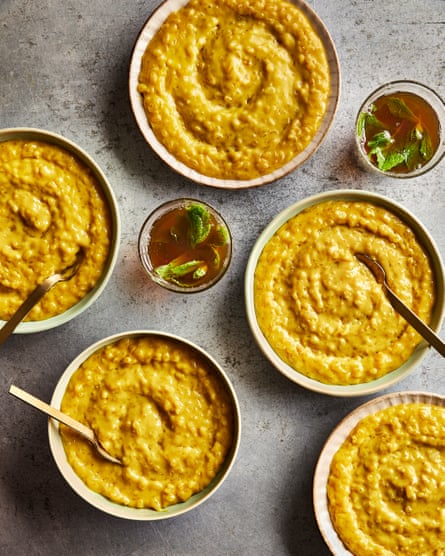
This unique take on rice pudding is a Sunni specialty from Beirut. I never knew about this dish when I lived in the city, and discovered it only a few years ago while researching my book Feast, when my friend Ziad Ghorly took me to al-Makari, the most famous müffata’a maker in the city. Mr Makari very kindly gave me his recipe.
Soak 30 min
Prep 5 min
Cook 2 hr
Serves 8-10
1 tbsp ground turmeric
250g short-grain white rice, rinsed under cold water, then soaked for 30 minutes
250g tahini
500g baker’s or superfine sugar
75g pine nuts, Mediterranean, ideally
1 pinch each ground fennel and ground anise
Put 875ml water in a large pot, add the turmeric and bring to a boil. Drain the soaked rice, add to the boiling water, then turn down the heat to low, partly cover the pan and leave to bubble gently for 30 to 45 minutes, stirring regularly.
Put the tahini, sugar and pine nuts in a second pot that’s large enough eventually to take all the cooked rice.
When the rice is done, tip it into the tahini mix, together any remaining liquid and the ground fennel and anise, and put the pan on a medium-low heat. Cook, stirring, for an hour or so, until the oil from the tahini rises and the pudding is very thick – you’ll know it’s ready when you dip a spatula into the rice, pull it out and no rice drops back into the pot.
Spread out the rice pudding on one large platter, or over eight to 10 individual plates, mark a groove all around the inside see image) and serve at room temperature.
-
These recipes are edited extracts from Lebanon: A Culinary Celebration, by Anissa Helou, to be published in August by Bloomsbury at £30. To preorder a copy for £27, go to guardianbookshop.com