3 months ago
90
3 months ago
90
Have I made a mistake in visiting Biebrza national park? Not that I mind encountering more bird species in a day than I do in a year at home. Nor do I regret meeting a young elk, all gangle and improbable proportions; or kneeling before a clump of lady’s slipper orchid in jaw-droppingly ostentatious bloom among Solomon’s seal and a carpet of lily of the valley. I definitely appreciate the homely clatter of the neighbourhood white storks, and the constant soundtrack of cuckoos and golden orioles. I certainly have no objection to watching the sunset from a wood-fired hot tub, listening to corncrakes as bats emerge and a beaver cruises past.
But something shifts in me when, in the space of a few minutes in an observation tower, we watch three species of marsh tern hanging like precision-engineered angels to tweezer insects from the water’s surface, and a white-tailed eagle hunting greylag geese then settling with its mate in a dead tree to watch a train of common cranes in the field below meeting a lone fox, all leaping as if in mock surprise, before going unconcernedly on their way.
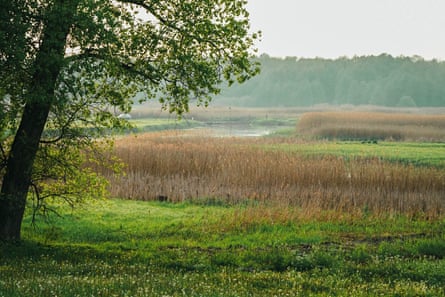
This is ecology writ large – a spectacular of interaction and a devastating demonstration of what we’ve lost at home. Because among all the exotic-seeming species, there are many familiar ones to remind us that this is a landscape close to what we too had before diversity and abundance were drained for productivity and profit.
Feeding everything in the Biebrza marshes is the eponymous river, looping its elaborate signature across the land, with meanders and oxbows cast off like old skins, so that the channel runs perpetually through impressions of its former self. These erstwhile connections are obvious from a satellite image, but on the ground it’s hard to make sense of them, and so the river appears as a protean thing, its water somehow both swift and still, deep and shallow, dark and bright.
Another evening, I slip into it myself to swim the quarter mile from our cabin to dinner and experience another revelation. The peaty bed makes the water look black from above, but it is in fact perfectly clear and in it my thoughts clarify too: what had started to feel like a depressing comparison is in fact a necessary recalibration.