3 months ago
86
3 months ago
86
One of the 68 UK-recorded species of mining bee in the genus Andrena, the ashy mining bee (Andrena cineraria) is classified as solitary. Yet on the narrow, balding strip of turf in front of my neighbours’ garage, they appear anything but.
The ground shimmers with movement, as several hundred bees hover low in the spring sunshine. While each female maintains her own burrow – a neat, pencil-eraser-sized hole excavated in the bare, sun-warmed soil – they’ve gathered here in a dense aggregation, turning this modest patch into a bustling settlement.
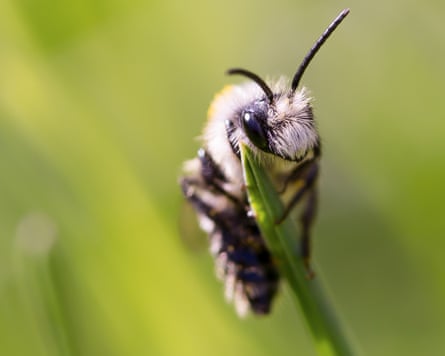
While the females are striking with their glossy, hairless black abdomens and fuzzy black‑and-ash-grey humbug-striped thoraxes, it is the smaller, hairier, white‑moustachioed males that draw the eye. They spend their short lives patrolling the airspace a few inches above the grass, holding position as they wait for females to emerge. Their flight has a strange rhythm – it looks as if each insect is tethered to a point below by an elastic thread. There is a steady oscillation of bodies rising and falling. When a female appears, the calm breaks. Several males converge at once, grappling for the chance to mate; one grabs her midair, and the pair tumble to the ground in a brief coupling.
Ashy mining bees forage widely and are considered polylectic, collecting pollen and nectar from a diverse range of spring-flowering plants and trees. But they are also important pollinators of oilseed rape, their activity peaking with the blooming of the ubiquitous bright yellow brassica. Perhaps no coincidence that the morning I notice them coincides with the onset of my hay fever.
Females returning from foraging flights navigate to their nests using blades of grass, stones, and the tiny, volcano-like cones of loose earth that mark each entrance, though they sometimes enter the wrong hole. I watch one bee chase another out of her tunnel, the pair tussling briefly at the threshold, before the rightful occupant slips inside and the other drifts off in search of her own burrow.
By dusk, the site falls still. The females have retreated below ground, their tunnel entrances temporarily sealed against intruders and the evening rain, while the males have dispersed to shelter in nearby flowers.