3 months ago
62
3 months ago
62
A week-long winter cold snap that would once have been normal in the Netherlands has caused more than 20,000 flight cancellations, chaos on roads and railways, buildings to partially collapse, and a stream of angry cyclists asking why roads seem better gritted than cycle lanes.
Since Saturday, up to 15cm of snow has fallen across the country, with temperatures of -10C (14F) including wind chill, sparking angry commentary over how some nations manage months of snow but the Netherlands, no longer used to it, appears paralysed.
According to the Royal Netherlands Meteorological Institute (KNMI), snow is becoming less frequent as the climate crisis bites. In 1961, there was snow cover on an average of 23 days a year at the institute’s weather station at De Bilt, near Utrecht; now, it is just three days a year.
Wiebe Wieling is a former chair of the Elfstedentocht (11 cities tour) Association, which tries to organise an outdoor ice skating race on natural ice across 11 Friesian cities if the ice is thick enough, something that has not happened since 1997.
He said: “We just don’t have the winters that we had in the 20th century. It’s not only my frustration. It’s a Dutch frustration. It’s a climate frustration.”
So when snow does come, like it did this week, some worry that Dutch people have forgotten how to cope with it.
“Yesterday, I was walking along an important cycle route to various schools in Rotterdam,” an environmental consultant, Vincent Luyendijk, said on social media, sharing photos of children forced into the middle of traffic. “I was blue in the face with frustration.”
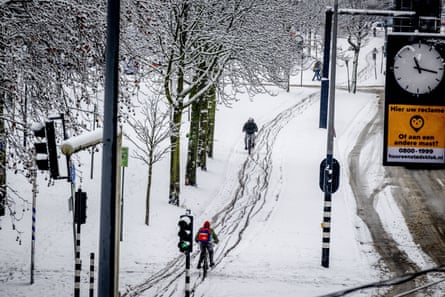
The national Fietsersbond cycling union is researching the situation after reports of “a lot of inconvenience” from snow-filled lanes in some areas. In Hilversum, some of the union’s members were livid.
“We saw that bike lanes were in such a state that you really don’t dare to get on your bike,” a volunteer, Marjolein van Dillen, told Dutch media. “While the road was clean, there was a whole ridge of snow, pushed to one side on the bike lane.”
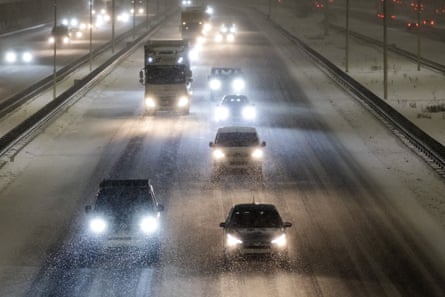
This week, according to the motor trade association Bovag, cars have been skidding off the roads partly because drivers failed to put on their winter tyres in October. The national airline, KLM, had to rush a truck to Germany to get 100,000 litres of de-icing fluid after it ran out, the spokesperson Elvira van der Vis said. ProRail, the rail infrastructure operator, spent much time explaining to angry commuters why trains kept being delayed – while Switzerland was managing just fine.
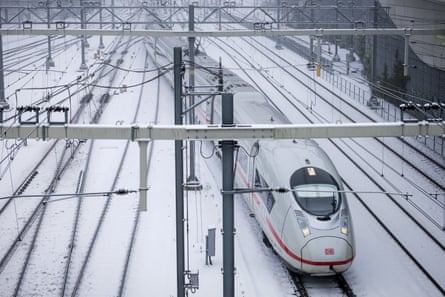
Rico Luman, a senior economist on transport, logistics and automotive at ING, said a calculation of the economic cost of this failure would come later. “Ice days have come down from, let’s say, 10 to three on average a year and that’s part of the problem,” he said. “It’s simply not worth it to invest massively in all those contingency elements to avoid disruptions. But this time it may be different. The damage is piling up and it’s not over yet.”
The KNMI has modelled that without global heating the current average snow cover of 5cm would have been 9cm – with some areas getting 22cm.
“Our normal conditions would imply westerly winds with relatively mild temperatures because of the nearby North Sea,” said the climate scientist Hylke de Vries. “The Netherlands has never been a country where lots of snow was the norm, but of course with climate change, these cases where temperatures are low enough for snow decrease quite considerably. So when it happens, then everybody is surprised.”
It is even more important to prioritise active mobility, according to Meredith Glaser, the chief executive of the Urban Cycling Institute. “We know that climate change doesn’t just mean warmer – it means more extreme and unpredictable weather,” she said. “These very intense cold snaps and snowfall mean that we need to make sure that our mobility networks are resilient. Snow doesn’t necessarily stop people from cycling. But, of course, poor maintenance does. So the city needs to make sure that these main routes are safe and cleared.”
Some continue to brave the icy roads, hoping they will not be the last generation to do so. “Funny to see how stubbornly Dutch people (including myself) keep their habit of cycling to work, even in this weather,” wrote Fonger Ypma on LinkedIn alongside a selfie taken at his snow-covered office in Delft.
Ypma, the founder of a project to thicken Arctic ice, said: “I see the spirit around me, but the younger generation is not so used to it. It fades away quite quickly if the [snowy] weather doesn’t occur any more.”