3 months ago
80
3 months ago
80
Key events Show key events only Please turn on JavaScript to use this feature
European leaders appear torn in face of new world order after Venezuela attack
Patrick Wintour
Diplomatic editor
European leaders emerged divided and torn as they tried to welcome the ejection of Venezuela’s authoritarian president, but still uphold the principles of international law that did not appear to allow Donald Trump to seize Nicolás Maduro, let alone declare that the US will run Venezuela and control its oil industry.
Europe tried to focus on the principle of a democratic transition, pointing out that the continent had not recognised Maduro as the legitimate leader of Venezuela since what were widely regarded as fraudulent elections in June 2024.
But Trump’s rejection of the Nobel prize-winning Venezuelan opposition figurehead, María Corina Machado, was awkward. Trump said she did not have support or respect in Venezuela, but European leaders have embraced her as leading an opposition that deserves power.
International lawyers say the US rejection of Maduro’s legitimacy opens a path for Washington to argue that he does not enjoy sovereign immunity as a head of state in the US domestic courts, in the same way that George Bush was allowed to try Manuel Noriega in the US after his capture in 1989.
US officials have claimed the operation against Venezuela was justified on the grounds of self-defence, arguing that the government was involved in drug-trafficking.
The Yale professor of international law Oona Hathaway, however, said she saw no plausible justification under the UN charter for the US use of force. “If drug trafficking is a reasonable justification for attacking another country then a whole range of possible arguments can be made that basically mean that self-defence is no longer a real exception. It’s the new rule.”
In a sign of Europe’s discomfort, Kyriakos Mitsotakis, the prime minister of Greece, one of the 10 non-permanent countries on the UN security council, tried to close down discussion of Trump’s methods. “Nicolás Maduro presided over a brutal and repressive dictatorship that brought about unimaginable suffering on the Venezuelan people. The end of his regime offers new hope for the country,” he wrote on social media, adding that “this is not the time to comment on the legality of the recent actions”.
The closer ideological allies of Trump in Europe, such as the Italian prime minister, Giorgia Meloni, deemed the US operation legitimate, describing it as a “defensive intervention”.
Criticism from others was possibly muffled for fear of attracting Trump’s displeasure when his support for Ukraine is still considered vital. The EU foreign affairs chief, Kaja Kallas, said: “The EU has repeatedly stated that Maduro lacks legitimacy, and has defended a peaceful transition. Under all circumstances, the principles of international law and the UN charter must be respected. We call for restraint.”
The European Commission president, Ursula von der Leyen, also focused on what might happen next. “We stand in solidarity with the Venezuelan people and support a peaceful and democratic transition. Any solution must respect international law and the Charter of the United Nations,” she said.
The German chancellor, Friedrich Merz, also dived for cover. “The legal assessment of the US intervention is complex and requires careful consideration,” he said.
France too was circumspect. Without mentioning the US military operation, Emmanuel Macron said on Saturday that the end of the “Maduro dictatorship” was something the Venezuelan people could “only rejoice in”, and called for a “peaceful and democratic transition” led by Edmundo González Urrutia, the opposition candidate for the 2024 presidential election. In an act of solidarity he also spoke to Machado.
The clearest critic was the French foreign minister, Jean-Noël Barrot, who said the operation to capture Maduro “violates the principle of non-use of force that underpins international law”.
“France reiterates that no lasting political solution can be imposed from the outside and that sovereign peoples alone decide their future,” he said.
“The repeated violations of this principle by nations entrusted with the primary responsibility as permanent members of the United Nations security council will have heavy consequences for world security, sparing no one.”
UK prime minister Keir Starmer shed no tears over Maduro’s departure and mentioned the importance of international law, but the UK prime minister did not discuss how it might apply in this instance.
Those who advocate for international law may now find themselves appealing to a vanishing world order in which Venezuela is the latest burial in an already crowded graveyard.
Paris court to rule on alleged online harassment of France's first lady
We are also expecting a news line from France this morning, as we are waiting for a verdict in a high-profile case brought for alleged online harassment of the French first lady, Brigitte Macron, with malicious comments about her including claims she was born a man.
10 people are accused of making malicious comments about her gender and sexuality. For some, this included equating her age difference with her husband, the French president, Emmanuel Macron, to “paedophilia”. If convicted, they face up to two years in prison.
The Paris trial is the latest phase in a legal battle on both sides of the Atlantic against the false claim that Brigitte Macron is a man named Jean-Michel Trogneux.
Here’s out latest report on the case:
At least two dead in Russian strikes on Ukraine
Meanwhile, at least two people were killed in a series of overnight Russian attacks on Ukraine, just a day before a high-level diplomatic summit in Paris on ending the war.
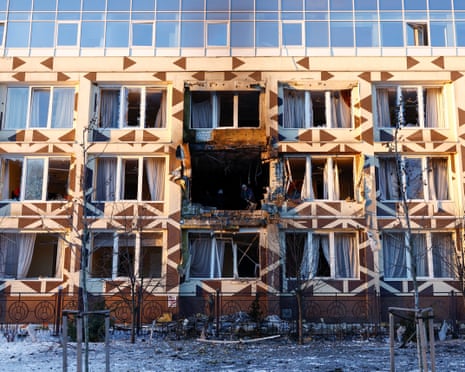
AFP reported that the strikes caused power outrages in some areas of the country, with backup systems activated to maintain water and heating supplies, the official said, as temperatures dropped to -8C.
Two airports in neighbouring Poland had to briefly close in the early hours on Monday, as the country’s military monitored Russian strikes on western Ukraine.
Morning opening: What a year, huh?

Jakub Krupa
Welcome back to Europe Live in 2026. Hope you all had a great break and are ready to face what’s ahead of us, as the new year looks set to be once again pretty wild.
So far, we have had the US military action in Venezuela leaving EU leaders torn, a major energy blackout in Berlin, a disruptive airspace control outage in Greece, heavy snowfalls in parts of Europe, new Russian attacks on Ukraine, and just last night, renewed US threats against Nato ally Denmark over Greenland.
Paraphrasing a popular scene from Tintin, which turned into a meme: what a year, huh? Captain, it’s only 5 January. Buckle up.
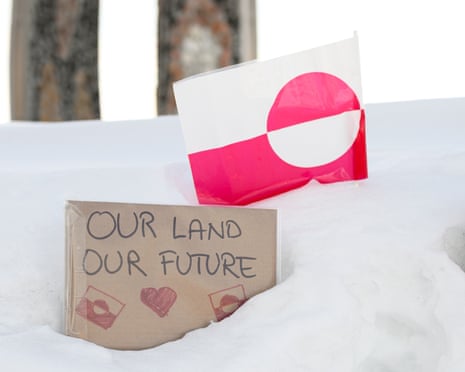
It’s not exactly normal for the Danish prime minister, Mette Frederiksen, to have to issue a stern statement telling the US president, Donald Trump, that:
“It makes absolutely no sense to talk about the US needing to take over Greenland. The US has no right to annex any of the three countries in the Danish kingdom.”
She added:
“I would therefore strongly urge the United States to stop the threats against a historically close ally and against another country and another people who have said very clearly that they are not for sale.”
She was swiftly and pointedly backed by other regional leaders, including Finland’s Alexander Stubb, Iceland’s Kristrún Frostadóttir, Norway’s Jonas Gahr Støre and Sweden’s Ulf Kristersson.
In a post on Facebook, Greenland’s prime minister Jens-Frederik Nielsen also called Trump’s comments “completely and utterly unacceptable,” and “disrespectful.”
But speaking aboard Air Force One on Sunday hours after their remarks, Trump doubled down on his claim that Greenland should become part of the United States.
“We need Greenland from the standpoint of national security, and Denmark is not going to be able to do it,” Trump told reporters, adding:
“You know what Denmark did recently to boost up security in Greenland? They added one more dog sled. … The European Union needs us to have it and they know it.”
“We’ll worry about Greenland in about two months … let’s talk about Greenland in 20 days,” he added.
Erm.
The Danish Trump watcher, a position set up to specifically monitor what’s coming out from the US president’s mouth to alert Danish leaders, must have sighed a few times last night.
I will bring you all the key developments here.
It’s Monday, 5 January 2025 2026, it’s Jakub Krupa here, and this is Europe Live.
Good morning.