3 months ago
104
3 months ago
104
Donald Trump has warned he is not ready to seek a deal to end the US-Israeli offensive against Iran, saying that though he thought Tehran was keen to negotiate a ceasefire, the US would fight on for better terms.
Trump’s comments came as Iran launched fresh missile and drone attacks on countries in the Gulf and on Israel, and Israeli and US warplanes launched new waves of strikes on Iran.
The conflict has plunged the Middle East into chaos, upended global air travel and disrupted oil exports from the region, sending fuel prices rising around the world.
Neither Tehran nor Washington appeared ready to moderate their rhetoric despite the mounting death toll and soaring oil prices after the virtual closure of the strait of Hormuz sea lane.
Trump, speaking on Saturday to NBC News, said the US may bomb targets on Kharg Island, which is the site of Iran’s principal oil export facility, once more “just for fun”, after US warplanes targeted military installations there on Friday.
“Iran wants to make a deal, and I don’t want to make it because the terms aren’t good enough yet,” Trump said, adding that US forces would step up attacks on the Iranian coast north of the strait to clear a path for oil shipments.
Experts say it will be extremely difficult for the US to reopen the strait through military means alone as long as Iran retains the ability to hit or harass shipping with missiles, drones or small boats.
Trump has called for other countries’ warships to help protect tankers passing through the strait, which usually carries about a fifth of the world’s oil and gas supplies. More than 600 ships are trapped in the Red Sea.
On Sunday, Iran’s foreign minister, Abbas Araghchi, urged other countries to refrain from any action that “could lead to escalation and expansion of the conflict”, in a conversation with his French counterpart, Jean-Noël Barrot, according to an Iranian foreign ministry statement.
Iran’s new supreme leader, Mojtaba Khamenei, has – in a written statement – vowed to keep the strait of Hormuz closed. But Trump dismissed this and suggested Khamenei may not even be in control, saying: “I don’t know if he’s even alive. So far, nobody has been able to show him.”
Iran has admitted that Khamenei, 56, was injured in the strike that opened the war on 28 February and killed his predecessor, his father, but has described the injuries as light.
The Israeli military announced a wave of strikes against targets in western Iran, after Iran’s Revolutionary Guards called Benjamin Netanyahu, Israel’s prime minister, a criminal and vowed that they would pursue and kill him.
In Tehran, people were able to go about their work week in the most normal atmosphere since the start of the war, witnesses said. Traffic was busier than last week and some cafes and restaurants had reopened.
More than a third of stalls in the Tajrish bazaar, a popular shopping hub in the north of the capital, were open, five days before Nowruz, the Persian new year.
Some shoppers queued at ATMs to withdraw cash. Online operations at Bank Melli, one of the country’s largest, had been paralysed in recent days. In some places, passengers were waiting at bus stops, which had been largely deserted since the beginning of the war.
More than 1,300 people have been killed by US and Israeli strikes on Iran, according to the International Committee of the Red Cross. That includes 223 women and 202 children, according to Iranian health ministry figures reported by Mizan, the judiciary’s official news agency.
The UN refugee agency says up to 3.2 million people have been displaced in Iran, most of them fleeing the capital and other cities to seek safety.
In a rare reference to diplomacy taking place, Araghchi told the London-based news outlet Al-Araby Al-Jadeed on Sunday that Iran was ready to consider any proposal that included “a complete end” to the war and said mediation efforts were continuing between Iran and its neighbours to de-escalate.
He gave no indication of whether progress had been made, and there was no independent confirmation of his claim, though Turkish officials have said they have made efforts to bring the conflict quickly to an end.
Violence has continued to flare elsewhere in the region. The US has urged its citizens to leave Iraq, where pro-Iranian groups have launched attacks on the US embassy and bases hosting western military units, and there were reports of new strikes against potential US allies among Kurdish factions in the north of the country.
Bahrain and Saudi Arabia said separately on Sunday they had intercepted renewed barrages of projectiles launched by Iran. Dubai has also been targeted.
Iran has accused the US of using “ports, docks and hideouts” in the United Arab Emirates to launch strikes on Kharg Island, without providing evidence. The UAE and other Gulf countries that host US bases have denied allowing their land or airspace to be used for military operations against Iran.
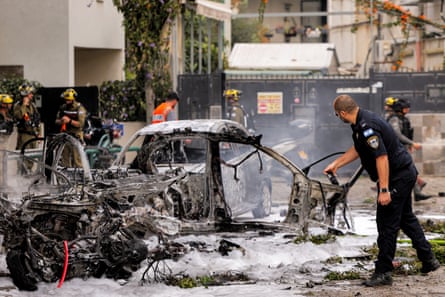
In Israel, 12 people are reported to have been killed by Iranian missile fire. On Sunday, two people were lightly injured in the latest attack, medics said. Loud booms rattled windows in Jerusalem as interceptors brought down missiles.
Israel has accused Iran of using cluster munitions in its targeting of civilian areas.
More than 800 people have been reported to have been killed in Israel’s latest offensive against Hezbollah, the Iran-backed militant Islamist movement in Lebanon that joined the conflict by launching missiles and drones into Israel to avenge the killing of Iran’s previous supreme leader, Ali Khamenei.
Overnight strikes in southern Lebanon killed at least four people, Lebanese state media and the government said on Sunday.
Lebanon’s state-run National News Agency said Israel had struck “an apartment in a residential building” in a northern district of the coastal city of Sidon, killing one person and causing a fire.
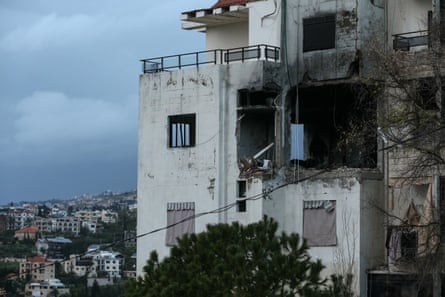
To the south-east of Sidon, in the village of al-Qatrani, three people were killed in an overnight Israeli strike, according to Lebanon’s health ministry.
Israeli military officials said their strikes aimed to degrade Hezbollah’s military capabilities.
On Sunday, Israel’s foreign minister, Gideon Sa’ar, denied reports that Israel could soon hold direct talks with Lebanon and rejected claims it had told the US it was running low on interceptors.
Sa’ar also said Israel saw “eye to eye” with the US over the war with Iran and that the two allies were determined to continue until their goals were achieved.
“We want to remove the existential threats from Iran for the long term. We don’t want to go every year to another war,” he told reporters.
At least 13 members of the US military have been killed since the war began, including six who died in a plane crash over Iraq last week. The director of the US National Economic Council, Kevin Hassert, said US strikes had so far cost $12 billion.