3 months ago
66
3 months ago
66
Travis Head’s latest masterpiece is three days old, the postmortems are complete and England supporters have done their pained vox pops in Australia. And somehow we’re still more than a week out from the second Ashes Test. It’s a hefty gap bound to be filled by rage, moving from the defeat in Perth to the preparation for a pink‑ball affair in Brisbane.
England’s first-stringers could pass the time with a day‑night knockabout against a prime minister’s XI in Canberra. Instead, as planned, it will be a Lions side that plays this weekend, joined by Josh Tongue, Matt Potts and Jacob Bethell, unused squad members in Perth. It is understandable why this has annoyed many, why Michael Vaughan’s soundbite – that it would be “amateurish” not to play the fixture – carries some substance.
The day-night Test is a regular part of Australia’s calendar, their record standing at 13 wins from 14. England haven’t played one in nearly three years and have won just two of their seven. Mitchell Starc, chief destroyer at Perth, has more pink-ball Test wickets than anyone else, at an average of 17. Taking in some match practice with an unfamiliar pill would be of obvious value, even if it is against a long-retired Peter Siddle, six years since the end of his Australia career, in conditions that are unlikely to mirror the Gabba. For fans there would probably be more comfort from a scorecard: hard, undeniable proof that the boys are hard at work.
Nonetheless, England’s decision to skip the fixture – adding further scrutiny to their methods – is hardly a surprise, keeping in line with Brendon McCullum’s and Ben Stokes’s refusal to play to the gallery. There is a stubbornness – sometimes admirable, other times deeply questionable – that has powered this whole movement since it began three and a half years ago. It was there in the comments after the two-day defeat in Perth, with McCullum stating that “we’ve just got to keep backing our approach”. It is in their continued selection of Zak Crawley when the returns say: are you sure?
For McCullum, the focus now will be “making sure that camaraderie is tight and morale doesn’t drop”. It is easy, after a crushing defeat, for some eye‑rolling, to retreat to the hellscape that is the BBC comments section – “bring them home if they can’t be bothered to act like professionals”, reads one entry – and petition for the abolition of golf.
But there is a case for avoiding a sudden vibe-shift, validity in not cramming when that hasn’t been your way all this time. This is a four-year project, a response to the misery of England’s last Ashes visit to Australia.
A squad has been finely tweaked and built for this series, and the mantras have stayed consistent: have a bit of fun and “run towards the danger”. They play the professional game but with the enjoyment of an amateur. This is an experiment that has produced exhilarating cricket and, while it hasn’t resulted in pedigree series wins against India and Australia, its successes meant England entered this tour with lofty expectations. Along the way, they haven’t played many warm‑up games. Why change now?
It is worth seeing this whole thing through before offering judgment. Even after a pair, they should continue with Crawley for the second Test because he has been their man for this cycle.
after newsletter promotion
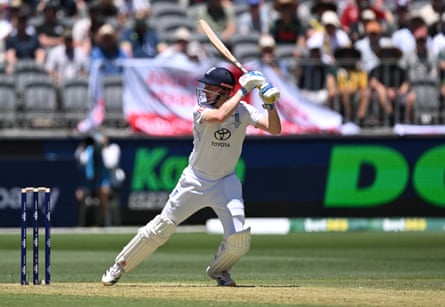
Of course it isn’t the wisest thing to swish so loosely outside off when your innings is minutes old, and some adaptation is necessary. But Harry Brook should not, and will not, turn suddenly into a nuggety grinder; his wildness still resulted in the second‑highest score of the first Test and has taken him to an outstanding record after 31 games.
This side has been pulverised in the past. After beginning with four consecutive victories in 2022, England were undone inside three days at Lord’s against South Africa with two sub‑200 totals. The response was a comprehensive win at Old Trafford, powered by a couple of grown-up tons by Stokes and Ben Foakes, indicating some adaptability even as their innings moved at close to four runs an over.
England will hope for a similar response this time round. If it doesn’t come in Brisbane, then the collapse is well and truly on. Should it go the way of previous tours, resulting in the embarrassment of a thumping, then the natural responses will surely follow, English cricket doing its thing: inquests and departures, a revamped team for the first Test of next summer at Lord’s against New Zealand. County Championship averages could become fashionable again. Accountability will come. For now, though, let them test the limits of this grand idea.