3 months ago
61
3 months ago
61
When Bill Clinton testifies later this week at a congressional investigation into Jeffrey Epstein there is unlikely to be any reference to his most precious foreign policy achievement – helping to bring peace to Northern Ireland.
Whether Clinton is linked to Epstein’s predations or turns the tables on his inquisitors, his legacy in Northern Ireland might appear to stand apart, a jewel of his presidency that is immutable, enshrined in history.
It is not. The fallout from proximity to Epstein threatens to cast radioactive dust over the former president’s role in ending the Troubles and has already contaminated his Northern Ireland point man, the former Democratic senator George Mitchell, who brokered the Good Friday agreement.
With each release of Epstein files, Mitchell and, to a lesser extent, Clinton have lost admirers in a part of the world that rained honours on them for three decades.
“How should we react when we discover that someone, once accorded almost god-like status, turns out to have feet of clay?” the commentator Alex Kane asked in the Irish News, a Belfast daily. For the institutions and public figures that once feted Clinton and his envoy, it is an agonising question.
The British and Irish governments paved the peace process but the 42nd US president played a vital role in weaning the IRA from violence and fortifying the nerves – and egos – of Northern Ireland’s paramilitaries and politicians. Mitchell, a Senate majority leader until 1995, was an inspired choice to chair multiparty talks. Indefatigable, affable and astute, he steered negotiations to an agreement in 1998 that drew a line under a brutal conflict and saved countless lives.
Mitchell “helped to make peace and thankfully sustain it”, said Bertie Ahern, a former taoiseach who, with Tony Blair, played a key role in clinching the agreement. “The assistance at the time by Bill Clinton as president and his visit to the north and his attention to the parties over many years was crucial,” said Ahern.
Bill and Hillary Clinton and Mitchell received standing ovations, and Mitchell was further honoured with a bronze bust, when they visited Belfast in 2023 for the agreement’s 25th anniversary – a reminder of an era of superpower enlightenment.
Mitchell returned last June for the premiere of a film about his negotiating triumph. “It was like the return of the hero,” said Noel Doran, a former editor of the Irish News who attended the screening. “It almost felt like a privilege to be in the same room as him.”
The reverence had persisted despite an allegation by Virginia Giuffre in 2019 that she had been forced to have sex with Mitchell in the 1990s, and despite his name appearing multiple times in the Epstein files.
Mitchell denies any wrongdoing or ever meeting Giuffre but this month, after another release of Epstein material, former supporters wrenched off the halo.
The US-Ireland Alliance announced on 1 February that its George J Mitchell scholarship programme would no longer bear his name. “We are not a court of law. We are an organisation which must make decisions that reflect what we stand for,” the Alliance’s founder and president, Trina Vargo, said this week. “Given all the new information that has come to light, we felt we could no longer ask our alums and future applicants to wear the name Mitchell.”
Queen’s University Belfast, which forged a close partnership with Mitchell during and after his term as the university’s chancellor from 1999 to 2009, followed suit. It erased his name from its Institute for Global Peace, Security and Justice, scrubbed laudatory articles from its website and removed the bust – estimated to have cost £35,000 – from the campus.
The moves followed information from the latest Epstein files, Queen’s said in a statement. “Senator Mitchell previously provided public reassurances regarding his contact with Epstein. The recent files have shown this to be incorrect and in light of this information, the university acted accordingly.”
Belfast city council is considering rescinding Mitchell’s freedom of the city in a proposal backed by nationalist and unionist parties. It is a poignant irony – even in disgrace, the former envoy from Maine has brought both sides together.
Is Mitchell’s tumble into obloquy an overdue reckoning or a reputational lynching? And will Clinton – after his grilling by a congressional oversight committee – be next?
The name George Mitchell appears 310 times in the files.
According to Mitchell, Giuffre’s identification of him was a case of mistaken identity. “In 2021, Ms Giuffre supplied a photograph to OK! Magazine, which incorrectly captioned it as depicting Senator Mitchell standing behind Jeffrey Epstein. The individual in the photograph was not Senator Mitchell,” said a spokesperson’s statement. “The publisher acknowledged the incorrect caption and removed it.”
The senator never met or had any contact with Giuffre or any underage women and learned of Epstein’s criminal activity through media reports about his 2008 prosecution and conviction, after which Mitchell “declined or deflected” invitations from Epstein’s office, said the statement. “Senator Mitchell profoundly regrets ever having known Jeffrey Epstein and condemns, without reservation, the horrific harm Epstein inflicted on so many women.”
For some, Queen’s should have disowned Mitchell after Giuffre named him. “The university’s past sycophancy towards him looks foolish beyond belief,” Suzanne Breen wrote in the Belfast Telegraph. In the spot vacated by his bust, Breen suggested erecting a statue to Giuffre. Ruth Coppinger, a left-wing member of Ireland’s legislature, said repudiating Mitchell should be just the beginning. “Let’s keep going for Virginia and all the other child victims / survivors.”
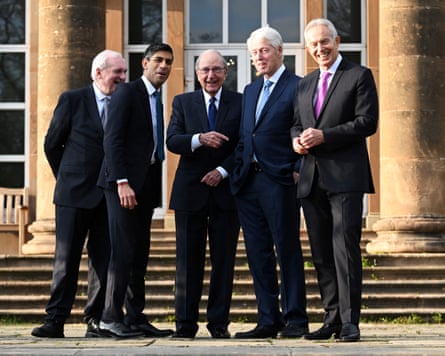
Former taoiseach Bertie Ahern, former British prime minister Rishi Sunak, George Mitchell, Bill Clinton and former British prime minister Sir Tony Blair mark the 25th anniversary of the Good Friday agreement, in Belfast, 2023. Photograph: Reuters
Others, however, say there has been a rush to judgment of a man who helped to end the Troubles. “We have the noose fixed even before the lynch mob arrives,” Niall O’Dowd, an Irish-American publisher, wrote on X. “God bless George Mitchell, we all owe him so much,” said Alasdair McDonnell, a former leader of the Social Democratic and Labour party.
Alf McCreary, a commentator and former information director at Queen’s, said Mitchell deserved better than the university’s “kneejerk” response. “He genuinely cared about us, he spent long, lonely periods away from his wife and family in America. He helped to drag the Good Friday agreement over the line, and he gave us hope.”
Ahern, the former taoiseach, said gratitude for Mitchell and Clinton’s peacemaking would endure. “Nothing can ever take from that and I like the vast majority of Irish people are thankful for their expertise and involvement. On the Epstein papers, I have not seen anything to alter my view.”
However the police investigation into Peter Mandelson – a former Northern Ireland secretary – and the arrest of Andrew Mountbatten-Windsor (both have denied wrongdoing) underlines the toxic power of association with Epstein – and the danger it poses to Clinton, who on 27 February will become the first former president to testify to a congressional committee since 1983. There are expected to be questions about his flights on Epstein’s plane, nicknamed the Lolita Express, and a photo of him in a hot tub. Neither Clinton nor his wife has been accused of wrongdoing by survivors of Epstein’s abuse, and both have denied knowledge of his sex offending at the time.
Damaging disclosures will put pressure on Belfast city council to rescind Clinton’s freedom of the city and on Queen’s to rename the William J. Clinton Leadership Institute, plus a lecture series named after the former president. Asked about potentially removing Clinton’s name, it replied: “Queen’s University is not currently considering any action against other individuals.”
Hillary, who will also testify at the congressional hearing, is the current chancellor of Queen’s. She said she met Ghislaine Maxwell – Epstein’s convicted associate – but not the financier, and that she and her husband have nothing to hide. “We have called for the full release of these files repeatedly. We think sunlight is the best disinfectant.”
In the reappraisal of peace process heroes there are notable silences. The taoiseach, Micheál Martin, and the tánaiste, Simon Harris, have avoided public comment. Emails to their offices asking about the repudiation of Mitchell and the unease over Clinton received no reply.
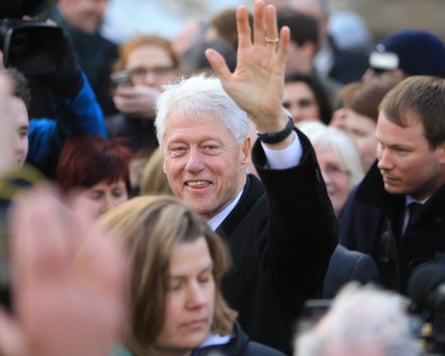
The timing is sensitive: Martin is due to meet Donald Trump at the White House on St Patrick’s Day, traditionally a time for Irish backslapping in Washington but now a minefield of potential disputes with a president who loathes the Clintons and is plagued by his own links to Epstein.
Another factor, unrelated to Epstein or US politics, has dulled the Good Friday glow that used to illuminate Mitchell and Clinton. Northern Ireland is a mess. Power-sharing has locked Sinn Féin and the Democratic Unionist party in a loveless marriage at Stormont, producing acrimony, dysfunction and disillusionment.
Optimism about a new dawn began to fade a decade ago, said Doran, the former editor. “Everything looked reasonably hopeful for a while and then it all started to come apart. We’re now into prolonged nastiness and confrontation.”
For this, the American peacemakers are blameless. But it is a bleak conjunction: while association with Epstein taints Mitchell and Clinton, their great accomplishment and legacy, Northern Ireland, slides into shadow.