3 months ago
83
3 months ago
83
The EU is to unveil a €3bn (£2.63bn) strategy to reduce its dependency on China for critical raw materials amid a global scramble triggered by Beijing’s “weaponisation” of supplies of everything from chips to rare earths.
The ReSourceEU programme will seek to de-risk and diversify the bloc’s supply chains for key commodities with a funding initiative to support 25-30 strategic projects in the sector.
These projects cover rare earths – a group of 17 heavy metals that are actually abundant but difficult and costly to extract – as well as the elements gallium, germanium and lithium, used in batteries for electric vehicles.
The plan centres on creating a European hub for critical materials that would pool company orders and build joint stockpiles for key projects including urgent defence programmes, an effort driven by the EU industry commissioner, Stéphane Séjourné.
The discussion comes as the French president, Emmanuel Macron, visits China, which has threatened to expand its controls on the exports of rare earths, including magnets used in everything from car and fridge doors to MRI scanners.
Concerns that Europe could fall behind the US, Japan, Canada and Australia are widespread in industry, with large American car companies already working with mining conglomerates to reduce reliance on Beijing.
Efforts by the US, the EU and the UK to reduce dependency on China for supplies took on a fresh urgency in October when China threatened to introduce sweeping controls on global exports of rare earths from December.
That threat was lifted as part of the tariff deal struck between Xi Jinping and Donald Trump in Korea six weeks ago, but the reprieve only holds for 12 months, preserving China’s future leverage on supply chains.
While chips and magnets can be low cost they are of high political value. China has shown it is prepared to use this power, as it did in October when it imposed a ban on chip exports in the wake of a Dutch intervention in a Chinese-owned chip factory, Nexperia.
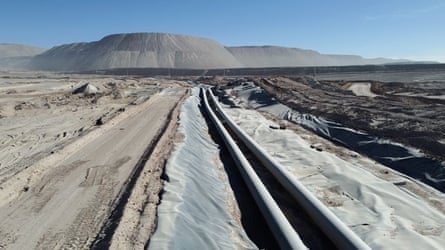
The commission has previously estimated that the demand for rare earths and lithium alone is expected to increase five to 12 times and nearly 60 times, respectively, by 2050. In 2020, more than 98% of the EU’s rare earths imports came from China and 78% of its lithium needs were sourced from Chile.
ReSourceEU is part of a wider package being unveiled on Wednesday that the commission calls its economic security doctrine, intended to make European firms more self-sufficient.
Last week Séjourné told the European parliament that the commission would create a “European centre for critical raw materials” to act as an EU-wide supply hub.
after newsletter promotion
Mining rare earths is a slow and expensive process and there are fears that it could take a decade to reduce reliance on China, which has a stranglehold on the world’s supplies of raw materials and refined products such as the lithium hydroxide used for charging components in car batteries.
Keir Starmer unveiled a critical raw materials strategy for the UK last month, but only announced £50m in funding, a small sum given the amounts needed to bring products from mines, through refineries and into supply chains.
Europe’s only lithium hydroxide factory, operated by AMG Lithium in Germany, took £150m to build, and the company was already in the mining business. Earlier this year its chief executive, Stefan Scherer, told the Guardian that the EU might as well “apply to be a province of China” so little was being done in practice to cut reliance. “Europe has to become independent of China, otherwise it’s just blah blah blah,” he said.
Bruno Jacquemin, of the French industry group the Alliance for Minerals, Metals and Materials, made similar remarks on Radio France International on Wednesday.
“If you prefer to buy your steel in China, your rare earths in China because they are cheaper, you will be in the hands of actors who can put you in a state of absolute vassalisation,” he said.
“I am doubtful about the practical effectiveness of a system run from Brussels. Should Europe spell out everything it does for these national defence issues? I am not sure it is a good idea to proclaim that loudly.”