2 months ago
55
2 months ago
55
In the unassuming, dusty lanes of the Nepali city of Damak, an unprecedented political showdown is unfolding. Pitting an old political heavyweight against a rapper-turned-politician with a penchant for dark sunglasses and sharp suits, the battle is one that could completely reshape the country’s politics.
As Nepal heads into its most gripping election in years, at the forefront stands Balendra Shah, the 35-year-old known simply as Balen. He rose to fame as a popular rapper whose songs criticised the ruling elite, before pivoting to politics and winning a resounding victory to become the mayor of Kathmandu in May 2022.
Yet it was after Nepal witnessed the bloodiest day of protest in recent history – when a gen-Z uprising last September against corruption and a social media ban was responded to with police brutality and live fire across the country – that Balen emerged as a nationally popular and unifying figure, particularly among a Nepali youth widely enraged at a political system they feel is broken and unrepresentative.
The protests and ensuing violence left more than 70 dead and quickly brought down the communist government of the veteran prime minister KP Oli Sharma, which had long been dogged by allegations of corruption, nepotism and elitism. Balen was the favoured choice by gen-Z leaders to step in as interim leader but he declined, opting to wait and fight it out at the ballot box.
“As mayor, Balen showed he could transform governance,” said Parbat Basnet, a 24-year-old business graduate and one of the leaders of the gen-Z uprising in Damak, which was also met with police firing.
“He could have accepted an unelected position of power after the protests but instead he chose the democratic path. He wants to defeat corrupt leaders through the ballot box so that both leaders and voters change their mindset.”
To many in Nepal – particularly the 46% of the population who are below the age of 24 – this week’s polls are a crucial test of whether the frustrations and demands that fuelled the gen-Z uprising can be harnessed into sustained political change, or whether the old guard will simply reclaim their thrones.
Basnet emphasised that the aftermath of the uprising was not only felt among the young in the election. Nepal’s unwieldy electoral system has entrenched an endless cycle of weak coalition governments and widespread election fatigue; the country has had 31 prime ministers in 35 years, including several who came back repeatedly.
“But the energy in this election is different,” said Basnat. “Even old voters are finally questioning leaders: where is the gas pipeline you promised? Where is the railway? Where is the development you spoke about?”
“Earlier, leaders were treated like gods. Now people are demanding accountability.”
Nowhere is this more palpable than the constituency of Jhapa-5 and its central city of Damak. For years, this region has been the stronghold of the four-time prime minister Oli and his Communist party of Nepal (Unified Marxist-Leninist), known as UML.
After Oli announced that he would be rerunning for office yet again, despite his unceremonious toppling six months ago, Balen resigned as Kathamndu mayor and announced he would directly contest Oli’s seat and run for prime minister.
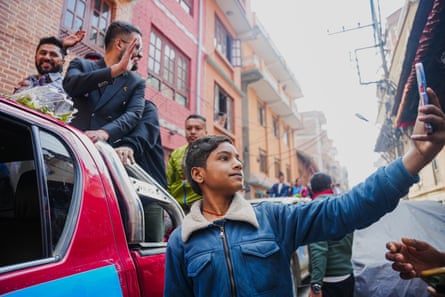
Since then, Balen’s status has soared to meteoric heights and the “Balen effect” appeared infectious across Jhapa-5. At a roadshow in Damak, huge crowds gathered on the roads, on balconies, rooftops and standing on trucks, and there was a surge to try to touch Balen as he emerged from the roof window of his campaign truck dressed in his signature black suit and shades. Women who could not reach him for selfies collapsed in tears.
Sarita Baral, 23, was among those who snapped a prized rally selfie. Prior to the gen-Z protests, she said she had little political engagement, but that had all changed. Now she wanted to fight for a country where most of the youth did not have to travel to exploitative jobs abroad, in places such as the Gulf, in order to find employment.
“Young people in Nepal are very supportive of Balen because we want change, we want job opportunities and an end to corruption,” said Baral.
“Balen is different from other politicians, doesn’t make big promises and he seems brave. He could have contested from any constituency, but he chose Jhapa-5 to fight KP Oli. That itself makes us feel that he is a bold leader.”
The contrast to Oli’s campaign was stark. As his campaign motorcade drove through Damak it was largely ignored. Speaking to the Guardian in rare comments from his home in the city, Oli remained largely unrepentant about the violence unleashed on gen-Z protests against his government.
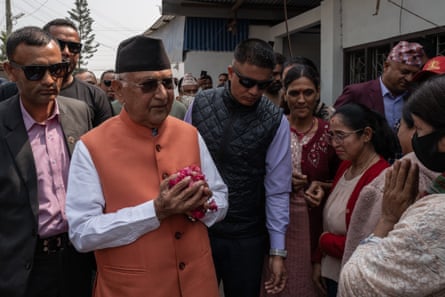
“Young people were misled, they were brought out into the streets and then their movement was hijacked by criminals,” said Oli. “This was a conspiracy to topple my government. Yes it was a matter of sorrow, I was very sad that people died. But their conspiracy was greater than our preparation, they wanted to burn the country.”
After he resigned, Oli was not seen publicly for weeks, but he denied fleeing or going into hiding. “This is bad propaganda,” he said, adding that there was “no doubt” that he could win.
Oli’s UML does retain strong loyalty, particularly in more rural areas of Jhapa-5 where he has won six times. There have also been concerns raised over Balen’s campaigning style as well as his history of volatile social media posts and impulsive tendencies, which some fear could have geopolitical implications for a small country land-locked between China and India.
Balen has largely shunned interviews in mainstream media in favour of social media posts, where he has millions of followers, and his team did not respond to requests from the Guardian. Out on the campaign trail, his campaigning style is unconventional and his interactions with voters are largely brief, leading to accusations that he is shying away from any difficult questions. On the rare occasions Balen has addressed crowds, his remarks have lasted no more than three minutes.
His silence appeared to rile some in Jhapa. During an appearance at Gaurigunj, a small town about 20 miles from Damak, he simply smiled at the crowds and then moved on. “He walks from place to place but doesn’t speak at all,” said Buddhimaya Kerung, 47. “If he wins, will it be even harder to hear him?”
It was just a few months ago, just before midnight, that Balen posted on Facebook “Fuck America, Fuck India, Fuck China” as well as other Nepali political parties. He deleted his post but his lack of transparency on his foreign policy strategy, and how he intends to manage Nepal’s delicate tussle between overpowering Indian and Chinese interests remains a concern for some voters.
“Balen is not easily accessible, you cannot really ask him questions anywhere. He waves to the crowd, stands on stage, and that’s it,” said Kumar Khatiwada, 62, who said he would be voting for Oli.
For the gen-Z figures backing Balen, they too acknowledged that for all the hype, he remained untested on the national stage.
“Yes, expectations are high but I am not blindly following him because he is a celebrity or a rapper” said Basnet. “If he does well, I will support him. If he fails, I will question him. We must never stop questioning our leaders.”