2 months ago
62
2 months ago
62
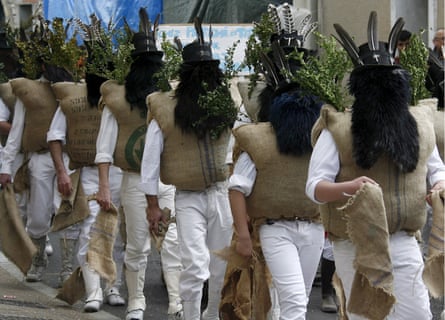
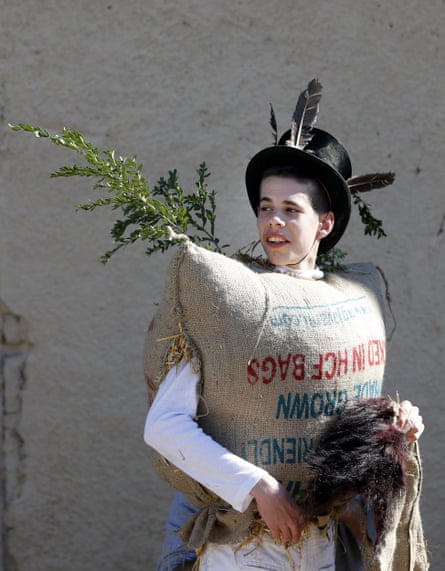
In the early afternoon of Ash Wednesday, dread creatures dressed in white walk the streets of the medieval southern French village of Cournonterral. They wear long masks of black badger hair, top hats crowned by feathers and sprays of boxwood, and body armour comprising sacks stuffed with straw. Despite the early hours, some of them stagger from drink, whips of hessian sacking dangling from their hands.
These menacing characters are exclusively male – the only women taking part in the traditional festivities today are their prey. Among les blancs – also dressed in white but with no armour except red ribbons in their hair and around their waists – are a few teenage girls in heavy makeup.
The festival of Pailhasses is one of France’s most ancient carnival traditions. Celebrating the end of a longstanding rivalry with a neighbouring village, it has for more than 700 years allowed villagers to release frustrations before Lent. Its rituals are about strength, chasing and some form of attack. It is also notoriously secretive. Smartphones and cameras are banned; the village’s official website states that spectators are not welcome.
Behind the scenes, however, modernity rubs against tradition as women are trying to gain a bigger role in the visible part of the carnival – beyond cooking specialities, sewing or organising. Whether this is possible depends partly on a village’s global approach to safeguarding its traditions.
In Cournonterral, the church bell strikes three, marking the start of the festivities. The Pailhasses carnival began as a feud: the villagers from Cournonterral habitually stole wood from the forests of Aumelas, which led to strife until, in 1346, the seigneur asked the local authority named Pailhas to bring peace, and the Pailhasses became the culminating feature in a carnival week before Lent.
The badger-men dunk their whips in vats filled with violet wine lees and animal hair, and, eyeless and soundless, chase the blancs down alleys, whipping them until they drip purple. There are screams and laughter. The people doing the whipping and the people doing the running are mainly young, and it is said that the festival serves as a rite of passage as well as a perverse form of flirting between village youth.
“Following larger societal movements in the 1970s and 1980s, women were allowed to come into the street as blancs, instead of staying at home as they had for centuries,” says Corinne Lamarche, an anthropologist who studied the carnival. “Children were also allowed a bigger place.”
But that’s as far as women’s roles have changed. Elsa, 26, grew up in the village and now lives in nearby Montpellier. She loved the event when she was younger but no longer participates. “No one from the old village dares to suggest changes, but perhaps it could do with evolving. The idea remains that any woman who tries to use a whip would end up stripped to her underwear in the square.”
A larger conservatism and elitism is at play. It’s not just women who can’t take on the prestigious role of Pailhasses. There are also many men who can’t. Only certain families are considered legitimate “Pailhasses families”, a right handed down from generation to generation.
The traditionalist approach taken by Cournonterral is part of a larger grappling to hold on to identity occurring in rural areas which have either seen a large population decline or, in the case of peri-urban Cournonterral, an influx of new inhabitants who live on the outskirts and don’t share the same culture.
Beatrice Barbara, who is from a “carnival family”, explains this approach. “People from the outside don’t understand what the carnival means to us. For most of the year, the village seems empty. We wait all year for this moment to come around. People take a week off work, and people who have moved away come back. During carnival, we again become proud of who we are. We don’t want to change it.”
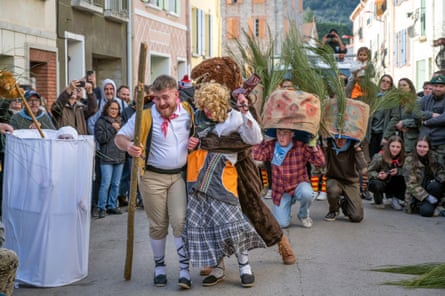
In the Eastern Pyrenees, other villages show it is possible to hold on to your traditions while also opening up to the outside world. The local “Bear festivities” differ in each village, but they have traditionally involved men acting as barbers and a bear chasing people through the streets. In the past, young women were particularly targeted, but now – as is the case in Prats – anybody can be brought to the ground by the bear before having soot smeared on their faces.

According to Lilian Grainger, on the organising committee of Prats-de-Mollo-la-Preste, its inclusion in the Unesco Intangible Cultural Heritage list in 2022 means “our tradition won’t disappear and we are no longer seen as savages”.
The increased pressure to present a good public image to the outside world, as well as managing the safety and expectations of the increasing numbers of tourists, may be a contributing factor.
Changes do not happen without resistance from within the village. For the past four years in Prats, a group of women has dared to dress as the traditional male protagonists and carried out their own version of the bear festival at the end of the official event. These “bears with glitter”, as they call themselves, faithfully reenact the ritual to keep its symbolic nature. This has created controversy, and their version is not recognised by the organisers.
In what may have been an attempt at a compromise, a new female role was officially created by the organising committee in 2023. The pastoretes (shepherds) educate spectators and maintain safety.
In the nearby village of Saint-Laurent-de-Cerdans, Sandrine Flores says they faced opposition, not only from men but also other women in the village. In 2010, she and her friends, bored because they were no longer young enough to interest the bear, brought a historical female protagonist back. “We just wanted to have fun, but maybe subconsciously there was a feminist side to it,” she laughs.
The figueretes smear figs and muscat wine on faces and, unlike the pastoretes, have some symbolic equality with the male barbers who smear blood sausage and muscat wine. “We were told by women that it was not feminine to be ugly and violent like that.” Between 2010 and 2025, no other women dared join them, but in 2026 young women want to take on this role, so they are now a multigenerational group.
As is the case in Cournonterral, women acting the star role is still inconceivable. Getting to be a bear is a great honour and highly competitive; in Prats, men have to send in a letter of motivation. Any demands from women to take on the role are flatly refused. “There’s a lot of male chauvinism related to these festivities,” says Flores. “They don’t want women to have as important a place as men.”
Dominique Pauvert, ethnomythologist and author of The Carnival Religion, says, “There wouldn’t be a problem with a woman doing it as long as she is behind a mask and helps to create the fear that is needed to get the sense of collective release.”
Carnivals are supposed to be subversive and turn order on its head. It remains to be seen how much this will extend to women in the context of rural communities trying to hold on to traditions and what makes their carnivals unique.