3 months ago
47
3 months ago
47
Rescuers have reached five of seven people who have been trapped for a week in a flooded, remote cave in Laos, after days spent navigating narrow, inundated passageways amid persistent rains.
Video footage shared on social media by rescue divers showed the five men crouched together on a rocky ledge in a dark cave chamber, surrounded by muddy water. “There’s no need to cry,” one of the rescue team told the men, who first entered the cave on Wednesday. Two men remain unaccounted for.
When asked about their health, the men told the rescuers they were hungry and dehydrated.
Outside, rescuers jumped up and down in joy, hugging one another after learning the group had been located. A boy, among families desperately waiting for news, spotted his father in the group and raised his hands in a gesture of gratitude. “I am happy for you, son,” a member of the rescue team responded.
“What a feeling,” wrote Mikko Paasi, a Finnish diver, on social media after he was filmed reaching the men along with Norrased Palasing, a Thai diver. But he added: “This is only a brief relief as the 5 survivors are still in the terminal chamber, all healthy and in good spirits, but the extraction is still ahead and it ain’t going to be easy.”
The group reportedly entered the cave in Xaysomboun province, central Laos, to hunt for wildlife and search for gold, but heavy rain blocked the cave entrance.
Thai and international divers, including Paasi and Palasing, who helped in the dramatic rescue of a young Thai football team in 2018, travelled to Laos to help bring the men to safety.
For days, teams had been battling to reach a terminal chamber about 300 metres from the cave entrance, crawling and climbing through tunnels that were at times just 60cm deep. Passageways were almost completely filled with water and sediment. On Tuesday, the team had focused on reinforcing safety measures, and installing internet cables in the cave so that the team could monitor the situation and relay first aid advice quickly if necessary.
Paasi described the environment as “extremely remote and hostile”. Reaching the site involved a 4km jungle track, he said in a Facebook post earlier on Wednesday. “When inside the mine you have to navigate hundreds of meters of constant restrictions, flood waters, collapse hazards and high risk of contaminated air quality.”
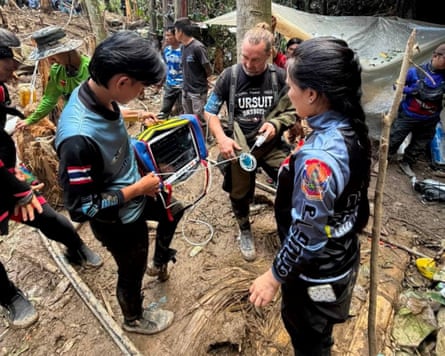
Kengkard Bongkawong, the head of operations of the Metta Than Rescue group from Thailand, told the Guardian they were now planning how to locate the remaining two men. “Health checks and first aid were administered at the scene,” he said of the men who were located.
Kengkard was also was part of the diving team in the 2018 Tham Luang cave rescue, when 12 young footballers and their coach were brought to safety after more than two weeks in a flooded cave in Thailand’s Chiang Rai province.
Rescuers have remained optimistic that the group would be found alive, saying they had originally entered the mine with the resources to stay for several days.
A major challenge has been the persistent rains, which continued even as rescue workers pumped water out of the cave complex. Late on Tuesday night, Jakkrit Taengtang, a rescue technician for the Saithan Saphanboon Foundation, a group helping in the rescue, said he had been forced to retreat from the cave immediately when the rain started. “We are afraid that the water will flood into the cave so we needed to urgently retreat. We did our best,” he said in a Facebook video.
Divers re-entered the cave again on Wednesday to deliver oral rehydration salts and water, rescuers said, adding they would then plan how to bring the men out as quickly as possible.
Kengkard said the cave had not collapsed but people had been trapped following heavy flooding, adding that sand and gravel had been carried by the waters into the cave, blocking a crucial passageway.
It is not clear if the trapped group were searching for gold ore as part of small-scale artisanal activity or were working for a mining company when they became trapped.
Alluvial mining, which includes mining for valuable minerals such as gold, diamonds, and platinum, has boomed in Laos over recent years, with research by the Stimson Center, a US thinktank, suggesting almost 200 such mines opened between 2023 and 2025. Last year, the government announced a ban on any new permits for alluvial gold mining due to environmental concerns.