3 months ago
52
3 months ago
52
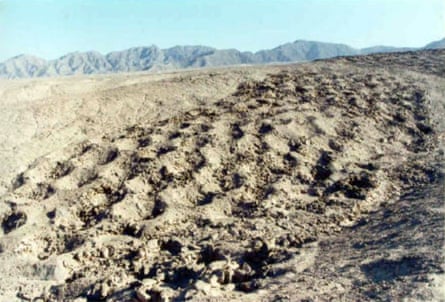
A Florida archaeologist’s decades-long persistence has helped solve one of Peru’s most puzzling geographical conundrums: the origin and purpose of the so-called Band of Holes in the country’s mountainous Pisco Valley.
Charles Stanish, professor of archaeology at the University of South Florida, and an expert on Andean culture, spent years studying the more than 5,200 curious hillside shallow pits known to local residents as Monte Sierpe - serpent mountain.
He surmised during numerous field trips since the 1980s that the holes were man-made indentations created during the pre-Inca period for a rudimentary market place, then adapted by Incan civilization into a sophisticated kind of accounting and storage system, likely for agriculture.
Rival theories abounded – from the sensible to the bizarre. Some analysts opined the holes might be an intricate network of water storage tanks; a more extreme postulation, aired on the Ancient Aliens television program and exploited by an enterprising travel company, was that they were crafted by extraterrestrial beings, perhaps to cover up the crash of their spacecraft.
Now Stanish, in partnership with Dr Jacob Bongers of the University of Sydney, his former graduate student at the University of California, Los Angeles, believes he has found the smoking gun.
On their most recent expedition they used advanced drone technology to conduct the first comprehensive aerial mapping of the site, producing high-resolution images revealing “striking patterns” in how the holes were organized.
The rows of holes, each between 3ft and 6.5ft wide, appeared segmented and mathematically structured, they said, a layout mirroring khipus, knotted-string devices the Inca used for counting and record keeping.
“Monte Sierpe is extremely difficult to map from the surface,” Stanish said. “Even from the mountain above you can’t see its full pattern because of the permanent haze in the area. And because there were few artifacts, archaeologists couldn’t date or interpret it accurately.”
Even more conclusive, Stanish said, were the results of microbotanical analysis of sediment samples taken from inside the holes. Fossilized seeds revealed traces of crops such as maize and wild plants traditionally used for weaving and packaging goods.
“We proved that the seeds didn’t fly in, they weren’t airborne, they had to be put there by humans,” he said. “We didn’t get any, with one exception way down below, colonial-era seeds, and we got one carbon-dated to slightly pre-Inca, which was fascinating.
“And the coolest stuff was we found the reeds, the traditional reeds and the willows that the Inca and the Quechua peoples use to carry commodities, even up to the present day. So we got the reeds, we got the seeds.”
Stanish said future work will focus on further analysis of the recovered seed samples, while Bongers plans to lead an upcoming expedition for more excavation. But he said he believed his explanation for the Band of Holes’ existence was now “pretty solid”.
“If we do find anything that changes interpretation, we’ll say that. But I doubt it,” he said.
He said he hoped that authorities in Peru would recognize the historical significance of the holes, and move to protect them.
“I’m not worried about tourists, about foreigners coming,” he said. “I’m worried about landowners getting the land and then irrigating it. People have to make a living, and I admire that. But, yes, this is a precious site, for the Indigenous peoples and for their pride, and its important to recognize that.”