3 months ago
49
3 months ago
49
As the playoffs begin for the 40th time, it is easy to forget there was once a world without them. But where did they come from? Whose idea were they? And how did they take root in English football? The EFL granted access to its archives containing the documents and meeting minutes charting how an idea, conceived to help lower-league clubs financially and add late-season spice, evolved into one of the most cherished fixtures in the English football calendar and gave birth the “richest game in football”, as the Championship final is known.
It is hard to comprehend quite how broken English football was in the mid-1980s. In the 1988 book League Football and the Men Who Made it, Simon Inglis writes: “The year 1985 was the most devastating in the hundred years of the Football League.” Hooligans attracted headlines, fans were killed in riots and clashes with police drew the attention of the prime minister, Margaret Thatcher, who told football to get its house in order.
There was the Bradford stadium fire, collapsing attendances and the threat of a breakaway Super League led by Liverpool, Everton, Manchester United, Tottenham and Arsenal. Bigger clubs wanted more power and a greater share of revenue, while the lower league clubs struggled to survive, but believed the richness of the English game lay in its pyramid. Negotiations with the BBC and ITV reached an impasse, leaving a season without televised football. Sponsors lost interest.
In December 1985, 10 officials representing all four divisions met at the Post House hotel near Heathrow to thrash out a solution. Gordon Taylor, the Professional Footballers’ Association chair, acted as intermediary during a six-hour meeting. Out of that division and chaos, the playoffs were born.
The idea was proposed by Brentford’s chair, Martin Lange, as a way to generate revenue for Third and Fourth Division clubs who would lose money under the new deal. Second Division clubs liked the concept so much they adopted it, too. Lange can not take all the credit – the idea was first floated in 1972 by the then Football League secretary, Alan Hardaker, but did not receive the same reception.
As part of what became known as the Heathrow Agreement, the First Division would shrink from 22 to 20 teams. “In order to make a fair and equitable transition rather than relegate four clubs and promote two, there would be a system of staggered promotion and relegation, supplemented by a system of play-offs,” read one proposal.
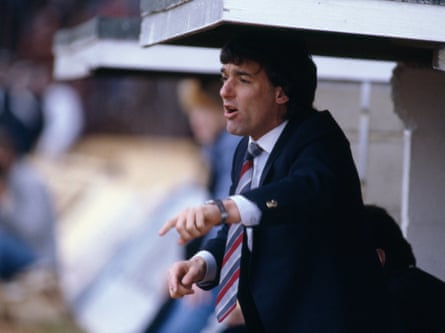
“The exact format for those has yet to be worked out, but they would be similar to those used in American leagues and would be tried in all divisions. Initially the play-offs would operate for two years, but if they proved popular with spectators they could become a permanent part of the calendar.”
In the first iteration, fourth-bottom in the First Division competed with third, fourth and fifth in the Second. The wider membership still had to vote on the plans, which were not universally liked. Meeting minutes describe the proposals as “the best of a bad job”.
Before an EGM at the Cumberland hotel on 28 April 1986, the 22 First Division chairmen threatened to break away if the Heathrow Agreement were not adopted. Faced with that ultimatum, the plans were reluctantly accepted. The Football League had survived and work began on finalising the playoff format.
On 23 May 1986, the structure was confirmed: the semi-finals and final would be decided over two legs and by away goals. “If scores were still level after this a replay would be played the next day,” minutes state, which would go to extra time and penalties. Initially, teams “would toss a coin for venue”, though this was later replaced by neutral grounds. Semi-final replays were dropped.
Meeting minutes from 6 April 1987, reveal “a suggestion that corners be counted” to decide the final if away goals could not separate teams “was left on the table for future consideration”, though the notion of promotion and relegation being settled by who won more corners never progressed.
Although clubs had agreed to the system, only when the consequences were felt at the end of the 1986-87 season did the backlash begin. Straight after winning the inaugural Third Division playoff final, Swindon’s manager, Lou Macari, called for the format to be abolished. Joe Royle was furious after Oldham went out on away goals to Leeds in the first Division Two playoff semi-finals after finishing seven points above them.
Despite the complaints – and an initially indifferent reaction from the media – the end-of-season drama quickly took hold. In 1986-87, promoted Charlton had battled to stay in the First Division and were forced to fight for their lives again after finishing fourth-bottom.
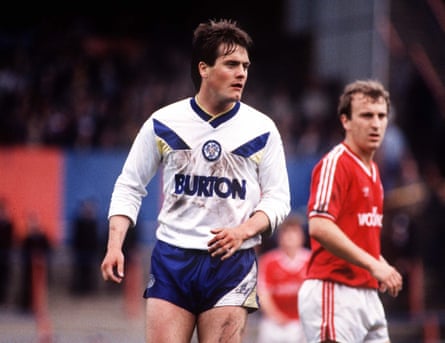
The players were unsure how to feel. “It’s end of the season, you’re knackered, you just want to put your feet up on a sunbed,” says the Charlton centre-back Peter Shirtliff. “But we were up for it.”
Charlton beat Ipswich 2-1 on aggregate in the semi-final, then faced Leeds in a final that could not be separated over two legs, each winning 1-0 at home. The competition was proving popular, with crowds of about 30,000 packing Elland Road for both Leeds home games. A replay at Birmingham’s St Andrew’s followed – a playoff to decide the playoffs, if you will.
The score was level after 90 minutes and Charlton looked doomed when John Sheridan scored in extra time. But Shirtliff struck twice in four delirious minutes. It remains the only playoff final to go to a replay, after that idea was dropped.
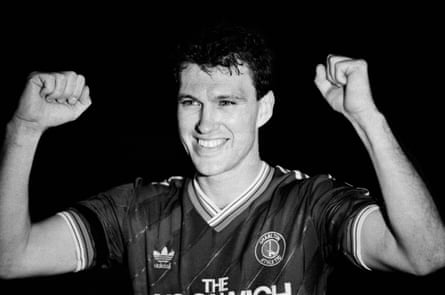
On the journey home, the Charlton coach hurtled down the M6 until the players, starving, demanded to stop. They pulled into a service station and tucked into cheap fast food. “I’m thinking: ‘We’ve just managed to stay in the First Division and we’re all eating chips and god knows what in a services,’” Shirtliff, now 65, says, chuckling. “Every time I think about it, I think: ‘What would they be doing now?’ They’d probably be in five-star restaurants or in a hotel with their own chef cooking for them.”
There was no celebration when they returned to their training ground late that night. “Everyone’s got into their cars and just gone. That was it. See you later. There were no mobiles in those days, no social media or anything like that. That’s it, well done lads, we’ll let you know when pre-season starts. Unbelievable.”
Shirtliff still enjoys watching the playoffs and the competition – more popular than ever – continues to evolve. Last summer’s Championship, League One and League Two finals drew a record 211,858 fans to Wembley.
Just as in 1980s, the concept is not standing still. From next season, the Championship playoffs will expand from four to six teams. Fifth through to eighth will play “eliminator ties”, with the winners facing third and fourth in the semi-finals. “We are confident this change will further strengthen the Championship as a competition and give more clubs and their supporters a genuine opportunity of achieving promotion,” said the EFL’s chief executive, Trevor Birch.
The new idea is proving almost as controversial as the original concept, all those years ago.