3 months ago
89
3 months ago
89
In Thailand, news anchors ditched their jackets on air as the government called on the public to reduce their use of air conditioning to save energy. In the Philippines, many government workers are now operating on a four-day week. In Vietnam, officials have urged employers to allow staff to work from home.
Across south-east Asia, governments are scrambling to find ways to conserve energy and shield the public from soaring costs as war in the Middle East causes what the International Energy Agency has described as the largest supply disruption in the history of the global oil market.
Asia, which relies heavily on imported energy, much of which passes through the strait of Hormuz, is acutely affected by the crisis. In the Philippines, which depends on the Gulf for 90% of its oil requirements, the government is introducing cash handouts for drivers of public transport vehicles, and has told government agencies to cut electricity and fuel use by between 10 and 20%.
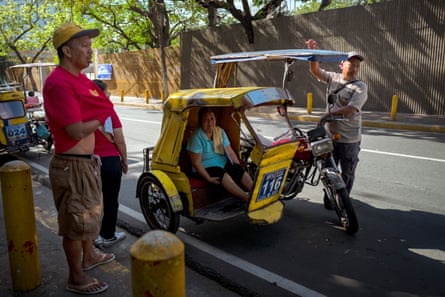
The price increases are already causing misery for many. Elmer Carrascal, 58, who drives a jeepney, vehicles that make up the backbone of the country’s transport system, said his income has fallen dramatically, by more than half, since the war.
“Before, I spent 700 pesos [£8.80] on diesel and took home around 1,000 pesos per day. Now I only earn 400 pesos. It’s not even enough for food,” said Carrascal, who has plied the roads of Mandaluyong City, in the capital region, for 35 years.
“How far can your 400 go? Rice alone is 65 per kg.”
On Tuesday, the Philippine senate granted the president, Ferdinand Marcos Jr, emergency powers to temporarily suspend or reduce excise taxes on oil, but has warned it is unclear how long the crisis will last.
“We are victims of a war that is not of our choosing,” Marcos said earlier this month. “But we control how we will protect the Filipino,” he said, as he announced a series of energy-saving measures.
Governments across the region are racing to conserve energy, find alternative supplies and protect the public from punishing price increases. The Thai and Vietnam governments have encouraged steps to reduce energy use, introducing work-from-home policies for many public sector workers.
The Thai government has suspended most overseas trips for bureaucrats, and has instructed officials to wear short-sleeved shirts without neckties, except during ceremonies, to reduce the need for air conditioning. Government offices have been urged to set air-conditioning temperatures at 26-27C to reduce the use of elevators and promote carpooling. If the energy crisis worsens, other measures, such as dimming billboard brightness from 10pm onwards, and closing petrol stations, will be considered.
The Thai government is also increasing the ratio of biofuels blends from 5% to 7% and suspending most oil exports, while Indonesia is also accelerating a biodiesel programme that blends 50% palm-oil-based biodiesel with 50% conventional diesel. Vietnam has asked Japan and South Korea to help increase its access to crude oil.
Thailand, the Philippines, and Vietnam – large net importers of oil and gas that depend on Middle East supplies – are major economies especially vulnerable to price rises, according recent analysis by Eurasia Group.
Many countries in the region have introduced temporary subsidies and price caps, though Eurasia Group warned in its analysis that budget pressure make subsidies “difficult to maintain beyond one to two months”.
Diesel subsidies are costing the Thai government more than 1bn baht (£22m) a day.
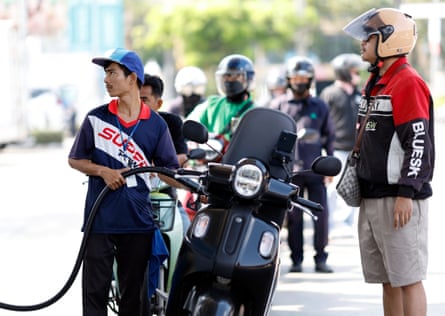
Petrol stations across Thailand have experienced panic buying, as consumers fear further price increases. Some shops have put up “out of stock” signs, introduced rationing or banned customers from filling up containers to conserve stock.
This week, a major temple in north-eastern Thailand announced it had suspended cremation service because gas stations refused to allow it to fill up jerry cans with fuel, according to a report by ThaiPBS. In the ancient Thai capital, Ayutthaya, an elephant camp said its elephants were now walking 5km to work because fuel rationing at local gas stations meant they could no longer travel in a trailer truck.
On Tuesday, tricycle drivers in the Philippines lined up to receive cash handouts offered to cushion the impact of the fuel price spikes.
Financial support will also be offered to jeepney drivers such as Carrascal, though he says the handout of 5,000 pesos will make little difference in the long term. “It will only last for days and it’s gone,” he said, adding that more sustained support was needed.
The cost for rides on jeepneys are also increasing, though Carrascal fears higher prices will deter customers. “There are fewer passengers now because a lot of companies implemented work from home. It’s a double blow, the fuel prices increased and we’ve lost passengers,” he said.
Before the war in Iran, diesel cost 52-53 pesos a litre, he said.
Now it continues to rise by the day. “Last week, it was 79.40 pesos at the gas station where I usually get diesel,” he said. In many gas stations the cost for diesel has already surpassed 100 pesos. “Tomorrow there’s another increase.”