3 months ago
81
3 months ago
81
Welcome to How I Beat The Bookies: My Gambling Journey. Yes, my extreme methods can work for you. But only in the usual way. Which is to appear very briefly to work and then not to work at all.
First it is necessary to address the latest blow to English football’s otherwise watertight economy. People often talk about playing the world’s tiniest violin, a way of expressing sarcastic sympathy for bogus suffering, usually accompanied by a finger-and-thumb gesture that suggests, incorrectly, this is the size of the world’s tiniest violin.
In reality there are violins beyond violins. There are micro-violins. There are violins so tiny they can only be played by a highly skilled nano-grasshopper in a formal tail suit, mandibles whirring away at a shard of maple wood so small even other nano-grasshoppers with tiny violins will say, whoah, that’s a really tiny nano-grasshopper violin. Although as experienced nano-grasshopper violinists we also have to say its music is unusually sweet and full of pathos.
This is the tiny violin currently being played in response to complaints from Premier League clubs this week that they have been unable to find shirt-front sponsor deals equivalent to those offered by betting websites.
As revealed in these pages, nine clubs are still in search of the kind of sums offered by the gambling industry, which will be banned from shirt-fronts next season under a voluntary agreement. “Nearly everyone is losing money,” a club executive is quoted as saying, presumably while dressed in a suit made entirely from gold leaf, bitcoin shavings and vintage parmesan cheese.
There are many ways in which this is a deeply unsympathetic complaint. How will an industry where the world champions can lose £335m cope without an extra £4m to custard pie at the nearest agent? How unfair is it that this is all because they’ve been told to stop doing something that actively harms the people who support and ultimately fund them. Fire up the nano-grasshoppers. We’re going to need a smaller micro-violin.
The real problem here is gambling itself. I am a long-time opponent of force-fed sports gambling. In part because it’s so dull. Betting is the opposite of sport. If you need to bet to watch or chat or banter about sport, then you don’t really like sport. All you’re doing is guessing at an outcome you don’t care enough about otherwise, monetising a collective mono-culture boredom.
Which is fine if you want to do it. But the degree of overreach, the ceaseless intrusion of gambling into sport is bizarre. The ubiquitous presence of words like Betwang, Puntbot, FunHate. Logos bigger than club badges, so present the next step will be to simply reach out and click on Ethan Pinnock’s chest in order to max-wangle your mid-game booster-boost.
Plus, there is the deeply sinister lifestyling of sport gambling, as though we all just exist inside a world of accas and cash spurt buzz-outs, of face-painted people in pubs overwhelmed with happiness, fellow-feeling and boost-ball euphoria.
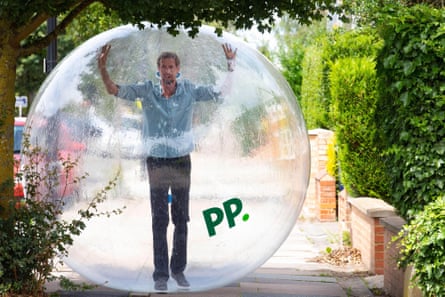
If you gamble enough Jermaine Jenas will play table football with you in a bucolic communal setting. If you gamble you will stop feeling lonely and scared. If you gamble a random bet-crazed woman on a sofa will hug an excited Peter Crouch, who is for tax purposes simply playing the role of “Excited Peter Crouch”, because of a sensational fizz-back stake-multiplier. Don’t you want that?
I’ve never gambled on sport. You can’t win. Even if you do, the bookies will ban you, to the extent successful pro gamblers now often resort to hustling the dealer, deliberately losing under an assumed name just to be allowed an account.
But last week I decided to try. I started a betting project to see if there is such a thing as workable gambling. In theory, there are events where you know what’s going to happen. The plan was to get from £10 to £1,000 as boringly as possible, to stride across this chaos like hippy Jesus walking through the counting houses, sandals barely touching the stones.
I spend my life staring at sport trying to half-guess and hedge to deadline. Surely with these skills, eschewing all risk, you can at least outstrip a 4% savings account? And yeah, people try to do this all the time. But they crack. They make the mistake of liking gambling. If you don’t actually “play” you can’t lose. If the fun never starts, the fun never stops.
This was conceived as a long-term project. In the event it seems to have lasted about five days. My first bet was on a horse race in Florida that happened to be live on a screen in a pub in Peckham, 10 quid on a strong second-favourite to place in the 3.30.
Uncle’s Gold won. There was brief, air-punching euphoria. Then … I felt nothing. I felt sad. Why hadn’t I put everything on this? Why am I stupidly passing up the chance of limitless wealth? My empty digital pounds meant nothing. All I could feel was my hypothetical losses. Already I hated my reproachfully puny stash, my empty high. Uncle’s Gold had seduced me but also betrayed me.
This is the main reason for hating gambling. It’s massively addictive. Of course it is. It’s a stimulating, highly available activity. And people like addictions because they’re nice and life is hard and because that thing you crave is being aggressively retailed in your direction.
Two years ago it was reported up to 1.4 million UK adults could have a gambling problem, with the attendant financial and social cost. The lancing of regulations ushered this in. Smartphones were the head shot, an opportunity to mainline moreish defeat straight into your eyeballs. I’m already addicted to at least three things that can eventually kill me. But not this, because I am going to beat gambling, beat the dealer with self-control and yes, salty hard-won wisdom.
My next bet was Manchester City to beat Liverpool with Rayan Cherki to assist, another bet where it’s just so obvious, why can’t everyone see it? It didn’t feel obvious when the game started and there was a dizzying realisation of endless possibilities, of the fact I don’t actually control the real world.
But Liverpool gave up. Cherki produced a lovely scoring pass. Next up was half the pot on Southampton to beat Arsenal in the FA Cup. This was placed with Southampton 1-0 up. And it was the system working. I knew Arsenal were going to lose because I stare at sport all the time and I can see when something is crap. I’m the crap whisperer.
They duly lost. And this was my high point. Ten pounds had become £120. Yes, somehow only that tiny amount after all this winning and omniscience. But still a vast return in five days! I’ve got the key. I’ve got the secret. I am invincible. I … cannot lose.
Except, it wasn’t enough. I still felt nothing. Little fizzles of excitement. But I needed more. I hated my incremental returns, I despised my caution. I just want to feel something. I want to know what love is. And because I am invincible I knew exactly what was going to happen in the Champions League this week.
This is where we get to hyperspace. A four-way bet on who makes the semis would take me to £500, just for knowing who is going to win, which I knew anyway. Look at the words, manifest the future. Real Madrid, Arsenal, Barcelona, Paris Saint-Germain. Simple, mathematically perfect, out there spinning in space. I am … the universe.

Plus, I had the inside knowledge that I am in fact secretly always wrong. Last week I wrote that Harry Kane might win the Ballon d’Or. So that’s going to be wrong for a start! Even your basic wrongness is telling you how right you really are. So bet on Real Madrid. Get what you deserve! I don’t just love this, I almost don’t love it because soon there will soon be no more worlds left to conquer.
And now. Well, it lies in ruins. Kane let me down by scoring a goal and reliably being the thing I said he was, an example of how betting is impossible because voodoo and the lust for narrative so easily intrude. Diego Simeone had never previously won a game at the Camp Nou. He has now! Halfway through step four the project is all but derailed. The world has revealed its true nature: harsh, untameable, whirling with variables. We can pray – and actually please could you just pray – that Barcelona and Real Madrid return to the path of righteous omnipotence in the second legs.
But there are already learnings from this journey. First, betting on sport is designed to disturb you. It’s addictive, and everyone has an addictive personality on some level, because addiction attaches to things you’re hard-wired to want.
Gambling will prod away at the desire to solve things. It snags at your addiction to thriving and surviving, the dopamine hit of victory. Batter people around the head with this, force it into their eyeline, and they will eventually bite, then find that the bites start to feel a little different.
Finally, it is worth remembering there is no such thing as money that “comes into the game”, only money that comes out of your pocket. When football says we need more, it’s simply telling you to spend more, twisting your arm with the latest triple-meth-boost accumulator deal over at DeathBet.com. And in the end the £4m shortfall on gambling sponsorships some Premier League clubs are so worried about is in fact the rarest of things, an act of sensible self-regulation.