2 months ago
75
2 months ago
75
it was the second Tuesday in November but Christmas was already in crisis. Sarah Gibbons had just received a shipment of baubles at her Glasgow homeware shop, Modern Love Store, and some crucial ornaments were missing. She hopped on a long-distance phone call to her suppliers in the US – she needed to sort this out. After all, her customers were clamouring for them. “People aren’t just buying one,” the 39-year-old shopkeeper told me after discovering the missing decorations, “they’re buying three or four at a time.” Three what? Turtle doves? Nutcrackers? Or perhaps some classic candy canes? Of course not. This year’s must-have bauble is in the shape of a lightly glittered syringe of Ozempic.
Growing up, my favourite Christmas ornament was a little pink plastic baby Jesus resting in a manger. He was bought by my great-aunt in Oberammergau, Germany, in 1990 – and although his battery hasn’t been changed since, you can still press his belly to hear Silent Night play. Today, decorations are a little different. Ozempic isn’t the only needle hanging from our needles: Britons can also purchase Christmas tree ornaments shaped like syringes of Botox and filler. Meanwhile, Selfridges is selling a dirty martini bauble, M&S is peddling a hanging prawn cocktail and Aldi is offering an ornament shaped like an air fryer. Move over, baby Jesus; glass has now been blown into the likeness of Harry Styles, Taylor Swift and The Bear’s Jeremy Allen White.
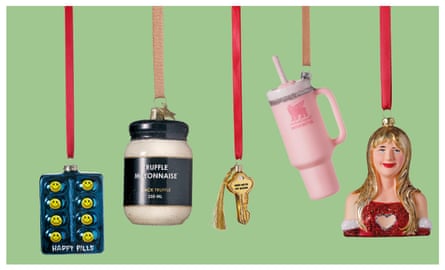
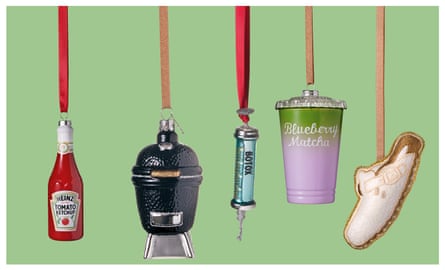
Goodbye, angels, shepherds and stars. When it comes to decorations, we’re really branching out. Should you want to – and people do – you can buy baubles shaped like coffee machines, puffer jackets, hair dryers, credit cards, oat milk, orange wine, “happy pills”, wrinkle cream, pasta, matcha, Doritos, sriracha, Perelló olives and a bottle of Heinz tomato ketchup. O Christmas tree, O Christmas tree, how lovely are your brand deals.
What’s going on? Is this a straightforward story of sacrilege, or is something else at play? It’s hard to deny tastes have shifted dramatically. A 1990 photograph of an in-store John Lewis Christmas tree features beads, bells, bows and carousels – the most unusual ornament is a masquerade mask. Today, the department store sells baubles shaped like sardines, snooker balls, espresso martinis, kitchen scales, hot dogs, caviar, and miniature Quality Street tins. “Boxed baubles have been in decline,” says Lisa Cherry, the enviably titled head of Christmas at John Lewis. “Over the last 10 years, our box bauble sales have declined by about 60%.” It seems that customers no longer want a generic set of matching balls, but, Cherry adds, sales have been made up in the rise of loose baubles. “People are just changing what they’re looking for on the tree.”
When Cherry and her team start to consider a new Christmas decoration collection, they don’t think about the festive season at all. Instead, they use sales data from across the department store – and its stablemate Waitrose – to track purchasing trends. They then try to reflect them in their ornaments, which is how you end up with a blueberry matcha bauble, as well as a pint of stout. “When you were young, who put chillies on their tree?” Cherry laughs. “But for the last few years, that has been one of our most popular food baubles.”
After chewing over the trends, the John Lewis team come up with a macro theme for their decorations – this year’s was “wisdom”, to reflect the fact that customers seem to be appreciating craftsmanship and nostalgia. This is why the department store is selling retro baking equipment baubles, as well as a miniature of the record player seen in its latest Christmas ad. Plus, for £8 you can also get a bauble shaped like a stack of books, with the titles on the spines reading “Happiness”, “Healthy Food,” “Mindfulness” and “Let’s Go to the Gym”.
At a time when eight in 10 Britons think Christmas is more secular than religious, perhaps this all makes sense – but, then again, why not stick to the cute little woodland animals that John Lewis also sells? Why do people want to bedeck their trees with crisps, pints and lattes? Is this a case of a selfish generation, obsessed with identity, forcefully trying to put the “I” in “tree”?
As always, it’s a little more complicated than that. Cherry says that quirky, themed ornaments reflect a huge rise in people gifting baubles. More and more, people are turning up at dinner parties with a thoughtful little trinket that says they know their host. This means that unusual ornaments sell best at the start of the season, and “as you get nearer to Christmas, you’re selling more traditional”. It also explains why Gibbons can sell four Ozempic ornaments at a time.
Another trend driving the bauble bonanza is the rise in two-tree households. In 2023, John Lewis’s festive traditions tracker report found that 27% of Britons had two Christmas trees. “It could be easily up to half of customers now,” Cherry says. She has also noticed a rise in people using ornaments elsewhere around the house – on wreaths, in garlands, up banisters and on walls.
And we simply love to spend. This year, sales in Selfridges’ Christmas Shop have risen 47%, with ornaments alone up 15%. The four most popular baubles the brand offers are ones emblazoned with its logo, but a Taylor Swift-inspired ornament comes in fifth place. In total, Selfridges is selling more than 1,200 different baubles this year – the Ozempic one was so popular it has already sold out.
Just how far have we strayed from tradition? The Illustrated London News printed a picture of Queen Victoria’s tree in 1848. Accompanying it was a description of its ornamentation: wax tapers and ribbons were overshadowed by real “fancy cakes”, gilt gingerbread, and little baskets and miniature boxes carrying sweetmeats. Foodie trees, then, are nothing new, even if things used to be a lot more edible. And if we look at Charles Dickens’s description of a Christmas tree from 1850, we find that our taste for novelty isn’t that new, either. “There were rosy-cheeked dolls, hiding behind the green leaves; and there were real watches … dangling from innumerable twigs,” Dickens wrote. Then there were the miniature items of furniture “perched among the boughs, as if in preparation for some fairy housekeeping” – plus guns, swords, drums, and even witches. “In short, as a pretty child before me delightedly whispered to another pretty child,” Dickens wrote. “There was everything, and more.”
Still, there’s no denying we often used to bake and make our own decorations, and by 1990, a writer in the BBC magazine the Listener was bemoaning that, “The postwar mentality of never throwing anything away has succumbed to the modern consumer’s need to be seen to be in tune with the style of the times.” Dickens might have appreciated a miniature fortune-telling witch, but it’s easy to imagine him balking at a weight-loss injecti-bauble.
Gibbons, though, is happy to sell the bejewelled jab. “They’re very zeitgeisty,” she says. “Some people will think they’re the tackiest, most disgusting things ever … but it’s just a bit of a joke.” She also sells ornaments shaped like cigarettes, iced coffee, spaghetti and mayo – not to mention a weed-smoking Jesus (“If my granny was still alive, she would be absolutely furious”).
How does Gibbons explain this niche level of decoration? “People want to collect ornaments that mean something to them. A plain red-and-white striped bauble might have no meaning to you.” She says, too, that customers “want to buy new stuff every year” and switch their trees up annually. It’s now a tradition in her own home that she, her husband and her children each buy a new bauble every Christmas – “and then I cheat and buy one on behalf of the cat”.
One of Gibbons’s suppliers is the US wholesaler Cody Foster, which has been creating novelty baubles for more than 25 years. Foster produced the Ozempic bauble, but the Dutch brand Vondels created the filler jab ornaments seen on British shelves. The company’s baubles are stocked in high-end stores such as Fortnum & Mason, Selfridges, Liberty and Harrods and also available in more than 50 countries worldwide.
“We constantly are absorbing what is hot and what is not, and what is happening around us,” says Loesje Donner-Raedts, who founded Vondels a decade ago. At the time, she was a buyer in a department store and was tired of the “traditional, predictable and uninspiring” baubles on offer. She wanted to create “ornaments that are connected to you instead of connected to everyone”. She believes that a Christmas tree should be “personal” and “tell a story about you or your friends”.
after newsletter promotion
Right now, Vondels offers baubles shaped like washing machines, golf carts and cans of Pringles. Throughout the year, the team look at concept stores, restaurants, cocktail menus and holiday destinations to figure out what’s trending. Other current Vondels ornaments include wrinkle remover, false lashes, truffle mayonnaise and a gold glass key emblazoned with the words “Meet me in my room”.
“Of course, we don’t want to offend anyone,” says Donner-Raedts. “We want to give this playful nod to modern beauty culture, but we don’t want it to be … how do you say? Like, the bad part of sassy?” As a result, Vondels avoids the overtly sexual and anything that might shock.
But there are also other limitations on what can be bauble-ified. Vondels has a collaboration with the Dutch children’s character Miffy and this year the company wanted an ornament of the rabbit riding a bike. “But for glass-blowing you cannot make it too thin, so actually it looked more like a motorcycle,” Donner-Raedts laughs. “We had to stop the process.”
How do licensed ornaments like these actually work behind the scenes? Look closely at some of the branded baubles on offer in various shops and you’ll see they’re not actually branded at all – they’re just cleverly coloured to imitate recognisable products. Celebrity baubles are also often unofficial, and thus tactfully titled – when it comes to Swift, they might be called “Taylor inspired” or “Miss Americana”. But sometimes an imitation bauble can lead to an official collaboration. In 2024, design brand Studio Thie created ornaments that looked like cans of Perelló olives – then founder Simon Thie contacted the brand and orchestrated an official partnership.
“You just start picking up on things that everyone has or is using,” Thie says, explaining that the brand capitalised on the “designer larder” trend, by creating a “Real Housewives of Clapton” set featuring clogs, greyhounds and bougie bottles of wine and crisps. At the other end of the spectrum, they’ve also collaborated with Heinz, which means they sell ketchup sachets, cans of beans and even salad cream bottles as ornaments.
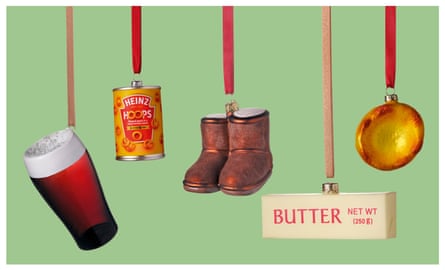
“Some people have ketchup on their Christmas lunch – my brother included,” Thie says. OK, sure, but was it difficult to get Heinz on board? “I think maybe they saw it more as a marketing idea – not that they’re going to sell or make loads of money from some Christmas decorations,” Thie explains. “I guess maybe, for them, it’s keeping that conversation going.”
A decade ago, Vondels shook up the bauble industry – but, nowadays, more and more stores are selling unusual novelty ornaments. It’s now a battle to stand out, and while Vondels might avoid sexing things up, other brands are happy to fill that particular hole in the market.
“I said we should call them Christmas dick-olations,” says Lucy St George, one of the founders of Rockett St George. The online homeware store sells ornaments shaped like bikinis and antidepressants, but St George is referring to the brand’s pink sex toy ornaments – complete with veins. “I thought we might have gone too far,” says co-founder Jane Rockett, but then the dick-olations promptly sold out.
Where could all of this possibly end up? (Apart from in a landfill, of course.) It’s hard to imagine what couldn’t be baubled next – I’ve just Googled the most ridiculous items I can think of but they already exist. Waitrose is selling a toilet paper bauble; Cody Foster has a tin-foiled baked potato complete with chives. Perhaps we will eventually tire of novelty or something will jolt us back towards tradition. Until then, why not hang a cheese toastie on your Christmas tree? It will look lovely next to the hot sauce.