3 months ago
90
3 months ago
90
Many Ukrainians are without heating in sub-zero temperatures as a result of relentless Russian strikes on energy infrastructure, while the country suffers through its coldest winter of the war so far.
Ukraine is especially vulnerable to such attacks, as Moscow can exploit a widespread Soviet-era heat system in which multiple apartment blocks rely on communal central heating.
Under this system, water is heated at a huge main power plant and then is pumped via pipes to residential blocks, where it is distributed into radiators and taps. That means that with a single strike on a heating plant, Moscow can wipe out heating for whole neighbourhoods.
Ukraine says that all such power stations have now been hit during the course of the full-scale war. These thermal power plants often also produce electricity, leaving people cold and in the dark.
Kyiv has been the main target of such attacks this year, with heavy bombardment of thermal power plants and sub-stations that pump the hot water.
People in the capital live in 20th-century Soviet Union apartment blocks that were mass-produced out of concrete panels and are called panelki. Cities across the former USSR are dotted with these multi-storey residential buildings, which were built during a postwar housing shortage in the 1950s and 1960s.
The heating system was considered efficient, and can serve tens of thousands of people across entire neighbourhoods.
But a centralised infrastructure is inherently vulnerable to attack. Russian bombardment this year has left about 3,500 apartment buildings in Kyiv without heating, according to mayor Vital Klitschko.
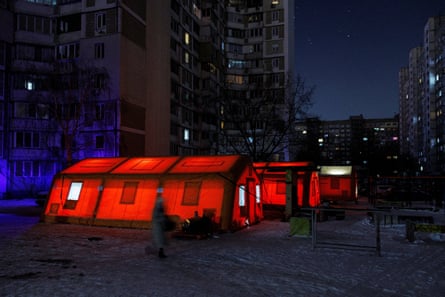
There are frequent capital-wide blackouts restricting electricity to three or four hours a day. Authorities in Kyiv have set up tents where local residents can go for warmth.
The intense bombardment has coincided with bitterly cold conditions. The lowest temperature recorded this year at a weather station in Kyiv was -20.7C on 2 February. Average daily temperatures have not risen above freezing this year.
Several people have frozen to death, and some residents have started to dig cesspits as the water system fails.
Other cities have also been badly hit. Nearly 300,000 people were left without power and water supply in the southern city of Odesa after a Russian attack, the deputy prime minister, Oleksiy Kuleba, said this week. More than 10,000 consumers were also left without heating in the south-eastern city of Dnipro.
The European Commission last month said it would deploy 447 emergency generators.
“The EU will not let Russia freeze Ukraine into submission and will continue helping Ukrainians get through this winter,” the commission has said.
Russian attacks have also disrupted electricity infrastructure, meaning backup generators or battery packs can fail, leaving people with very few options to keep warm.
The Facebook account of the Kyiv city state administration posted an image of candles held underneath bricks, which it said was used as a rudimentary but dangerous source of heat. It cautioned that the temperature would only rise by 1 or 2C.