3 months ago
122
3 months ago
122
Hello and welcome to The Long Wave. As the resident Arsenal fan, I’m stepping in for Nesrine the week after my club lifted the Premier League trophy for the first time since 2004, prompting celebrations on a scale we rarely see, at home and across the globe.
Arsenal have a storied history with Black players, and its fanbase reflects that. A cursory look at the joy on Bukayo Saka and Eberechi Eze’s faces at Selhurst Park and the ensuing melee of supporters on the streets of London right through to Kampala is strong proof of that. I look at why a north London club has the love and dedication of so many in the Black diaspora – a flame that has remained lit through the good, the bad and indifferent.
The perfect place
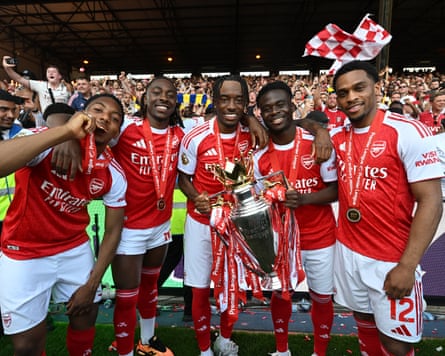
In many ways, Selhurst Park, the home ground of Crystal Palace, was the perfect setting for Arsenal’s Premier League trophy lift. It is where they signed Eberechi Eze and former player – now national treasure – Ian Wright, who was there to observe (and indulge in) the festivities. Only one Overground stop away from Brockley, where Wright grew up alongside the late great David Rocastle, a holder of the No 7 shirt that Bukayo Saka now wears with distinction.
When the pictures of Eze alongside Saka, Myles Lewis-Skelly, Noni Madueke and Jurrïen Timber – all descendants from west Africa and the Caribbean – surfaced cheesing in front of a raucous away support, it was a reminder of the club’s rich tapestry. That image, though, was only part of the story.
People in their thousands mixed outside Emirates Stadium after the league was confirmed, then the crowds returned a few days later – flares and fireworks in hand – in even greater numbers. This weekend’s parade in London, meanwhile, is expected to dwarf both of those celebrations, making it clear something out of the ordinary is taking place. And it hasn’t just been happening in north London.
Scenes unravelling across Africa tell their own stories. In Nairobi, a sea of red shirts rushed to the streets joyously; some people were seen jumping on cars in Addis Ababa; footage surfaced of people wearing traditional Arsenal-themed agbadas; some gave thanks in Nigerian churches, holding aloft replica trophies in jubilation.
It’s difficult to avoid Arsenal, and make no mistake, this newsletter has a strong Gunner contingent: Dipo and I, along with picture editor Joe Plimmer, are long-suffering fans. Even Nesrine, whose love for Arsenal is growing as we shower information on her, told me she has family flying into London for the long-awaited crowning glory.
None of this, though, is just a circumstance of winning. English football’s top prize has evaded Arsenal for more than two decades, yet the club have retained the loyal support of Black fans, from the regular to the iconic, among them director Spike Lee (who led celebrations in Brooklyn), actors Daniel Kaluuya and Idris Elba, rapper 21 Savage and crossbench peer Lady Lola Young. Their cultural currency remains at an all-time high, and the club has worked hard to earn it.
A cultural influence beyond the pitch
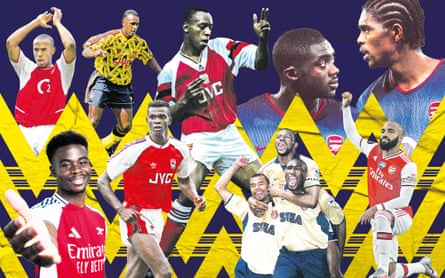
The roots of that understanding run deep. Clive Chijioke Nwonka, author and co-editor of the 2024 book Black Arsenal, argues that while every other club can point to Black players, none come close to Arsenal in terms of wider cultural impact and the impression made on their supporters.
The trailblazing of Paul Davis, an academy product in the 1980s at a time of political and social division, laid the groundwork for Rocastle and Michael Thomas, who were the talk of every Black barber shop after helping Arsenal win the league in the most dramatic fashion at Anfield in May 1989, coming into the game needing to win by two clear goals and securing it in the last minute. After that, Kevin Campbell came through the academy and showed his greatness, helping the Gunners to a title just two years later. Then there was the marketability of Wright, whose everyman energy was perhaps best encapsulated by him celebrating his goals, which were plentiful, with the Jamaican Bogle dance on TV screens across the country in the early 90s. The significance of that extended well beyond football. At a time when the relationship between Englishness and Blackness was being contested, with some clubs still being infiltrated by the far-right National Front, the experience of watching Arsenal – whether in historically diverse Islington or elsewhere – became a sanctified third space where Black cultural expression was safe.
An (almost) all-Black team
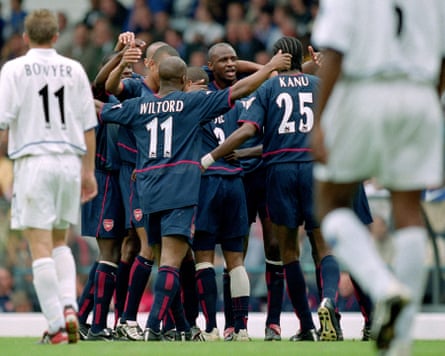
Arsène Wenger’s arrival as manager in 1996 took this further. Over his 22-year reign, his penchant for attractive, winning football, with Black players as protagonists, extended his influence beyond these isles and helped to shape a more cosmopolitan club – one of the first to advocate for the women’s game. Wenger’s knowledge of the African market and the trust he placed in players from the continent won over international fans. In September 2002, Arsenal named a lineup against Leeds United in which nine of the 11 starters were Black, the first time this had happened in an English top-flight match. Nigerian Nwankwo Kanu is widely credited as the reason for the club’s popularity in west Africa. Then there is his strike partner that September day: Thierry Henry, widely accepted as the greatest player in Premier League history, has gone a long way in attracting Black fans to the club over the past 25 years.
What Wenger built, the current generation inherits. It shouldn’t be forgotten that this is Arsenal’s first league title in the digital age, which amplifies what they are globally. While their visibility has stayed high, partly via the outrage and click economy, ultimate triumph after drought sells. Across Africa, where communal viewing is common and extreme football fandom can border on religion, the top European clubs command a loyal following. And even without a Kolo Touré, Kanu, Lauren or Patrick Vieira in the squad, love for Arsenal from the continent continues to burn.
Commercial savvy
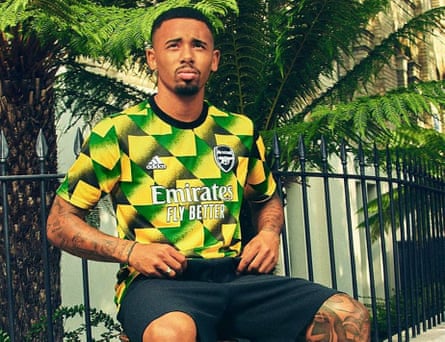
This is a savvy corporation operating at the top of the game. In their 2024-25 financial update, Arsenal had record revenues of roughly £770m, almost double their income from just a few years ago. That commercial firepower deliberately finds its way into the culture. Their partnership with Labrum London, the brainchild of creative director Foday Dumbuya, produced a pan-African away jersey in 2024 decorated with cowrie shells and the colours of red, black and green. In 2022, a Jamaica-themed jersey celebrating “those who call north London and Jamaica home” was released and became a hit at Notting Hill carnival. Music elevates the branding, too. The video announcing the £105m signing of Declan Rice drew on the virality of Nigerian rapper Odumodublvck’s song about the midfielder, while the jazz band Ezra Collective and drummer Femi Koleoso composed the soundtrack for Martín Zubimendi’s arrival last summer. The product of a club that understands its audience, and has done for a long time.
An organic love
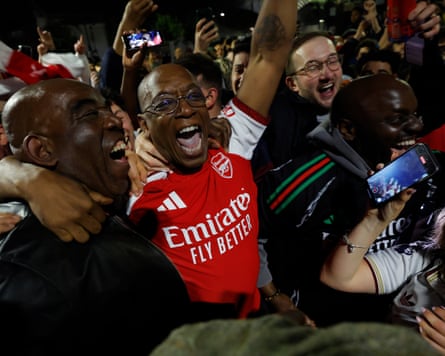
Underneath all of it, Arsenal’s position as a polished cultural centre is something special, but their responsibility to Black fans is not solely corporate. Many of those supporters go to Arsenal, rain or shine, because of the organic cultural memory embedded in their football-watching lives.
To date, Sol Campbell remains the only Arsenal player to score in a Champions League final. Eze, Saka and the rest have the chance to change that in Budapest, to add their own chapter to a history that Davis, Rocastle and Wright spent decades making possible, and, with it, usher in a tranche of new fans.