2 months ago
60
2 months ago
60
Hungarian public media outlets close to Viktor Orbán have suspended broadcasting, the country’s prime minister said as he hailed efforts to dismantle the longtime nationalist leader’s control over information.
Péter Magyar, who ousted Orbn in a landslide election victory in April, wrote on Facebook: “A historic day. Today marks the end of propaganda broadcasts on public media platforms. They lied at night, they lied during the day, they lied on every wavelength. That is now over.”
A tight grip on the media was a central pillar of Orbán’s 16-year rule, during which he transformed the central European country into a self-styled “illiberal” democracy, pitting it against EU norms.
The Kossuth radio station and M1, Hungary’s main public television channel, had halted transmission by Tuesday afternoon, with the latter showing the message: “Public media should not lie. We are sorry for doing it for so long.
“Public media now will be reformed so it will be independent and trustworthy. Our news programme is currently suspended. Stay tuned!” it added against a black screen.
Kossuth radio’s frequencies were broadcasting a Béla Bartók classical music programme, Agence France-Presse journalists reported, while the websites for M1 and Kossuth were both down.
According to a statement from Hungary’s state media umbrella group MTVA, M1 television will resume broadcasting in the evening without news programmes.
Other public service programmes will not be affected by the changes.
“Another example of Tisza tyranny!” Orbán posted on social media, suggesting that viewers “interested in the truth” should watch the Hír TV channel linked to his Fidesz party instead.
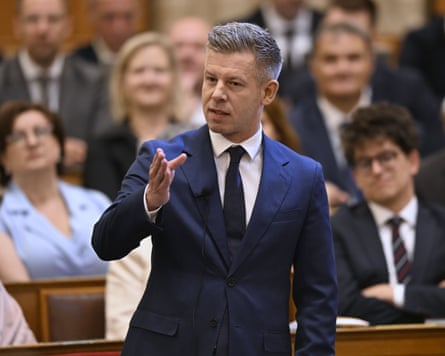
Magyar’s Tisza party swept the elections in April, winning a two-thirds supermajority in parliament on the promise of “regime change” and a clean break with the Orbán era.
Magyar said after the election that he wanted to create “a truly balanced, objective news service”. In one of his first decrees as prime minister, he ordered a “comprehensive and immediate” review of public service media and its financing.
Tuesday’s suspension of the broadcasters came shortly after Magyar’s government replaced the management of state TV and radio.
Besides public media, the new administration has also targeted private outlets owned by Orbán-allied business people. At TV2, one of Hungary’s top private broadcasters, the main news anchors have been replaced and its news director pushed out since Magyar’s election victory.
after newsletter promotion
On taking power in 2010, Orbán and Fidesz systematically turned state media into government mouthpieces, weaponising outlets to promote themselves and their allies while vilifying purported enemies including the philanthropist George Soros and the Ukrainian president, Volodymyr Zelenskyy.
Hungary fell to 74th place in 2026 from 23rd in 2010 in Reporters Without Borders’ press freedom index, as government efforts left swathes of the country in a parallel information reality.
During the election campaign, state media demonised Magyar as a puppet of Brussels, an absentee father and a traitor. As a candidate, he vowed to suspend state media coverage, describing it as a “factory of lies” whose coverage was akin to propaganda from North Korea and Nazi-era Germany.
Under Orbán, an estimated 80% of the media landscape was controlled by Fidesz loyalists, including state media and private outlets. They were set against embattled independent media, whose journalists nevertheless uncovered scandal after scandal.
Several of the Fidesz-linked private media companies are expected to survive the change of government, as they remain popular, analysts said. Their influence, however, may be hemmed in by more competition, while their editorial line may evolve with the change in government.
Agence France-Presse and Reuters contributed to this report