3 months ago
71
3 months ago
71
Mircea Lucescu is fighting for one last World Cup while at the same time battling his own body. He has lived through thousands of games as a player and manager but these could be the hardest of them all: two playoff games to take Romania to their first World Cup in 28 years.
Lucescu is 80 years old now and has not been well – but he has lost none of his energy, nor love for the game. Since December he has been admitted to hospital on three occasions but here he is, with an espresso in front of him, discussing his long career, the playoff semi‑final against Turkey on Thursday and Ukraine, a place he used to call home. He does not, however, want to disclose the exact nature of his illness for fear that it will become the focus over the next few weeks.
“When the doctors told me I could go on coaching, I focused on what I had to do for Romania,” he tells the Guardian in a rare interview. “I spoke to the federation and they told me they couldn’t find a solution to the situation. I’m not in my best shape so I would have stepped away if there was another option available. But I insist: I can’t leave like a coward. We must believe in our chance to qualify.”
Lucescu has lost weight but his face still lights up when talking about football. It has always been like that for him. Before an impressive managerial career, he was a player and captained Romania at the 1970 World Cup. The Tricolours faced Pelé’s Brazil, England – the defending champions – and Czechoslovakia. Romania left a strong impression on the football world. They beat Czechoslovakia 2-1 but lost narrowly against Brazil and England. Their football, under the guidance of the iconic manager Angelo Niculescu, has been recognised as an inspiration for Pep Guardiola and tiki-taka.
“We achieved some extraordinary results when we played our way of football,” Lucescu says. “We knew little about what was happening around us; we were coming from a closed, communist regime.
“We reached the World Cup in Mexico. Just 16 teams there. We tried to show our way of playing: we knew how to pass well and we used this to counter the force of our opponents. After 1970 things changed in the national team and we lost our identity.”
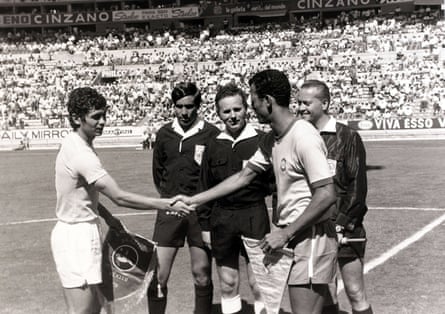
Just a decade after that tournament, however, Lucescu was given the chance to coach Romania for the first time. He was only 36 years old but the team reached Euro 1984 (only eight teams did) and was close to qualifying for the 1986 World Cup with him in charge.
“When I built the national team more than 40 years ago I wanted the young players to be hungry to play for Romania. I gave them chances at the senior level. I want players who are strongly motivated and who can control their emotions. I wanted to build self‑belief in their minds – that leads to performance. The 80s and the 90s were full of success. Even though the boys left Romania after the fall of communism to play abroad they always remembered the connection between themselves and the national team.”
In 1983 Lucescu gave a debut to an 18‑year‑old Gheorghe Hagi, arguably the best player in Romania’s history. He went on to play for Real Madrid and Barcelona and was later coached by Lucescu at Brescia and Galatasaray. Lucescu stayed as Romania coach until 1986 and built the foundations for the country to reach three consecutive World Cups in 1990, 1994 and 1998 as well as the European Championships of 1996 and 2000.
A successful career as a club coach followed with Lucescu taking charge of sides such as Inter, Galatasaray and Besiktas, Zenit St Petersburg, as well as Shakhtar Donetsk and Dynamo Kyiv. For a long time, he was the second most successful manager in the world, with more than 30 trophies won, behind only Sir Alex Ferguson before Guardiola overtook him.
His second stint as Romania manager began shortly after the 2024 European Championship. “I felt it was my duty to take charge of the team. It wasn’t just a major responsibility. It was my duty for everything that Romanian football has ever given to me. I was indebted. It was never about money, never about another medal. I have enough trophies. I hoped to help by changing the way Romanian football works at a mental level.”
While in hospital, he kept in close contact with his players and staff while also analysing Turkey games. “We will play in front of an impossible atmosphere. I know it to perfection: Besiktas’s home stadium. When I left the club I had two more years left of my contract but I left the money to the club with the firm commitment that they would use it to rebuild the stadium. It’s one of the best stadiums I’ve ever been to. When the other team has the ball they put the pressure on. And it’s an extraordinary pressure. I don’t know if there’s any remedy for the noise they will create. I will need to explain to my boys, to those who haven’t been to play in Turkey, what awaits them.”
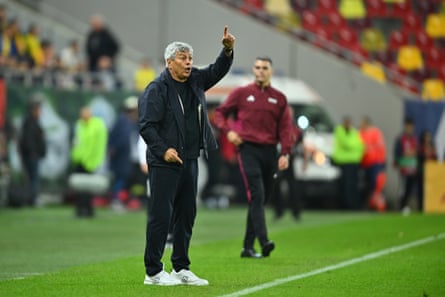
Lucescu knows what awaits him and the team in Turkey but other things have taken him by surprise. “I was very surprised to see how things had changed since I returned to coach Romania,” he says.
“It’s tougher and tougher these days to find praise, isn’t it? I mean I am half-joking but I guess I want those who are criticising us to put everything into context and to be objective, without hate. We see how fake news moves these days and how it influences the public. What was possible 40 years ago isn’t possible now, with everything that has happened with technology and the media. But you just can’t build if you’re surrounded by a negative environment all the time. It’s impossible.”
The buildup to the Turkey game has not been easy. Lucescu had been hit by withdrawals and now he has to do without the Celta Vigo goalkeeper Ionut Radu and the Pisa midfielder Marius Marin because of injuries. They would both have started. Lucescu is not one to feel sorry for himself, though. “I need players who come and put their entire soul on the pitch. And I don’t need those two hours or a day or two. I want national team players to be above everyone else. I often call the boys, and I tell them to try to do this and that. Because I don’t need them to run three kilometres during a training session. During a match, you need to run 11 kilometres! If they are not playing, I tell them to train more than everyone else. To go to a forest, to go to a park, to run and exercise. Everything starts in your brain. You make settings for success or failure in your brain.
“I speak a lot with them. They regularly ask me how I’m feeling. They thank me for sticking around. In tactical talks I need to be quick. [These days] players lose concentration during meetings after about 10 minutes. You need to be able to tell them what’s essential for them to know in those minutes when you have their full focus.”
Lucescu refuses to look ahead to a potential World Cup finals berth – they would have to overcome Slovakia or Kosovo in the playoff final if they beat Turkey – but he has been thinking about Ukraine, who are in a different playoff path. He left an unmatched legacy after 12 years at Shakhtar Donetsk and then spent another three with Dynamo Kyiv. Lucescu still thinks of the home he left behind in 2014. He was in Donetsk when the first shots were fired, 12 years ago, then in Kyiv when Russia invaded in February 2022. “I keep in touch with my former players and my friends in Ukraine. The situation there is horrible. I remember I left Donetsk in 2014 when the conflict started in Donbas. I left my apartment with everything inside and I never returned. I don’t know what happened to my home there. I have no information from anyone as we had to move the club from Donetsk.”
His mind returns to the here and now and a World Cup playoff that is just a few days away. “I am happy for the players. They made it to this level under highly difficult circumstances. They went to play for clubs all over the world, from China to the Gulf states, to the European lower leagues and the Romanian championship. They are trying to adapt and make a name for themselves. Like all the Romanians working outside our borders.
“I hope that my players treat this game as a moment to mark a before and after. It can define a generation. It would be an extraordinary achievement to reach the World Cup. Not for me, but for Romania.”