3 months ago
123
3 months ago
123
Beneath the cooling towers of Mazatlán’s power plant, in the Mexican state of Sinaloa, a dozen women pick through the marshland, looking for the upturned soil – and the scent – that betrays the location of a buried body.
They are part of Hearts United for One Cause, one of hundreds of collectives scattered across Mexico looking for the members’ missing relatives. But these searchers have been marked out by another layer of tragedy: one of them was murdered in February, and another disappeared in October.
That makes them the starkest example of a grim trend in Mexico, where the number of searchers who are themselves then murdered or disappeared has soared.
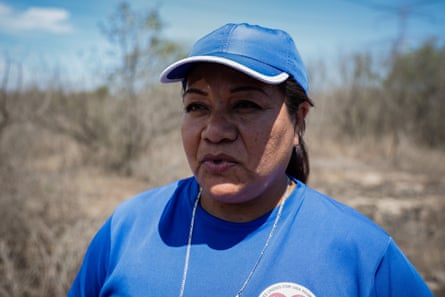
“We’ve suffered these two heavy blows,” said Noemí Padilla, the collective’s leader, who has herself been threatened with forced disappearance. “And I don’t know if they were meant as a kind of warning.”
The number of people registered as missing in Mexico has climbed relentlessly for the past two decades, surpassing 130,000, as warring organised crime groups began both recruiting by force and burying, burning, or even dissolving their victims with acid so as to conceal their crimes and sow terror.
Consecutive governments have failed to stop the disappearances. A UN committee recently said there were indications of state security forces themselves being involved in some cases, describing these as crimes against humanity, though the current government rejected its report as “biased”.
Now it seems organised crime groups are going a step further and eliminating the only people who truly look for the disappeared: their relatives.
According to Artículo 19, a human rights organisation, at least 44 people, mostly women, have been murdered or disappeared since 2010. But the rate has accelerated dramatically: 18 of those incidents took place under the previous president, Andrés Manuel López Obrador, from 2018 to 2024, while another 15 have happened in the 19 months since the current president, Claudia Sheinbaum, took power.
“2025 was the most deadly year yet, with seven murders and four disappearances,” said Jessica Alcázar from Artículo 19. “It’s a message of terror: ‘If you keep looking, we will kill or disappear you too.’”
Sinaloa is among the worst-hit states. So when Rubí Patricia Gómez missed a meeting at the end of February, the others in the collective were unnerved and went to her home.
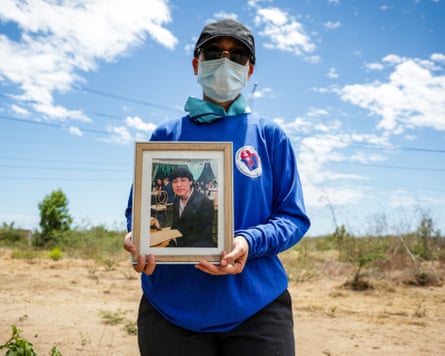
“I remember going up the stairs, calling her name,” said Laura Ivonne Valdés, a friend of hers from the collective who is looking for her uncle, Ricardo Ramírez Uribe. “The door was ajar. And that’s how I found her.”
Gómez had been stabbed 14 times. The authorities quickly arrested a man who allegedly knew her and had gone to her home to collect a debt, only to end up killing her.
But there are still many unanswered questions about what happened, said Valdés. Gómez had never mentioned any debts or threats.
This came just months after María de los Ángeles Valenzuela, one of the collective’s founders, was taken from her home and bundled into a car by two armed men.
“Now we’re looking for her too,” said Padilla, whose son, Juan Carlos Rivera Padilla, disappeared in 2019.
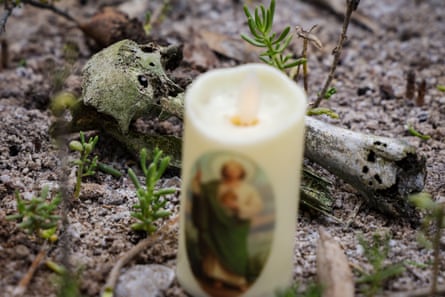
The marshland around the power plant, with its spongy soil, has yielded discoveries before. This time someone spotted an arm bone among the mangrove roots.
The women gathered around as Valdés began to swing a pickaxe in brutal arcs.
“Does the soil feel loose?” the women asked. “Does it smell?”
María de los Ángeles Bernal, who is looking for her son, Emanuel Garay Bernal, placed an electric candle with the face of San Judas, the patron saint of lost causes, on the ground by the bone.
Bernal is one of many mothers looking for sons who have disappeared since war broke out between factions of the Sinaloa cartel in September 2024.
“They started disappearing lots of young people then, and it hasn’t stopped,” said Bernal. “At first I refused to believe it, but maybe he was recruited by force.”
The war has left more than 6,000 dead or missing so far.
“We don’t know if our sons are alive, if they’re out there being made to work,” said Padilla. “Whenever we eat, we wonder if they’ve eaten. When it’s hot, we wonder if they have water. When it rains, we wonder if they have shelter.”
“Whenever I got out searching I feel like he could be here,” said Padilla, looking around. “But I can’t find him.”
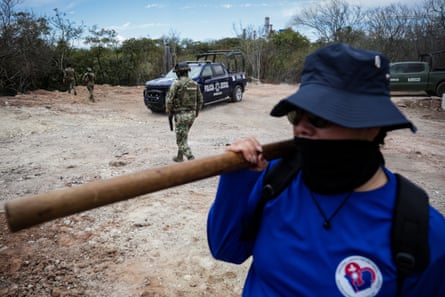
In the field, the searchers are often shadowed by an armed escort of police and soldiers. But it is when they break up and go home, often to the very neighbourhoods where their relatives disappeared, that they are most vulnerable.
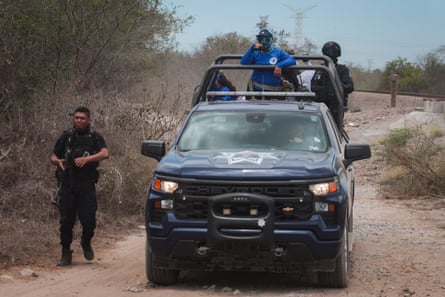
After the attacks on the collective, Padilla and Valdés, the most visible members, were given government protection. This meant cameras for their homes and cars, a telephone number for emergencies, and, for a month or two, occasional patrols visiting their homes.
But they both said it’s not enough: not for them, and certainly not for the rest of the collective. They at least want every member to be given a panic button to immediately alert authorities if they are in danger.
The other way to protect searchers would be to show that attacks on them are properly investigated and the perpetrators brought to justice.
“But, shamefully, most of the cases we have documented have gone unpunished,” said Alcázar. “There’s a lack of political will to really guarantee their protection or to even recognise what’s happening to them.”
The federal institution responsible for protecting human rights defenders did not respond to a request for an interview.
Before long, Valdés and the others had dug half a metre deep. They found nothing but earth, roots, rocks. Bernal picked up the candle and flicked the light off. The power lines overhead fizzed with electricity.
“Of course we’re afraid. With things how they are in Sinaloa, you can’t trust anyone,” said Bernal. “But if we don’t look for them, who will?”