3 months ago
92
3 months ago
92
While the Italian word polpette is generally translated as “meatballs”, it actually has a much broader definition than that. In fact, the literal translation is “little balls of polpa”, or pulp. And, yes, the word polpa is strongly associated with minced meat, so, for many people, the word polpette conjures up round or torpedo-shaped morsels of minced and seasoned meat fried or simmered in sauce. But polpa can also refer to an infinite range of pulps and mixtures of pulps made from vegetables, pulses, fruit, bread, cheese or fish, all of which can be shaped into balls, wonderful balls.
Whatever the pulp base, one thing is generally agreed on: once formed, let those balls rest for at least 30 minutes (and up to a few hours), so they firm up and are therefore easier to poach, simmer, fry, air-fry and so on. Beyond resting, however, freedom reigns: the type of pulp, the inclusion of bread, or eggs, or herbs, or seasonings …
Everybody knows how to make balls their way, and our experience, preferences and secrets are kneaded into the mixture, which is then rolled between our palms. Matters of size. Whether you flatten them into UFOs or lengthen them into submarines. To fry or not to fry? And do you serve them with sauce, or not? Some people feel strongly about meatballs, while others just shrug and tell you that the ones they ate when they were growing up are second to none, which is surely just another way of saying there is no taste like home.
My own recipes are partly inherited, partly practised. Lately, we have been making polpette from ricotta, parmesan, eggs and breadcrumbs, delicate balls that are the same shade as Dulux pure white matt emulsion and that turn red in their rich tomato, basil and chilli sauce. I have also made Tom Hunt’s polpette di pane, AKA bread balls, which have much in common with those ricotta balls, albeit focusing on bread and also suitable for vegans so long as the eggs (which are essential for binding) are substituted with aquafaba (chickpea or bean water saved from a can) and the cheese is vegan-friendly. Tom also suggests poaching his bread balls in tomato sauce, and serving them with white beans and greens, for a substantial and lovely meal.
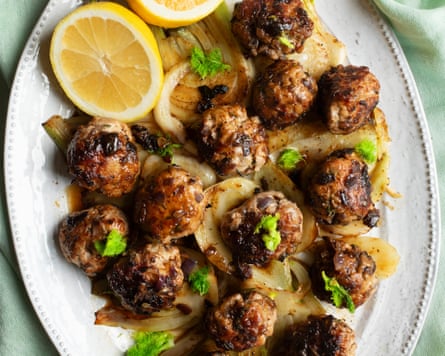
When it comes to vegetable polpette, mashed aubergine provides silky substance that is plumped out with a little bread, seasoned and bound with egg. Inspired by a trattoria in Rome called Cesare al Casaletto, those aubergine balls can then be coated in breadcrumbs and deep-fried to a crisp finish (and dipped in seasoned yoghurt, perhaps), or simply poached. Mushrooms lend themselves well to being squashed into balls, as shown by Yotam Ottolenghi, who mixes chestnut mushrooms with rice and herbs for his “not meatballs”, which he serves with spaghetti. Meera Sodha suggests tofu balls spiked with sambal oelek (an Indonesian sauce made with chillies and shallots) and poached in a lemongrass curry sauce.
Which brings us to meatballs proper, about which Felicity Cloake has good advice and strong opinions, as do I, not least when it comes to these Roman-style polpette that are best poached directly in tomato sauce with no initial fry. Tamal Ray chooses pork as his pulp, and pairs it with tarragon and lemony leeks, while Nigel Slater suggests pork meatballs with fennel and juniper, and I enjoy a pork, lemon and fennel mix that, once shaped, can be poached or deep-fried. Chicken, too, makes a good pulp, producing pale and tender balls, especially when paired with ricotta and lemon, which bring lightness. As does lamb – Thomasina Miers gives us a recipe for Greek-style meatballs in a rich tomato sauce and strewn with melted feta, while José Pizarro suggests lamb albondigas simmered in a tomato sauce enlivened with a big splash of sherry; Yotam, on the other hand, pairs cinnamon and allspice-spiked lamb meatballs with fregola (a Sardinian semolina pasta that resembles giant couscous) and feta for a one-pot supper. Felicity, of course, has advice on how to make the perfect lamb köfte, with chargrilled cigars of lightly spiced meat that are served up with warm flatbreads, a crunchy salad and a tangy yoghurt sauce.
And, not forgetting fish, here’s my recipe for Italian fish polpette, which is inspired by those at La Torricella in Rome and for which any tender white fish will do: it’s mashed with bread, herbs and a little cheese, then simmered in either tomato sauce or, even better, a white wine one, which thickens thanks to the bread.
My week in food
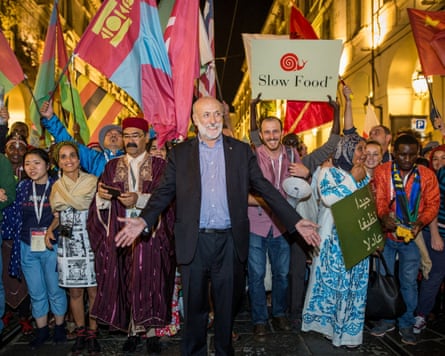
A slow food maverick | The great Carlo Petrini, who died last week aged 76, founded the Slow Food movement, the international campaign that reshaped the way we speak about food, agriculture, biodiversity and the politics of eating. He was also a moral presence in everyday culture, a defender of memory and locality, who said that food was never just food. And he was a passionate, funny speaker, always in Italian and always comprehensible.
Dinner lady | Eleanor Steafel’s new book, But First, Dinner, landed on my desk or, rather, my bed when I was lying low for a few days last week. I read it from cover to cover, and fell for her warm, intelligent ability to put into words the internal dialogue so many of us have about what we do (and don’t) want to eat. Her recipe suggestions are so perfect that I felt as if she was reading my mind. In keeping with the theme of today’s newsletter, for example, there’s a fab one for chubby ricotta and basil dumplings.
Stay sharp | As much as I admire beautiful knives, and hope one day to handle them with a degree of skill, for now, I am happiest with my red Victorinox V6.7831, a serrated, 11cm, stainless-steel everyday Swiss knife (also available with a yellow, blue, green, purple, orange or black handle) with which I can do just about everything. Even if you are skilled with a knife, these small ones are unbeatable when it comes to slicing tomatoes.