2 months ago
75
2 months ago
75
Iranian officials expressed initial disapproval of a US ceasefire plan on Wednesday, even as intermediaries suggested direct talks between the two could start as early as this weekend.
Representatives from Pakistan who reportedly delivered the US plan to Iran told the Associated Press that it was a 15-point proposal that would include sanctions relief for Iran, dismantling Iran’s nuclear programme, restricting its use of missiles and reopening the strait of Hormuz, a chokepoint for about 20% of the world’s oil.
An Egyptian official also suggested it would restrict Iran’s support for armed groups across the Middle East. Some of these proposals proved to be intractable sticking points in negotiations before the war began.
A senior Iranian official speaking to Al Jazeera described it as “extremely maximalist and unreasonable”, while other officials said the country was still reviewing the proposal, despite viewing it as too favourable to US demands.
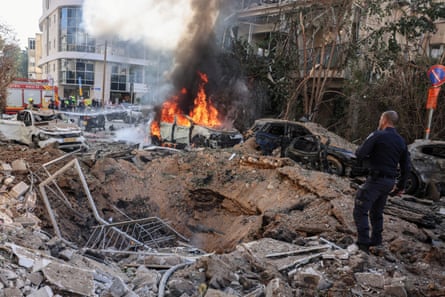
Iran had previously scoffed at the diplomatic effort and mocked the US president, Donald Trump, claiming Washington was negotiating with itself. Overnight and on Wednesday, Tehran launched even more attacks on Israel and Gulf countries, including an attack that sparked a huge fire at Kuwait international airport, while Israel continued its bombardment of Iran.
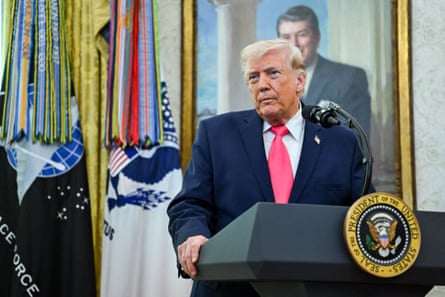
“Our first and last words have been the same from day one, and it will stay that way: someone like us will never come to terms with someone like you,” said Lt Col Ebrahim Zolfaghari, an Iranian military spokesperson.
Many parts of the 15-point-plan were not new and were the subject of negotiations prior to the US-Israel war with Iran. Iran had previously refused to compromise on its ballistic missile programme or regional proxy network, which it sees as key to its self-defence in front of the militarily superior US and Israel.
Egyptian and Pakistani officials suggested that in-person negotiations between the US and Iran could begin as quickly as Friday in Pakistan while other sources suggested Turkey as a venue for talks. Trump said that the US was currently in negotiations with a party in the Iranian government who is engaging with his son-in-law, Jared Kushner, the US special envoy, Steve Witkoff, the US secretary of state, Marco Rubio, and the US vice-president, JD Vance. It was reported that Kushner and Witkoff had suggested a one-month ceasefire during negotiations.
It was unclear who exactly the US negotiating team was in contact with, as officials from Iran’s foreign ministry and military denied Trump’s statements that negotiations were taking place.
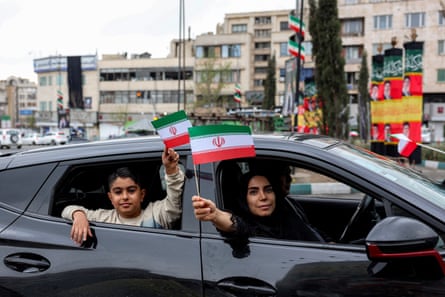
Iranian officials are skeptical of coming back to the negotiation table with the US, after the country was attacked twice before while in the middle of discussions. The US attacked Iran’s nuclear facilities during the 12-day war between Iran and Israel last summer and launched its latest conflict while progress was reportedly being made towards a comprehensive deal between the two parties.
Israel and the US have also killed much of Iran’s senior leadership, including more pragmatic figures such as the secretary of the supreme national security council, Ali Larijani, creating concerns for the safety of its Iranian interlocutors, some of whom Israel has threatened to kill.
“We have a very catastrophic experience with US diplomacy,” the Iranian foreign ministry spokesperson, Esmail Baghaei, told India Today on Tuesday.
Pressure has been growing domestically for Trump to find an end to the war in Iran, as Iranian attacks on Gulf energy infrastructure and the virtual blockade of the strait of Hormuz has sent prices soaring across much of the world. Oil prices fell after news of the 15-point-plan broke on Wednesday, as investors hoped for an end to the greatest energy crisis in decades.
About 59% of Americans say that the US war in Iran has “gone too far”, according to a new poll. Trump’s approval rating has dropped to an all-time low of 36% owing to the increase in fuel prices and the war in Iran, according to a poll by Reuters.
Israel, by contrast, has sought to keep fighting as it tries to degrade the Iranian regime further. Israeli officials were reportedly surprised by the US ceasefire plan.
As diplomacy sputtered forward, the US continued to amass troops in the Middle East. At least 1,000 troops from the 82nd airborne division will be sent to the region, according to the Associated Press, as well as 5,000 more marines and thousands of sailors.
The deployment of the additional troops comes as the Trump administration is weighing plans to invade Iran’s Kharg Island to pressure it to reopen the strait of Hormuz. The island holds 90% of Iran’s crude oil exports. The 82nd airborne division is specialised in flying into contested areas and securing them.
Israel continued to strike Iran on Wednesday, announcing the completion of several waves of airstrikes in Tehran, as well as the targeting of a submarine development centre in Isfahan. Iran responded in kind with ballistic missile launches targeting Israel, with missile sirens activating multiple times on Wednesday. It also targeted Arab Gulf states and Saudi Arabia said it destroyed at least eight drones in the eastern part of the country where oil infrastructure is located.
Israel continued to pound Hezbollah targets across Lebanon, as well as engaging in ground fighting with the group south of the Litani River. The Israeli army had been slowly advancing northwards despite fierce resistance, with soldiers posting videos in the previously contested towns of Taybeh and Khiam.
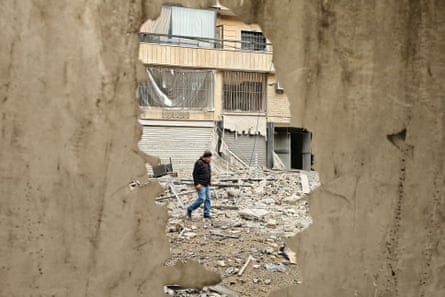
Israel also continued to target civilian infrastructure such as bridges and gas stations, as well as killing two medical workers in the city of Nabatieh, south Lebanon on Tuesday. Human rights groups warned that Israel’s striking of civilian targets, even if some had an affiliation with Hezbollah, could constitute war crimes.
Hezbollah continued to fire rockets and drones into northern Israel throughout the day. A woman was killed in northern Israel by Hezbollah fire on Tuesday night, an attack that injured two others as well. The woman was the first person killed by Hezbollah in Israel since the group launched rockets at Israel on 2 March, triggering an Israeli military campaign.
So far Israeli strikes have killed 1,094 people and wounded 3,119 in Lebanon, according to the Lebanese health ministry. The Iranian health ministry reports that at least 1,500 people have been killed in Iran. According to Israel, 20 people have died in the war, including two soldiers in Lebanon. At least 13 US military personnel have been killed, as well as more than a dozen people across the occupied West Bank and Gulf states.