2 months ago
81
2 months ago
81
ƒ
A string of large offshore wind projects in Europe are facing potential delays as the Iran war threatens to disrupt shipping of crucial parts manufactured in the Gulf.
Industry sources are concerned that components ordered from suppliers in the United Arab Emirates could become trapped if shipping remains effectively blocked through the strait of Hormuz.
Iran’s chokehold on the crucial trade route has upended oil and gas deliveries from the Middle East. Sources fear contingency plans may have to be put into action to avoid delays to clean energy projects too.
These include two giant offshore windfarms planned for UK waters, as well as a series of projects that will supply offshore wind power to Germany and the Netherlands.
The UK windfarms, which will lie off the coast of Norfolk, were each awarded a 20-year support contract from the British government just a month before Iran effectively closed the strait of Hormuz.
The developer behind the plans, the German energy giant RWE, has contracted a Dubai-based company to deliver more than 180 components from its UAE fabrication yard while the windfarms are constructed.
The windfarms are expected to supply the equivalent of about 4m UK homes before the end of the decade, meaning they would play an important part in supporting the Britain’s aim to quadruple offshore wind capacity by 2030.
A spokesperson for RWE said it had begun liaising closely with its supply chain partners amid the Middle East conflict, which has included airstrikes against key infrastructure.
“Our primary focus is the safety of those working in the area,” they said. “To date there has only been a limited effect on our supply chain partners’ activities, but we are monitoring the situation closely and putting mitigation plans in place should the situation continue for a prolonged period.”
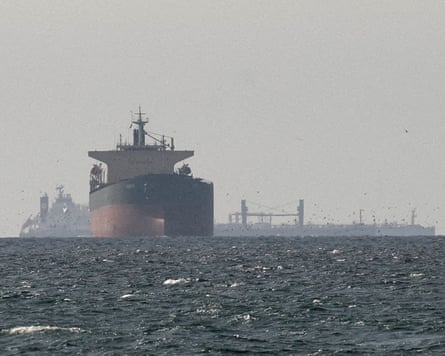
Gulf fabrication yards play only a small role in the global renewable energy supply chain, which is well established in Europe and Asia. The Gulf was expected to emerge as a hub for international renewable energy supply chains within the next 25 years, according to the Middle East Institute, a Washington DC-based thinktank.
RenewableUK, a sector trade body, said: “We’re aware that the conflict in the Middle East could have an impact on several supply chain contracts that UK offshore windfarm developers have with companies based in the United Arab Emirates.
“These include large steel fabrication work on key components such as turbine foundations and offshore substations. As with many other sectors, the implications of the disruption in the strait of Hormuz on global supply chains does somewhat depend on whether it remains closed for an extended period of time.”
The shutdown of the strait may also have an impact on a large project by the transmission operator TenneT that will link offshore wind projects in the German North Sea to mainland Germany.
The company has contracted a UAE fabrication yard to deliver structural steel components, including a 5,461-tonne jacket foundation built for the BorWin6 high-voltage transmission project. The section was successfully shipped from the UAE yard just three weeks before the strait was shut.
Another three offshore grid projects – LanWin2, BalWin3 and LanWin4 – have contracts with suppliers in the UAE.
A TenneT spokesperson said the company’s supply chain was “geographically diversified” and only parts for the LanWin2 project were already being made in the UAE. They declined to comment on the construction and delivery schedule of components for the company’s other projects.
The threat to supply chains is likely to reignite calls for the industry to prioritise local manufacturing of the key components needed to meet renewable energy targets.
Ajai Ahluwalia, the head of supply chains at RenewableUK, said: “We’re working hard with the government to maximise the growth of the offshore wind supply chain here in the UK, with initiatives such as the clean industry bonus which incentivises the domestic production of components.”