3 months ago
75
3 months ago
75
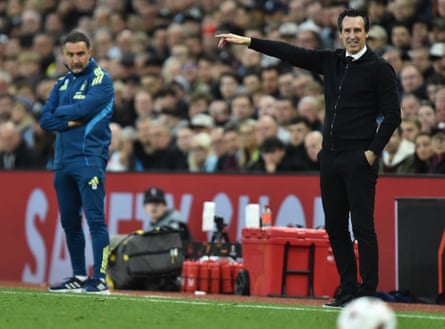
There will be no doubting Unai Emery’s supremacy in the Europa League if he is reacquainted with the trophy in Istanbul this month. A fifth title would add to the Aston Villa manager’s legend and it would show he can do it with an English club. The latter achievement, though, may be diminished in value. A greater concern lies in the way that Premier League clubs, gradually but discernibly, are dominating Europe’s smaller competitions in a way Uefa surely could never have intended.
Villa will be the eighth English finalists from the last 22 teams to reach the Europa League’s showpiece. Should they win, it would be the first time since the first two years of the Uefa Cup, its predecessor with the same trophy, that sides from England have won the secondary tournament in consecutive seasons. They would build on Tottenham’s haphazard triumph of last May and while neither consistency nor relative excellence should be sniffed at their progress contributes to a concerning broader trend.
In south-east London on Thursday night, a jubilant Dean Henderson said Crystal Palace “need to get back what we deserve”. It was a reminder they felt affronted to be in the Conference League after losing their appeal against demotion from the Europa League. Nonetheless, after lurching through the early stages with the cavalry sometimes held back, once the business end arose Palace were simply too good. Fiorentina and Shakhtar Donetsk, clubs with rich European pedigree, battled gamely, but neither came especially close to holding them off.
If Palace win one more test of strength against Rayo Vallecano, whose identity as their opposition at least makes the final a clash of traditional big-city upstarts, they will be the third English winners of the Conference League in four years. Two things can be true: it is a fairytale achievement, in their own context, for Palace to reach this level of a continental event for the first time; it is also the case that, even when stumbling over their own shoelaces, Premier League teams are achieving exactly what their colossal financial advantage has long threatened.
That was not the aim of the Conference League, which was created to offer sides outside the modern-day elite a realistic shot at Europe in an age when the Champions League is – with honourable but sparse exceptions – a gated community. It has certainly given plenty more of them a chance to play, even if there is an argument it also has the effect of keeping them at arm’s length. Listening to executives at certain well-known clubs, among them domestic champions, describing regular Conference League football as the realistic height of their ambitions sticks in the craw.
Olympiakos’s victory felt closer to an intended consequence, but even that has the feel of an anomaly two years on. Palace will fancy their chances this time and a glance at their off-pitch firepower suggests they should: last year’s £200m revenue made them the 26th-richest team in Europe, according to Deloitte’s money league. It is almost four times that of Rayo, mid-table in a La Liga whose rump has been left far behind by Premier League clout.
One hundred and fifty-two games – 188 in the Europa League – and then the English win? The risk is it will soon feel like that. The Europa League has been democratised and weakened since Uefa removed the safety net for some Champions League dropouts to enter its knockouts. That is far better for the competition’s integrity, but has cast the power of its Premier League representatives into stark relief.
It is one thing when, as in 2022-23, Juventus, Sevilla, Roma and Bayer Leverkusen are around to plunder the semi-final spots. This time Villa and Nottingham Forest, neither hitting top gear, cruised through a weak field to face each other in the last four. Freiburg, whose £140m revenue is cast into the shadow by Villa’s £378m haul, would hardly have a prayer in the final if money did all the talking.
Defenders of the status quo point out that cash does not always scream loudest. Even if Arsenal win the Champions League, perhaps creating a first English clean sweep, only two of the Premier League’s preposterous six representatives reached the last eight of that competition. Maybe the margins simply tighten at the top; perhaps, in a suggestion that itself bodes ill, the Premier League is underperforming.
Proposed financial redistribution models for Uefa’s club competitions, including innovative suggestions from the Union of European Clubs, tend to draw short shrift from those running the sport. In any case it is hard, given the bleak outlook for domestic television rights revenues for much of Europe, to see how the Premier League does not continue to pull away. If English clubs continue to trample to the finish line then, for as long as no solutions are found, their victories may be accompanied by an increasingly bitter taste.