3 months ago
84
3 months ago
84
Music’s equivalent of catching a home run at a baseball game happened on Saturday in Sydney, when a 21-year-old university student jumped in to save a performance of the movie La La Land with live orchestra. The band’s keyboardist had fallen ill and couldn’t perform in the second half. Unable to find a replacement at such short notice, the conductor Justin Hurwitz (winner of two Oscars for the film’s music) asked the audience if there was a pianist in the house. Sterling Nasa answered the call, and performed in the second half, improvising a solo, and not getting a tempo change or key signature wrong.

It’s a great story – and incredible that an audience member had the requisite sight-reading and technical skills to carry it off. Could it happen in a classical concert? There have certainly been moments here too when an audience member has saved the day. The best of those stories comes from the summer of 1974, when the London Symphony Orchestra and Chorus brought Carl Orff’s Carmina Burana to the Proms, conducted by André Previn, with the baritone Thomas Allen among the soloists. You can actually hear the shocking moment from the live radio broadcast when Allen collapses into the cello section in an episode of the BBC World Service’s Witness History. He had fainted and was carried off the stage. After a brief pause, Previn chose to keep going rather than stop the performance.
Enter the prommer and recent music graduate Patrick McCarthy, who was in the Royal Albert Hall watching the concert and following it with his score. He had sung the part as a student, and went backstage to offer his services. In an amazing piece of quick-fire BBC decision-making, they said yes (Allen’s understudy, one of the LSO Chorus, turned out to be the very doctor who was attending to the singer). McCarthy was given a hastily located dinner jacket, went on stage, and gave the performance of his life. None of the listeners on Radio 3 were told – although his mother, listening at home, recognised his voice immediately.
By the time of the TV broadcast a couple of days later, McCarthy’s musical heroism was a national story. These days, he’d be a social media sensation. Back then, he had his 15 minutes of fame – it was “a dream-like experience”, he said – but the Prom gave him the confidence that singing would be his life, which it has been ever since, singing baritone and tenor, and conducting choirs and orchestras.
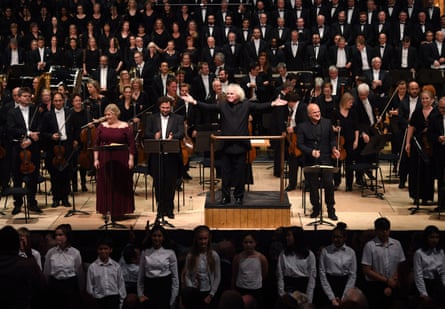
Moments like these are made when classical and large-scale concerts are in jeopardy, and the wall between us in the audience and the performers on stage is broken. Nasa and McCarthy saving the day might make the headlines, but what’s really remarkable is that stories like these don’t happen more often.
It’s only when things go wrong that we’re reminded of the superhuman achievement it takes to put on a classical concert of any kind: when a string breaks (like Ray Chen’s while playing Korngold’s Violin Concerto); an oboe reed cracks (here’s the LSO’s Olivier Stankiewicz during a Berlioz solo); or most dramatically of all, when a soloist starts to play a different concerto than the one the orchestra starts to play. That’s what happened to the pianist Maria João Pires with the Royal Concertgebouw Orchestra and conductor Riccardo Chailly: a nightmare that came true – she had prepared for the wrong concerto – became a miracle when she then played Mozart’s Piano Concerto No 20 in D minor from memory flawlessly.
So next time you’re in a hall with live musicians playing for you, remember that every serene moment they give us comes from a never-ending battle with risk: the certain knowledge that things can go wrong at any point; that everything is at stake in a musical high-wire act. Don’t take it for granted. It’s our energy in the audience that helps carry them through – and if it doesn’t, start practising that baritone or piano solo now. You never know when your big chance might come – just ask Patrick McCarthy and Sterling Nasa.
The world premiere of John Tavener’s Krishna at Grange Park will finally let audiences hear what the composer called “the most ecstatic piece of music I have ever written”. He completed this “mystic pantomime” in 2005, eight years before his death, but it’s had to wait until now for its first staging, directed by Sir David Pountney with choreography by Shobana Jeyasingh. Krishna belongs in the category of so many Tavener pieces that attempt cross-cultural fusions of spirituality, story and meditation, from The Beautiful Names to the eight-hour The Veil of the Temple. The grandeur of Tavener’s project was magnificently ambitious for some; for others, epically naive.
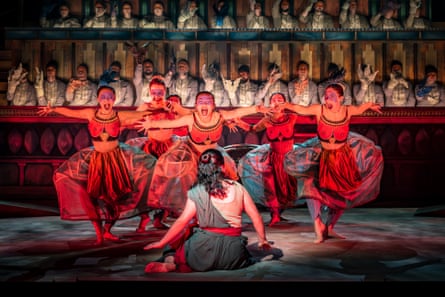
But there’s much more to Tavener’s music than meditation and serenity. Listen to The Death of Ivan Ilyich, composed for the cellist Steven Isserlis. This piece, written after Tavener’s recovery from a heart attack, is dedicated to Isserlis’s wife Pauline, who died in 2010. (Isserlis writes movingly about the intertwining biographical and musical stories that led to the composition: “John struggled with extreme pain in his last years – he described it (typically) as ‘a sort of ecstasy’.”) Setting Tolstoy’s story about a judge suffering from a terminal illness, Tavener’s music is unflinchingly honest in the soundworld it makes: the solo cello violently scrubbing and scratching as the voice declaims and screams; brass and percussion announcing stations of agony and transcendence; and pools of hymn-like calm that sound increasingly fragile as the piece continues. It ends in uneasydissonance, with a final point of quiet light as the cellist finds a note so high in its register that it sounds unearthly, unreal.
This week Tom has been listening to: Katia and Marielle Labeque’s 55: an anthology (out next Friday) of tracks that’s all about the sister-pianists’ endless curiosity, with music by Fanny Mendelssohn, Margaret Bonds and Marie Jaëll for the first time in their 55-year career, alongside pieces they’ve inspired and commissioned by David Chalmin, Bryce Dessner and Philip Glass – and there’s a breathtaking new version of the final movement of Ravel’s Mother Goose Suite too.