2 months ago
41
2 months ago
41
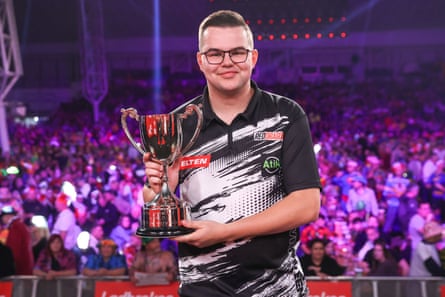
It’s the deciding leg of the European Championship final. Gian van Veen, the 23-year-old from the Netherlands chasing his first major title, has just missed two match darts to win 11-9. Luke Humphries, world No 1 at the time, starts the final leg with a 140.
“Oh, you’ve blown it here,” Van Veen replies when asked to describe his internal monologue during that moment in October. “Luke Humphries is not going to crumble under this pressure. Maybe it was a negative thought. But it also released some pressure for me, in a way.”
Feeling a strange kind of relaxation, Van Veen stepped up and pinned a maximum. A couple of minutes later, with Humphries having missed a match dart of his own, Van Veen took out 100 to win the biggest prize of his career: a moment of high emotion for a sensitive young dartist who had finally managed to block out the noise and make good on his abundant talent.
“I still remember when I hit that double 16, I walked off the stage to my girlfriend, and I fell into her arms,” he recalls. “And I said: ‘That’s what we’ve been dreaming of for all these years. This is why I started playing darts. For moments like this.’”
For all Van Veen’s talent, his journey to the top table has been anything but smooth. He begins this year’s world championship as one of the rising forces in the sport, the third favourite with some bookmakers. But as he learned during his degree in aviation engineering, the fastest route between two points is rarely a straight line. In his own case, the road to Alexandra Palace has been paved with doubt, derision and a crushing case of dartitis that almost forced him out of the game altogether.
“I’ve learned a whole lot about myself,” he says. “You learn what a mentally tough sport it is. If you keep losing, you doubt everything. How you hold the dart, the weight and point of the dart, and if that gets in your head, it’s a snowball effect. You don’t know how to grip the dart any more.”
Van Veen was a teenager when the dreaded yips first struck. Aged 13, he had been one of the top youth prospects in the country. But by 16, the wins had dried up. His throw would collapse under pressure and in the big moments doubts began to feed and fester.
“I was just afraid of losing,” he says. “Afraid of what people might think of me. What if I lose this game? What are my parents going to think of me? And that’s when it started. Dartitis, with me, was just being afraid to fail. And that was because I wasn’t confident in myself, not in darts, not in my personal life.”
Dartitis ends careers. Eric Bristow suffered from it towards the end of his; the Premier League champion Glen Durrant was crippled by it; Van Veen’s friend, the former PDC tour card holder Jules van Dongen, struggled so badly that he is now training himself to throw left‑handed. “That’s what top sport does to a person,” Van Veen says, with a grim expression. “It can be brutal.”
Perhaps it did not help that Van Veen was a natural thinker in a sport not overly prone to self-analysis. He was a smart kid; smart enough to go to university and study aviation, then work for a year at a logistics company selling freight space on cargo planes. Even now, he is one of the very few players on tour with a degree. “I stand out a bit in that regard,” he says with a smile.
What helped Van Veen out of his slump was a simple realisation: that he was playing darts for himself, not for money, not for attention, not for external judgment. “You don’t need to perform for anyone else,” he says. “Many players after games, we get messages from people who lost their bet for a couple of pounds. Yeah, well I just lost a game worth thousands. That’s what I learned most. That’s why I don’t let negative comments bother me.”
after newsletter promotion
Even now, Van Veen can cut a relatably fragile figure at the oche. He takes deep breaths, multiple practice throws, steps away at big moments, allows himself to feel doubt, allows us to watch him feel doubt. In a way, he is the anti‑Luke Littler: a reminder that in a sport still defined by machismo and bravado, there are multiple routes to inner peace.
“Luke is just pure talent, and I’ve got way less talent than him,” Van Veen says. “But I’m in the place where I am because of determination, the persistence to just keep on playing darts, that eventually it would work out. Thankfully, it did. That’s what I’m most proud of.”
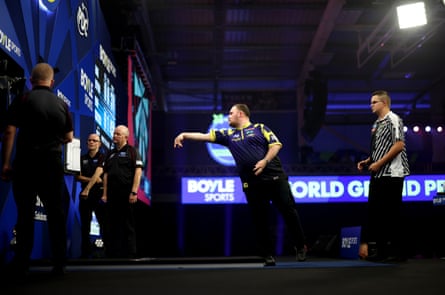
For years I’ve been struck by a question, and Van Veen is better placed than most to answer it. Beyond simple arithmetic, is intellect a help or a hindrance in darts? “You can see it both ways,” he says. “The first couple of years when I started playing, I was thinking too much. What happens if I miss this double? How will it affect the rankings? But the stuff around the darts – the calendar, social media, exhibitions – you need to be smart about that. Otherwise you wear yourself out.”
Now for Ally Pally and, as a major champion, expectations are sky‑high this time. A strong run would almost certainly earn him a slot in next year’s Premier League. But he has also never won a game at the world championship, and for that reason, he says: “I don’t think I have the right to look that far ahead. I’m No 10 in the world, but I’ve got much more to give, especially in the majors.”
And whatever happens, there are reasons to be cheerful. He could easily have been back in his office job, selling airline freight, telling people he could have been a contender. Instead, he is seven games away from a dream. “It’s just one or two millimetres that can win you or lose you a game. I think that’s the most beautiful thing. It’s so close. Everyone is so competitive. And I always wanted to show I could be competitive as well. That’s why I’m still playing this sport.”