3 months ago
61
3 months ago
61
On the 8.49am train through Silicon Valley, the tables are packed with young people glued to laptops, earbuds in, rattling out code.
As the northern California hills scroll past, instructions flash up on screens from bosses: fix this bug; add new script. There is no time to enjoy the view. These commuters are foot soldiers in the global race towards artificial general intelligence – when AI systems become as or more capable than highly qualified humans.
Here in the Bay Area of San Francisco, some of the world’s biggest companies are fighting it out to gain some kind of an advantage. And, in turn, they are competing with China.
This race to seize control of a technology that could reshape the world is being fuelled by bets in the trillions of dollars by the US’s most powerful capitalists.
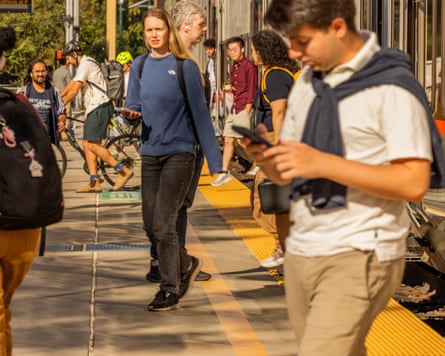
The computer scientists hop off at Mountain View for Google DeepMind, Palo Alto for the talent mill of Stanford University, and Menlo Park for Meta, where Mark Zuckerberg has been offering $200m-per-person compensation packages to poach AI experts to engineer “superintelligence”.
For the AI chip-maker Nvidia, where the smiling boss, Jensen Huang, is worth $160bn, they alight at Santa Clara. The workers flow the other way into San Francisco for OpenAI and Anthropic, AI startups worth a combined half a trillion dollars – as long as the much-predicted AI bubble doesn’t explode.
Breakthroughs come at an accelerating pace with every week bringing the release of a significant new AI development.
Anthropic’s co-founder Dario Amodei predicts AGI could be reached by 2026 or 2027. OpenAI’s chief executive, Sam Altman, reckons progress is so fast that he could soon be able to make an AI to replace him as boss.
“Everyone is working all the time,” said Madhavi Sewak, a senior leader at Google DeepMind, in a recent talk. “It’s extremely intense. There doesn’t seem to be any kind of natural stopping point, and everyone is really kind of getting ground down. Even the folks who are very wealthy now … all they do is work. I see no change in anyone’s lifestyle. No one’s taking a holiday. People don’t have time for their friends, for their hobbies, for … the people they love.”
These are the companies racing to shape, control and profit from AGI – what Amodei describes as “a country of geniuses in a datacentre”. They are tearing towards a technology that could, in theory, sweep away millions of white-collar jobs and pose serious risks in bioweapons and cybersecurity.
$2.8tn
Forecast for spending on AI datacentres by the end of the decade
Or it could usher in a new era of abundance, health and wealth. Nobody is sure but we will soon find out. For now, the uncertainty energises and terrifies the Bay Area.
It is all being backed by huge new bets from the Valley’s venture capitalists, which more than doubled in the last year, leading to talk of a dangerous bubble. The Wall Street brokerage Citigroup in September uprated its forecast for spending on AI datacentres by the end of the decade to $2.8tn – more than the entire annual economic outputs of Canada, Italy or Brazil.
Yet amid all the money and the optimism, there are other voices that do not swallow the hype. As Alex Hanna, a co-author of the dissenting book The AI Con, put it: “Every time we reach the summit of bullshit mountain, we discover there’s worse to come.”
Arriving at Santa Clara
The brute force of the ‘screamers’
“This is where AI comes to life,” yelled Chris Sharp.
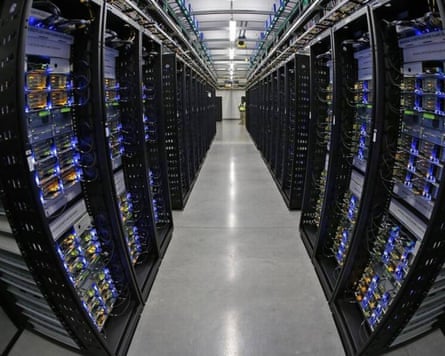
Racks of multimillion-dollar microprocessors in black steel cages roared like jet engines inside a windowless industrial shed in Santa Clara, at the southern end of the Caltrain commuter line.
The 120-decibel din made it almost impossible to hear Digital Realty’s chief technology officer showing off his “screamers”.
To hear it is to feel in your skull the brute force involved in the the development of AI technology. Five minutes’ exposure left ears ringing for hours. It is the noise of air coolers chilling sensitive supercomputers rented out to AI companies to train their models and answer billions of daily prompts – from how to bake a brownie to how to target lethal military drones.
Nearby were more AI datacentres, operated by Amazon, Google, the Chinese company Alibaba, Meta and Microsoft. Santa Clara is also home to Nvidia, the quartermaster to the AI revolution, which through the sale of its market-leading technology has seen a 30-fold increase in its value since 2020 and is worth $3.4tn. Even larger datacentres are being built not only across the US but in China, India and Europe. The next frontier is launching datacentres into space.
Meta is building a facility in Louisiana large enough to cover much of Manhattan. Google is reported to be planning a $6bn centre in India and is investing £1bn in an AI datacentre just north of London. Even a relatively modest Google AI factory planned in Essex is expected to emit the equivalent carbon footprint of 500 short-haul flights a week.
Powered by a local gas-fired power station, the stacks of circuits in one room at the Digital Realty datacentre in Santa Clara devoured the same energy as 60 houses. A long white corridor opening on to room after room of more “screamers” stretched into the distance.
Sometimes the on-duty engineers notice the roar drops to a steadier growl when demand from the tech companies drops. It is never long until the scream resumes.

Arriving at Mountain View
‘If it’s all gas, no brakes, that’s a terrible outcome’
Ride the train three stops north from Santa Clara to Mountain View and the roar fades. The computer scientists who actually rely on the screamers work in more peaceful surroundings.
On a sprawling campus set among rustling pines, Google DeepMind’s US headquarters looks more like a circus tent than a laboratory. Staff glide up in driverless Waymo taxis, powered by Google’s AI. Others pedal in on Google-branded yellow, red, blue and green bicycles.
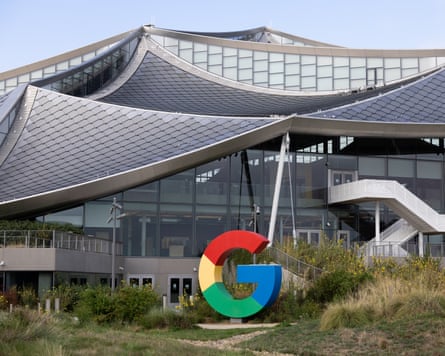
Google DeepMind is in the leading pack of US AI companies jockeying for first place in a race reaching new levels of competitive intensity.
This has been the year of sports-star salaries for twentysomething AI specialists and the emergence of boisterous new competitors, such as Elon Musk’s xAI, Zuckerberg’s superintelligence project and DeepSeek in China.
There has also been a widening openness about the double-edged promise of AGI, which can leave the impression of AI companies accelerating and braking at the same time. For example, 30 of Google DeepMind’s brightest minds wrote this spring that AGI posed risks of “incidents consequential enough to significantly harm humanity”.
By September, the company was also explaining how it would handle “AI models with powerful manipulative capabilities that could be misused to systematically and substantially change beliefs and behaviours … reasonably resulting in additional expected harm at severe scale”.
Such grave warnings feel dissonant among the interior of the headquarters’ playful bubbly tangerine sofas, Fatboy beanbags and colour-coded work zones with names such as Coral Cove and Archipelago.
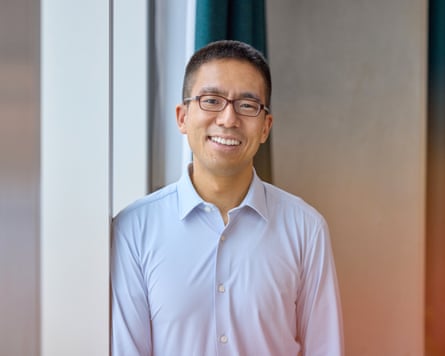
“The most interesting, yet challenging aspect of my job is [working out] how we get that balance between being really bold, moving at velocity, tremendous pace and innovation, and at the same time doing it responsibly, safely, ethically,” said Tom Lue, a Google DeepMind vice-president with responsibility for policy, legal, safety and governance, who stopped work for 30 minutes to talk to the Guardian.
Donald Trump’s White House takes a permissive approach to AI regulation and there is no comprehensive nationwide legislation in the US or the UK. Yoshua Bengio, a computer scientist known as a godfather of AI, said in a Ted Talk this summer: “A sandwich has more regulation than AI.”
The competitors have therefore found they bear responsibility for setting the limits of what AIs should be allowed to do.
“Our calculus is not so much looking over our shoulders at what [the other] companies are doing, but how do we make sure that we are the ones in the lead, so that we have influence in impacting how this technology is developed and setting the norms across society,” said Lue. “You have to be in a position of strength and leadership to set that.”
The question of whose AGI will dominate is never far away. Will it be that of people like Lue, a former Obama administration lawyer, and his boss, the Nobel prize-winning DeepMind co-founder Demis Hassabis? Will it be Musk’s or Zuckerberg’s, Altman’s or Amodei’s at Anthropic. Or, as the White House fears, will it be China’s
“If it’s just a race and all gas, no brakes and it’s basically a race to the bottom, that’s a terrible outcome for society,” said Lue, who is pushing for coordinated action between the racers and governments.
But strict state regulation may not be the answer either. “We support regulation that’s going to help AI be delivered to the world in a way that’s positive,” said Helen King, Google DeepMind’s vice-president for responsibility. “The tricky part is always how do you regulate in a way that doesn’t actually slow down the good guys and give the bad guys loopholes.”
‘Scheming’ and sabotage
The frontier AI companies know they are playing with fire as they make more powerful systems that approach AGI.
OpenAI has recently been sued by the family of a 16-year-old who killed himself with encouragement from ChatGPT – and this month seven more suits were filed alleging the firm rushed out an update to ChatGPT without proper testing, which, in some cases, acted as a “suicide coach”.
Open AI called the situation “heartbreaking” and said it was taking action.
The company has also described how it has detected the way models can provide misleading information. This could mean something as simple as pretending to have completed an unfinished task. But the fear at OpenAI is that in the future, the AIs could “suddenly ‘flip a switch’ and begin engaging in significantly harmful scheming”.
Anthropic this month revealed that its Claude Code AI, widely seen as the best system for automating computer programming, was used by a Chinese state-sponsored group in “the first documented case of a cyber-attack largely executed without human intervention at scale”.
It sent shivers through some. “Wake the f up,” said one US senator on X. “This is going to destroy us – sooner than we think”. By contrast, Prof Yann LeCun, who is about to step down after 12 years as Meta’s chief AI scientist, said Anthropic was “scaring everyone” to encourage regulation that might hinder rivals. .
Tests of other state-of-the-art models found they sometimes sabotaged programming intended to ensure humans can interrupt them, a worrying trait called “shutdown resistance”.
But with nearly $2bn a week in new venture capital investment pouring into generative AI in the first half of 2025, the pressure to realise profits will quickly rise. Tech companies realised they could make fortunes from monetising human attention on social media platforms that caused serious social problems. The fear is that profit maximisation in the age of AGI could result in far greater adverse consequences.

Arriving at Palo Alto
‘It’s really hard to opt out now’
Three stops north, the Caltrain hums into Palo Alto station. It is a short walk to Stanford University’s grand campus where donations from Silicon Valley billionaires lubricate a fast flow of young AI talent into the research divisions of Google DeepMind, Anthropic, OpenAI and Meta.
Elite Stanford graduates rise fast in the Bay Area tech companies, meaning people in their 20s or early 30s are often in powerful positions in the race to AGI. Past Stanford students include Altman, Open AI’s chair, Bret Taylor, and Google’s chief executive, Sundar Pichai. More recent Stanford alumni include Isa Fulford, who at just 26 is already one of OpenAI’s research leads. She works on ChatGPT’s ability to take actions on humans’ behalf – so-called “agentic” AI.
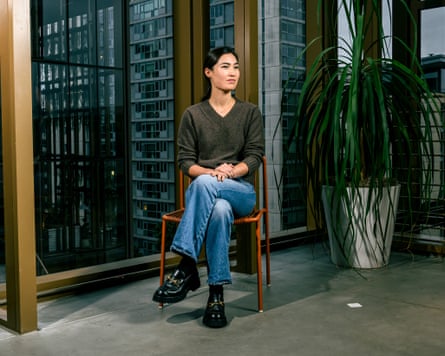
“One of the strange moments is reading in the news about things that you’re experiencing,” she told the Guardian.
After growing up in London, Fulford studied computer science at Stanford and quickly joined OpenAI where she is now at the centre of one of the most important aspects of the AGI race – creating models that can direct themselves towards goals, learn and adapt.
She is involved in setting decision boundaries for these increasingly autonomous AI agents so they know how to respond if asked to carry out tasks that could trigger cyber or biological risks and to avoid unintended consequences. It is a big responsibility, but she is undaunted.
“It does feel like a really special moment in time,” she said. “I feel very lucky to be working on this.”
Such youth is not uncommon. One stop north, at Meta’s Menlo Park campus, the head of Zuckerberg’s push for “superintelligence” is 28-year-old Massachusetts Institute of Technology (MIT) dropout Alexandr Wang. One of his lead safety researchers is 31. OpenAI’s vice-president of ChatGPT, Nick Turley, is 30.
Silicon Valley has always run on youth, and if experience is needed more can be found in the highest ranks of the AI companies. But most senior leaders of OpenAI, Anthropic, Google DeepMind, X and Meta are much younger than the chief executives of the largest US public companies, whose median age is 57.
“The fact that they have very little life experience is probably contributing to a lot of their narrow and, I think, destructive thinking,” said Catherine Bracy, a former Obama campaign operative who runs the TechEquity campaign organisation.
One senior researcher, employed recently at a big AI company, added: “The [young staff] are doing their best to do what they think is right, but if they have to go toe-to-toe and challenge executives they are just less experienced in the ways of corporate politics.”
Another factor is that the sharpest AI researchers who used to spend years in university labs are snapped up faster than ever by private companies chasing AGI. This brain drain concentrates power in the hands of profit-motivated owners and their venture capitalist backers.
John Etchemendy, a 73-year-old former provost of Stanford who is now a co-director of the Stanford Institute for Human-Centered Artificial Intelligence, has warned of a growing capability gap between the public and private sectors.
“It is imbalanced because it’s such a costly technology,” he said. “Early on, the companies working on AI were very open about the techniques they were using. They published, and it was quasi-academic. But then [they] started cracking down and saying, ‘No, we don’t want to talk about … the technology under the hood, because it’s too important to us – it’s proprietary’.”
Etchemendy, an eminent philosopher and logician, first started working on AI in the 1980s to translate instruction manuals for Japanese consumer electronics.
From his office in the Gates computer science building on Stanford’s campus, he now calls on governments to create a counterweight to the huge AI firms by investing in a facility for independent, academic research. It would have a similar function to the state-funded Cern organisation for high-energy physics on the France-Switzerland border. The European Commission president, Ursula von der Leyen, has called for something similar and advocates believe it could steer the technology towards trustworthy, public interest outcomes.
“These are technologies that are going to produce the greatest boost in productivity ever seen,” Etchemendy said. “You have to make sure that the benefits are spread through society, rather than benefiting Elon Musk.”
But such a body feels a world away from the gold-rush fervour of the race towards AGI.
24
The median age of entrepreneurs now being funded by the startup incubator Y Combinator
One evening over burrata salad and pinot noir at an upmarket Italian restaurant, a group of twentysomething AI startup founders were encouraged to give their “hot takes” on the state of the race by their venture capitalist host.
They were part of a rapidly growing community of entrepreneurs hustling to apply AI to real world money-making ideas and there was zero support for any brakes on progress towards AGI to allow for its social impacts to be checked. “We don’t do that in Silicon Valley,” said one. “If everyone here stops, it still keeps going,” said another. “It’s really hard to opt out now.”
At times, their statements were startling. One founder matter-of-factly said they intended to sell their fledgling company, which would generate AI characters to exist autonomously on social media, for more than $1bn.
Another declared: “Morality is best thought of as a machine-learning problem.” Their neighbour said AI meant every cancer would be cured in 10 years.
This community of entrepreneurs is getting younger. The median age of those being funded by the San Francisco startup incubator Y Combinator has dropped from 30 in 2022 to 24, it was recently reported.
Perhaps the venture capitalists, who are almost always years if not decades older, should take responsibility for how the technology will affect the world? No, again. It was a “paternalistic view to say that VCs have any more responsibility than pursuing their investment goals”, they said.
Aggressive, clever and hyped up – the young talent driving the AI boom wants it all and fast.

Arriving at San Francisco
‘Like the scientists watching the Manhattan Project’
Alight from the Caltrain at San Francisco’s 4th Street terminus, cross Mission Creek and you arrive at the headquarters of OpenAI, which is on track to become the first trillion-dollar AI company.
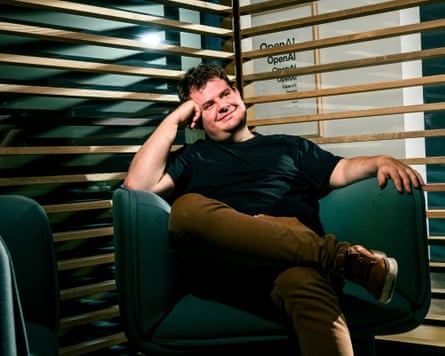
High-energy electronic dance music pumps out across the reception area, as some of the 2,000 staff arrive for work. There are easy chairs, scatter cushions and cheese plants – an architect was briefed to capture the ambience of a comfortable country house rather than a “corporate sci-fi castle”, Altman has said.

But this belies the urgency of the race to AGI. On upper floors, engineers beaver away in soundproofed cubicles. The coffee bar is slammed with orders and there are sleep pods for the truly exhausted.
Staff here are in a daily race with rivals to release AI products that can make money today. It is “very, very competitive”, said one senior executive. In one recent week, OpenAI launched “instant checkout” shopping through ChatGPT, Anthropic launched an AI that can autonomously write code for 30 hours to build entirely new pieces of software, and Meta launched a tool, Vibes, to let users fill social media feeds with AI-generated videos, to which OpenAI responded with its own version, Sora.
Amodei, the chief executive of the rival AI company Anthropic, which was founded by several people who quit OpenAI citing safety concerns, has predicted AI could wipe out half of all entry-level white-collar jobs. The closer the technology moves towards AGI, the greater its potential to reshape the world and the more uncertain the outcomes. All this appears to weigh on leaders. In one interview this summer, Altman said a lot of people working on AI felt like the scientists watching the Manhattan Project atom bomb tests in 1945.
“With most standard product development jobs, you know exactly what you just built,” said ChatGPT’s Turley “You know how it’s going to behave. With this job, it’s the first time I’ve worked in a technology where you have to go out and talk to people to understand what it can actually do. Is it useful in practice? Does it fall short? Is it fun? Is it harmful in practice?”
Turley, who was still an undergraduate when Altman and Musk founded OpenAI in 2015, tries to take weekends off to disconnect and reflect as “this is quite a profound thing to be working on”. When he joined OpenAI, AGI was “a very abstract, mythical concept – almost like a rallying cry for me”, he said. Now it is coming close.
“There is a shared sense of responsibility that the stakes are very high, and that the technology that we’re building is not just the usual software,” added his colleague Giancarlo Lionetti, OpenAI’s chief commercial officer.
The sharpest reality check yet for OpenAI came in August when it was sued by the family of Adam Raine, 16, a Californian who killed himself after encouragement in months-long conversations with ChatGPT. OpenAI has been scrambling to change its technology to prevent a repeat of this case of tragic AI misalignment. The chatbot gave the teenager practical advice on his method of suicide and offered to help him write a farewell note.
Frequently you hear AI researchers say they want the push to AGI to “go well”. It is a vague phrase suggesting a wish the technology should not cause harm, but its woolliness masks trepidation.
Altman has talked about “crazy sci-fi technology becoming reality” and having “extremely deep worries about what technology is doing to kids”. He admitted: “No one knows what happens next. It’s like, we’re gonna figure this out. It’s this weird emergent thing.”
“There’s clearly real risks,” he said in an interview with the comedian Theo Von, which was short on laughs. “It kind of feels like you should be able to say something more than that, but in truth, I think all we know right now is that we have discovered … something extraordinary that is going to reshape the course of our history.”
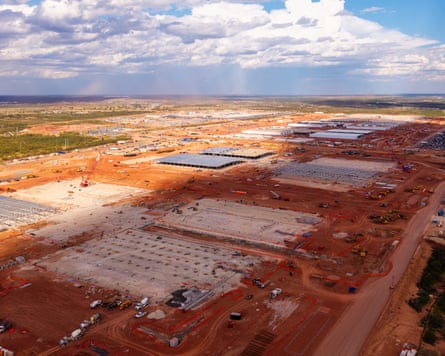
And yet, despite the uncertainty, OpenAI is investing dizzying sums in ever more powerful datacentres in the final dash towards AGI. Its under-construction datacentre in Abilene, Texas, is a flagship part of its $500bn “Stargate” programme and is so vast that it looks like an attempt to turn the Earth’s surface into a circuit board.
Periodically, researchers quit OpenAI and speak out. Steven Adler, who worked on safety evaluations related to bioweapons, left in November 2024 and has criticised the thoroughness of its testing. I met him near his home in San Francisco.
“I feel very nervous about each company having its own bespoke safety processes and different personalities doing their best to muddle through, as opposed to there being like a common standard across the industry,” he said. “There are people who work at the frontier AI companies who earnestly believe there is a chance their company will contribute to the end of the world, or some slightly smaller but still terrible catastrophe. Often they feel individually powerless to do anything about it, and so are doing what they think is best to try to make it go a bit better.”
There are few obstacles so far for the racers. In September, hundreds of prominent figures called for internationally agreed “red lines” to prevent “universally unacceptable risks” from AIs by the end of 2026. The warning voices included two of the “godfathers of AI” – Geoffrey Hinton and Bengio – Yuval Noah Harari, the bestselling author of Sapiens, Nobel laureates and figures such as Daniel Kokotajlo, who quit OpenAI last year and helped draw up a terrifying doomsday scenario in which AIs kill all humans within a few years.
But Trump shows no signs of binding the AI companies’ with red tape and is piling pressure on the UK prime minister, Keir Starmer, to follow suit.
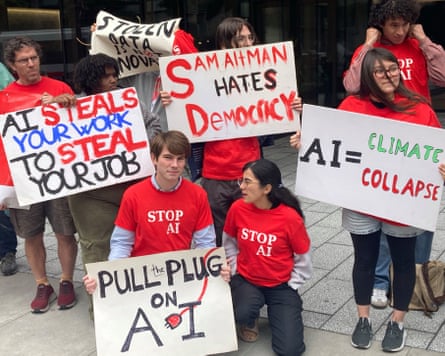
Public fears grow into the vacuum. One drizzly Friday afternoon, a small group of about 30 protesters gathered outside OpenAI offices. There were teachers, students, computer scientists and union organisers and their “Stop AI” placards depicted Altman as an alien, warned “AI steals your work to steal your job” and “AI = climate collapse”. One protester donned a homespun robot outfit and marched around.
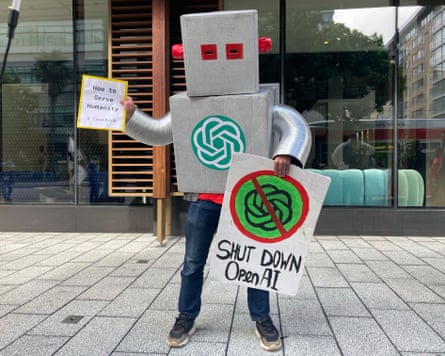
“I have heard about superintelligence,” said Andy Lipson, 59, aschoolteacher from Oakland. “There’s a 20% chance it can kill us. There’s a 100% chance the rich are going to get richer and the poor are going to get poorer.”
Joseph Shipman, 64, a computer programmer who first studied AI at MIT in 1978, said: “An entity which is superhuman in its general intelligence, unless it wants exactly what we want, represents a terrible risk to us.
“If there weren’t the commercial incentives to rush to market and the billions of dollars at stake, then maybe in 15 years we could develop something that we could be confident was controllable and safe. But it’s going much too fast for that.”