3 months ago
95
3 months ago
95
Walk down the specialist aisle in most British supermarkets and you will find a red jar with the kindly face of a middle-aged Chinese woman staring back at you. Branded Lao Gan Ma, meaning “old godmother”, these jars contain chilli crisp – a spicy, crunchy and moreish umami condiment that has made made hundreds of millions for Tao Huabi, the woman on the label. Doused over steaming dumplings, fried eggs, noodles and even ice-cream, Lao Gan Ma’s chilli crisp has become a social media sensation in recent years and has spawned a thriving cottage industry of independent chilli crisp producers in the UK.
“It’s such a convenient shortcut to flavour when you use it as a condiment,” says Fuchsia Dunlop, an expert in Chinese cuisine. “Every Asian cuisine has a form of chilli oil, but China and Lao Gan Ma invented chilli crisp and now the western world is more interested in authentic flavours, thanks partly to social media.” People, she says, want to have their own taste of that authenticity. “It’s far more exciting than a bottle of ketchup!”
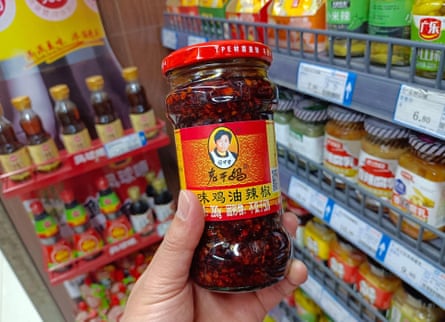
While chilli oil involves simply infusing a neutral oil with pepper flakes, a crisp is far more inventive and customisable. Typically made by pouring hot oil over chilli flakes, spice mixes and fresh ingredients such as spring onions, garlic and peanuts, the result can range from a jammy, piquant sludge to a sizzling crunch. It’s a multisensory flavour bomb, one that dozens of independent producers across the UK are putting their own twist on to meet growing demand.
Tom Palmer, the founder of the Sichuan-inspired brand Yep Kitchen, launched his chilli crisp in 2023 and has sold more than 120,000 jars since. “The demand for this category has grown so quickly that manufacturing can’t actually keep up,” he says. “We’ve gone from making batches in my mum’s kitchen to now building our own factory in north London, but we’ve had to import machines from China, since there are none available in Europe that can correctly jar the oil along with the right amount of that crunchy sediment.”
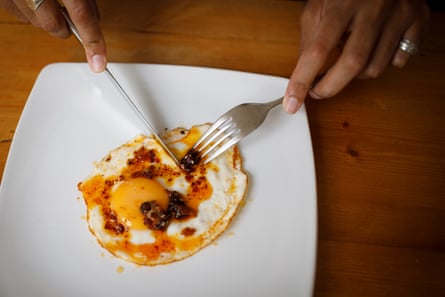
Inspired by a decade spent living in China and the chilli oils he would dot over every meal, Palmer’s version isn’t just spicy, but also coats the palate with the funky hum of a fermented soya bean paste and the numbing floral notes of Sichuan pepper flakes. He likes to swirl it through peanut butter on toast or spoon it over fried eggs.
He’s not alone in trying to find a novel approach. At the small plates restaurant Ardfern in Edinburgh, the head chef, Roberta Hall McCarron, uses shards of chicken skin in her chilli crisp to add a salty crunch to prawn toast, while the London-based Thai restaurant Khao Bird uses a peanut and Thai soya bean version over a vegan tofu dish. The author of the Chilli Crisp cookbook, James Park, has crafted a version to use in desserts.
“Since chilli crisps are balanced, rather than having the one-dimensional vinegar sharpness of hot sauces, they tend to go very well with everything, from curries to dairy products such as yoghurt or cream cheese,” Park says. “I developed a chilli crisp that could be used explicitly with sweet dairy desserts. It involves lots of roasted nuts and fewer savoury elements, and I’ve already found it adds a mouth-watering element to tahini brownies, caramels and lemon pound cakes.”
Park grew up in Alabama and has Korean parents. He struggled to connect with his heritage until he moved to New York for college and discovered Lao Gan Ma. “It became a way to find common ground with other Asian students, since everyone used it,” he says. “Although it used to be only Lao Gan Ma, since Covid hit, I’ve seen so many new products and producers pop up. Each brand expresses a new diaspora identity.”
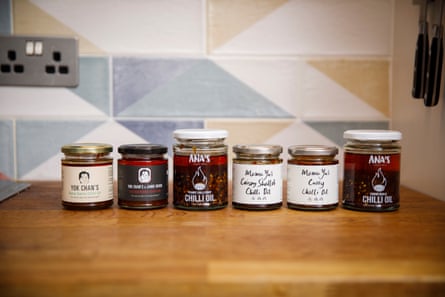
In Britain, chilli crisp products range from Sri Lankan blends to Filipino-Chinese chilli crunch, Taiwanese recipes and Malay versions, often created by cooks from several generations. Xiengni Zhou and her mother, Jolene Yu, run Mama Yu, a typical example of this diaspora heritage. Growing up, Zhou, who is Malaysian-Chinese, was surrounded by her mother’s home-cooked chilli oil at their family’s Sheffield Chinese takeaway, Wok Inn. In 2021, she encouraged her mother to start selling batches of 30 to 50 jars to their local network of customers; in the five years since, they have sold more than 75,000 units. They have both quit their jobs to keep up with the demand: their Instagram “drops” of new batches sell out in minutes.
“In Malaysian cooking, we use a lot of crispy shallots, whether it’s in soups, on noodles or over eggs, and we wanted to pay homage to that with our chilli crisp,” Zhou says. “It lends a natural sweetness to the sauce and it’s become one of our most popular items. The business has been a lovely way to stay close to my mum and also to pay tribute to our heritage.”
A mother-son duo, Michael Perera and Yok Chan have created a curry-scented, jammy-textured condiment that references Perera’s father’s Sri Lankan heritage as much as Chan’s Chinese background. Ana Morales says her shrimp-garlic chilli crisp honours her Filipino background by incorporating bagoong, a fermented shrimp paste that is common across the archipelago. “My mission is to put Filipino food on the map, as I don’t think it’s very well known in the UK,” she says. “The shrimp paste makes our product salty, garlicky and perfect for pizza, soups or basically any dish. It elevates everything.”
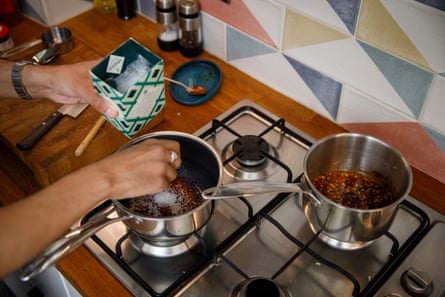
For those wishing to make and personalise their own version at home, the process is surprisingly simple. I follow Park’s recommendation to infuse my oil with flavour before heating it and pouring it over a spice mix. Finely sliced spring onion, garlic and a dollop of Korean gochujang are stirred into a warming pan of vegetable oil and cooked on a low-to-medium heat for about 20 minutes.
Setting the oil mix aside to cool, I add a spice blend of several chilli flakes – Sichuan, Aleppo and gochugaru – as well as MSG, chicken powder, soy sauce, salt, sugar and black vinegar into a heatproof bowl. I mix the cooled oil into the spice blend and in a separate pan begin heating plain oil until it begins to smoke. I carefully pour the hot oil into the fragrant cold blend and it sizzles to deliver a fragrant aroma.
The process takes about 30 minutes and, aside from the crucial detail of remembering to use a heatproof bowl so the scorching oil doesn’t cause it to shatter, the recipe is foolproof. I’m left with a hot, savoury and umami-rich sauce that I spend the next week spooning liberally on to yoghurt and toast (both excellent) and as a base for frying eggs (delicious, if indulgent). I even gingerly spray it over ice-cream (vile, bordering on criminal). Still, the salty, lip-smacking flavour is addictive, although anyone concerned about their spice tolerance might want to try drops rather than a drizzle.
“The British palate is becoming far more adventurous and tolerant to spice, and these chilli crisps are just the start,” says Dunlop. “You can add it to steamed vegetables, pies or a roast dinner. The combinations are endless.”