3 months ago
46
3 months ago
46
For hours, Hussein Abdel al-El and his wife, Um Alaa, did not move. They sat in the bathroom in the dark, not daring to touch their phones; the faint glow of the screen might give them away to the Israeli soldiers outside. It was 1am, the Israelis were raiding their neighbours’ house, and the septuagenarian couple did not want their door knocked on next.
In the next house over, Israeli soldiers had forced residents against the wall at gunpoint, zip-tying their hands. They searched the home and interrogated its occupants before putting a black bag over the head of a shepherd, Qassem al-Qadari, taking him to an Israeli military base across the border for further questioning.
The Israeli soldiers were gone by daylight. And so were the elderly couple’s neighbours. All the other houses on the outskirts of Kfarchouba, a mountain-side town on the Lebanon-Israel border, had been abandoned after the raids.
Kfarchouba is one of a handful of non-Shia-majority villages where the Israeli military has allowed people to stay in their homes, despite being within the “yellow line”, a 6-mile-wide strip along the Israel-Lebanon border which the Israeli military has occupied since the 17 April ceasefire agreement with Lebanon.
Israel has forcibly displaced the residents of most of the villages within the “yellow line” and has steadily worked to demolish the now-empty towns with explosives and excavators.
After Israel’s invasion of Lebanon began, a routine developed in Kfarchouba. During the day, people gathered in the town’s centre and looked down over Khiam and the Marjayoun plain, which stretches out below them. They watched as Israeli F-16s swooped overhead and dropped bombs on the towns below, the sounds of explosions growing more distant as Israeli forces steadily pushed back Hezbollah fighters and advanced deeper into Lebanon.
At night, families huddled around heaters in their living rooms; they did not dare to leave their homes. Outside, Israeli soldiers patrolled Kfarchouba’s streets. An unofficial curfew started at nightfall as the Israeli military began their raids. They searched homes for weapons and occasionally kidnapped residents and took them to Israel for questioning.
“Out there, it’s Gaza: they are levelling everything,” said Nazih Yehya, a shop owner in his 70s gesturing towards the Lebanese towns below them, already half-demolished by the Israelis. “Here it is the West Bank: it’s not destroyed, but they want to make sure this area is under their control.”
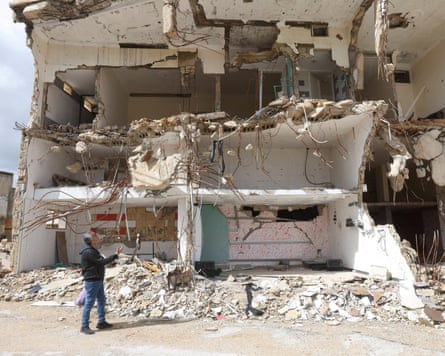
Kfarchouba and the neighbouring villages sit at the end of the “yellow line”, linking Israel’s occupation in southern Lebanon with the occupied Golan Heights and south-west Syria, where Israeli forces established a military presence after the fall of the president Bashar al-Assad. Together, these areas form a contiguous strip of Israeli-controlled land across three countries, a populated buffer zone on Israel’s northern borders.
Israel did not destroy Kfarchouba and the neighbouring villages, nor did it displace its residents. The residents can remain in their homes under a West Bank-style occupation, if they obey Israel’s strict conditions.
They must guard their towns against Hezbollah. Israeli military officials have called them and told them in no uncertain terms that if any member of the armed group enters the town, it will be bombed.
They cannot access the southern part of the town. An attempt by the mayor and a friend to fetch water from a well there was scuttled when an Israeli quadcopter dropped a stun grenade on them two weeks ago.
And they must not interfere with the Israeli army’s nightly raids. A patrol kidnapped a man in the neighbouring town of Halta and took him to Israel one night in late March. Hearing a woman screaming during the operation, 15-year-old Mohammed Abdel al-El emerged from his porch to check on the commotion, and was shot dead by the Israeli soldiers.
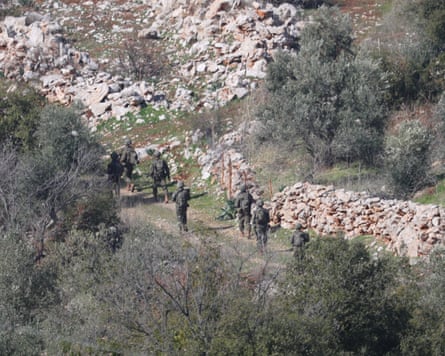
The residents of the mostly Sunni town are no fans of Hezbollah. During the last war, in 2024, the armed group used the strategic hilltop town to fire rockets towards the Israelis. Half of the town is still in ruins from the retaliatory bombs. Now, the mayor holds court in an ad-hoc town hall across the street from the old municipality building, which was bombed and has yet to be rebuilt.
Those who have stayed in the town, mostly elderly people, have agreed to Israel’s conditions so that they can remain in their homes. But they are uncomfortable being appointed guards against Hezbollah, an armed group which is said to rival some European militaries in size.
“If someone from Hezbollah comes and asks to put a rocket on my roof, I couldn’t refuse. How could I stop them? I would just flee,” said al-El, a 72-year-old retired sociology teacher, while sitting with his wife in his kitchen.
Still, they try. The roads leading to Kfarchouba are mostly blocked off by tyres, stones and mounds of dirt so that cars can only enter the town via one main street. Linger too long and a resident will emerge. Who are you, and what are you doing here?
“They are keeping us as human shields here to keep Hezbollah from entering,” said Imad Ali Saad al-Din, a municipal official in the town who was one of the villagers zip-tied and interrogated by Israeli soldiers during their raid on his home.
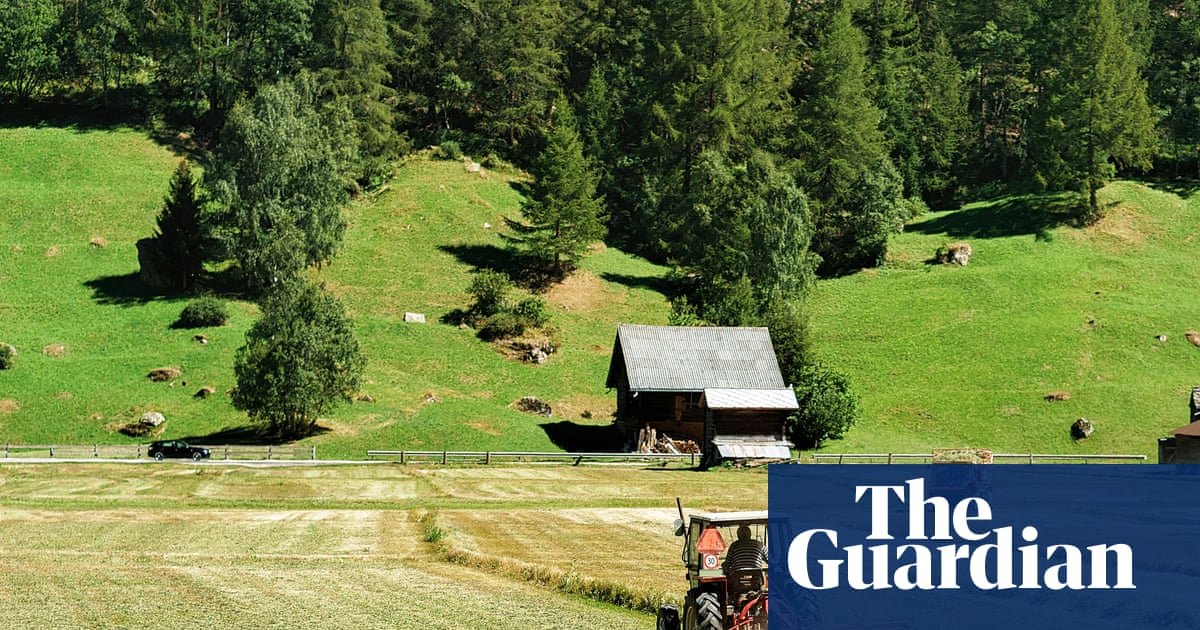
Kfarchouba is part of the Arqoub, a hilly, agrarian borderland of mostly Druze, Christian and Sunni villages that has long been caught in the region’s wars.
The residents of the Arqoub have seen and participated in their fair share of resistance movements. The area was used as a staging ground for Palestinian militants in the 20th century before coming under Israeli occupation from 1982 until 2000.
“The Palestinians, the communists, Hezbollah – they’ve all been here,” said Qassem al-Adiri, the mayor, wearily rattling off the names of revolutionary groups. The French-educated mathematician, now in his 80s, has watched as militant resistance groups, one after the other, hung their flags and chanted their slogans in his village.
Today, there are no resistance groups left in Kfarchouba, nor in the other villages in the Arqoub. Any Hezbollah fighters who had been in the town during the last conflict in 2024 have withdrawn or been killed. Only Lebanon’s striped cedar flag now flies in Kfarchouba, while Israeli soldiers walk freely on its streets.
“We’ve become a military zone. We lost the areas we once were able to go to. Our olive fields, the roads we used to drive. People are selling their flocks at a discount,” said al-Adiri. “We were supposed to liberate Palestine but now we’re just trying to survive in our village.”
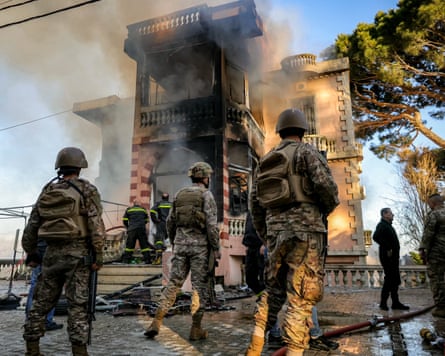
Walid Nasr is one of the villagers who has lost his land to Israel. After working his whole life in Lebanon’s general security directorate, he built a villa surrounded by olive trees on the far outskirts of Kfarchouba, directly under the Israeli Ramtha watchtower.
The villa was destroyed in an airstrike in 2024, and Israeli officers informed him that he was no longer allowed to go to his land. His olive trees have remained unpicked since.
“It’s like they’re playing games with us. One day they tell you you’re safe, the next they raid the place,” said Nasr. His own house was raided on 29 March, drawers ripped out of dressers, furniture overturned and his hunting rifle confiscated.
The nightly raids, the warnings from the Israeli army – all have left the people of Kfarchouba shaken. During the day, the Israeli gaze feels omnipresent, with three surveillance towers overlooking the town.
“I don’t even dare to fix the Lebanese flag on our roof. I’m scared to go up there, despite it being kinked. We can hear the Israelis shooting from their bases,” said al-El.
At night, the fear intensifies.
“What prevents them from coming into our house? Sometimes when the wind blows too hard and the door shakes, I think it’s them knocking. My dream now is one peaceful night of sleep,” al-El said.
As he spoke, a large boom in the distance made him and his wife jump. They waited in silence until a second boom came – just a sonic boom from a fighter jet overhead.
“What should I do? Wait for them with the heater on and put candy in the bowl?” he said wearily. “We have no means of resistance, our resistance is cowering in our houses.”