3 months ago
68
3 months ago
68
From Milan to Cortina and beyond, the star of the first Olympic weekend in Italy was … Italy.
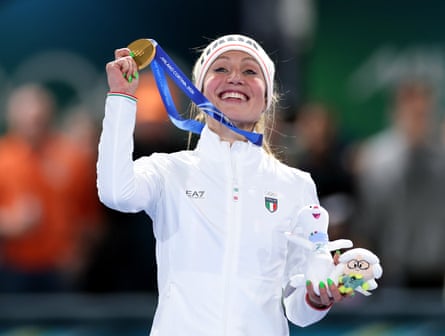
The electric celebrations started Saturday in Bormio, close to the Swiss border, with a silver and bronze in the men’s downhill. They echoed a few hours later in Milan, where Francesca Lollobrigida set an Olympic record in women’s 3000m speed skating for the host country’s first gold.
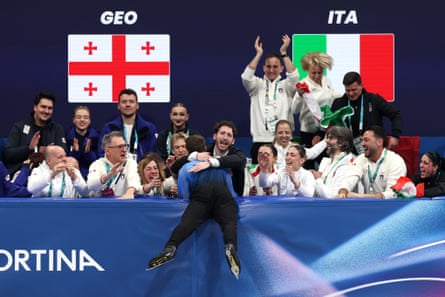
On Sunday, the celebrations rolled all over in diverse sports through dispersed venues: snowboard bronze in Livigno, biathlon silver in Antholz, luge bronze in Cortina among them. In Milan, figure skater Matteo Rizzo sank to his knees after finishing his free skate and sobbed tears of joy on the ice. He leaped over the wall to join his compatriots in celebrating their bronze, the country’s first-ever medal in the team event.
In two days, Italy already had more medals (nine) than they had garnered in Sochi 2014 (eight) and far more than in Vancouver 2010 (five). The host country was nearly halfway to its record Winter Olympic tally of 20 medals in Lillehammer 1994.
Monday passed without a medal, but Italy added to their total on Tuesday, taking medals in sports ranging from the genteel (mixed doubles curling, bronze) to the frenetic (mixed short-track speedskating relay, gold). On Wednesday, they doubled up in doubles luge (men’s and women’s) to move their gold-medal count up to four. Thursday brought another gold in the women’s super-G.
To an extent, a host-country boost is typical in the Olympics. The US shattered their medal records at Salt Lake City 2002. Canada set a record for gold medals in one edition of the Winter Olympics when they hosted in 2010, though that record has since been broken by Norway. South Korea and China won more medals as hosts in 2018 and 2022 than they ever had in any previous edition. (The 2014 Games in Russia can’t provide a solid point of comparison because of the pervasive doping issues involving the host country.)
Home advantage in the Olympics, especially the Winter Games, isn’t quite the same as it is in basketball or any code of football, where fans can intimidate opponents and officials. Curling frowns on heckling. Home fans aren’t shouting at opposing biathletes to make them miss their shots. Cheering can provide a lift, but only in some sports. A downhill skier leaving the start gate isn’t going to be affected by the cheers from the bottom of the slope.
But “home ice” can be a literal advantage. US bobsleigh, skeleton and luge racers had a stellar performance in 2002 on their beloved Utah Olympic Park track, where they knew all the turns like the backs of their hands.
And Olympic committees and sponsors are well aware of the opportunity they have when the Games come to town. Canada, who had suffered the embarrassment of failing to win a single event when hosting the 1976 Summer Olympics and 1988 Winter Olympics, launched the “Own the Podium” campaign five years before the 2010 Olympics in Vancouver. China started an audacious effort to get more of its citizens involved in winter sports.
Those investments can pay off beyond a host Games. The US have remained a winter sports power, merrily making use of the world-class facilities built in Utah that will once again stage the Olympics in eight years. Canada has remained remarkably consistent since 2010.
The country that has mostly failed to capitalize on hosting the Olympics in the 21st century is the one making up for it now.
In 2006, when the Games were in Turin, Italy came up well short of their best-ever performance 12 years earlier in Lillehammer. In 1994, they won 20 medals, seven of them gold. At home, they won 11 medals, five of them gold. Even if Lillehammer is written off as an aberration – skewed by a five-medal haul by cross-country skier Manuela Di Centa – Italy’s medal total as host lagged behind their total of 13 from four years earlier in Salt Lake City.
The indelible image of Italy’s 2006 efforts came in ice dance, where 2002 bronze medalists Barbara Fusar-Poli and Maurizio Margaglio tumbled to the ice near the end of their program, and Fusar-Poli stared at her longtime partner in despair and exasperation for a cringe-worthy 30 seconds before they finally took their bows.
What’s different this time?
General improvement is one factor. After the nadir of five medals in 2010 and no gold medals in 2014, Italy bounced back in 2018 and came close to its record by winning 17 in 2022.
The surge could also be a reflection of increased enthusiasm. Turin never really warmed up to the Olympics. This year’s Games feel different, and Italy’s early success – punctuated by vivid celebrations – should only keep the ball rolling.
Momentum is difficult to quantify. Did Italy’s figure skating team inspire ice hockey goaltender Damian Clara to stop 46 Swedish shots to keep Italy on the verge of a massive upset on Wednesday before he exited with an injury? Surely not in a direct sense.
Sports require the crunching of numbers. Thousandths of a second in luge. Picayune adjustments to execution scores in figure skating. But many of the best moments in sports defy explanation. When the crowd roars for Rizzo, then the short-track relay team upsets the traditional power, can the presence of something that’s simply magical be denied?