2 months ago
66
2 months ago
66
Lithuania warns Russia could be planning 'targeted' attacks on critical infrastructure
Meanwhile, Lithuania’s president Gitanas Nausėda warned that Russia could be planning attacks on infrastructure, with security around energy and transport sites to be tightened as a precaution.
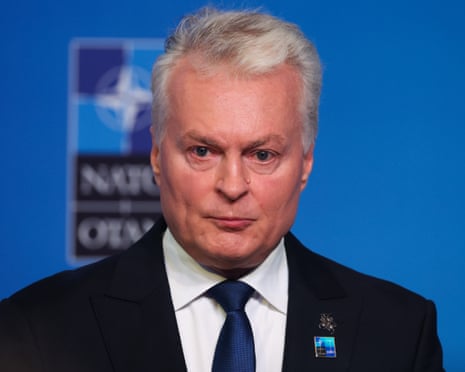
Speaking with BNS news agency, Nausėda appeared to confirm growing concerns, reported in the Guardian too, that Russia could be looking to escalate against one of the Baltic countries or Poland.
He said that Lithuanian intelligence services picked up “signals” of a potential provocation, but “they do not identify a specific place or time, because that is simply impossible to determine,” LRT reported.
“I cannot deny that we have such information and that it concerns kinetic operations – not on a large scale, but targeted kinetic operations that are very likely to be directed against critical infrastructure.”
He added:
“Anything that could stop these facilities from functioning is important because they matter not only in themselves but also because they ensure the functioning of the entire system, particularly our synchronisation with the continental European electricity grid.”
Nausėda’s comments are the latest to come from central and eastern Europe amid fears that Russia could be preparing an escalation against one of the countries in the region, after Poland’s prime minister Donald Tusk and foreign minister Radosław Sikorski issued similar warnings.
Key events
Former Hungarian foreign minister under Orbán says he will join Chinese carmaker BYD
In other news, Hungary’s former foreign minister Péter Szijjártó, who served as one of the closest loyalists of ousted prime minister Viktor Orbán who regularly visited Moscow for political talks despite ongoing war against Ukraine, has got a new job.
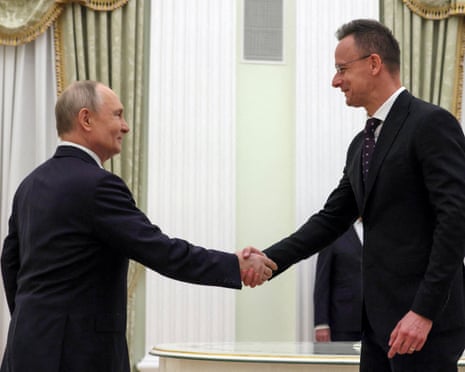
In a post on Facebook, Szijjártó announced he will be resigning from his job as an MP to join the Chinese carmaker BYD, working on external relations and business development.
The Hungarian media reported that his job will be a part of the international executive team, and not the carmaker’s national operations in Hungary.
Merz warns US against interfering with German elections with grants
In one of the stand-out moments of the press conference, Merz also got asked about reported US plans to support ideologically aligned groups in Europe with financial grants – and whether it could help the likes of the far-right Alternative für Deutschland party.
“For our part, we do not interfere in American elections,” Merz said. “And conversely, I do not want the American government or institutions close to the government to interfere in German elections.”
He added that it was illegal to finance German political parties from abroad, and “I assume that our friends in the world… will also abide by these legal rules.”
Germany's Merz defends his associate EU membership proposal for Ukraine, Balkans
Merz also got asked about his proposal for an “associate membership” for Ukraine and recent his push for western Balkan countries to be admitted to the EU.
He said the concept got mixed reception in Ukraine because of domestic political reasons, but he was ready to stand by the idea, which he argued was well received by other EU leaders.
“We have not admitted a new member to the EU for 13 years,” he said, “even though we promised accession to the EU to a whole range of countries in Europe.”
He said the EU either needed to take these promises back and say it’s impossible for anyone to join – “that would be the worst solution for everyone” – or push to make some, any, progress, “step by step”.
“You can call it something else,” he said, but defends the idea of a sort of half-membership without voting rights.
He accepted the accession process is “complicated” and may not be able to progress as quickly as some would want it to, but he said he was determined for the EU to “remain credible” with its promises of membership.
“If we lose this credibility, we lose more than that; we lose these countries, and geopolitically that would be the worst thing that could happen to us, Europeans,” he says.
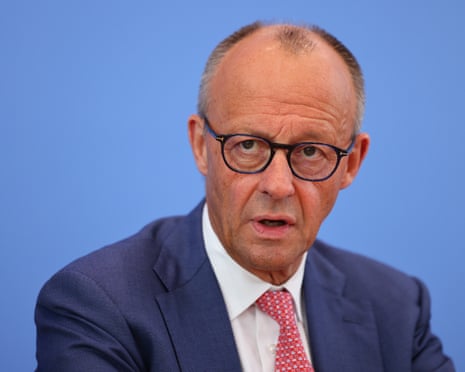
On Nato, Merz also said that the European member states recognise the need to step up on its defence capabilities, as he calls the Ankara summit a “success.” But “Nato must become more European so it can remain transatlantic,” he repeats the latest mantra.
Merz’s Q&A is mostly focused on domestic issues – including the immediate risk of far-right Alternative für Deutschland potentially coming to power in two states this autumn – but he also briefly discussed the EU and Germany’s foreign policy.
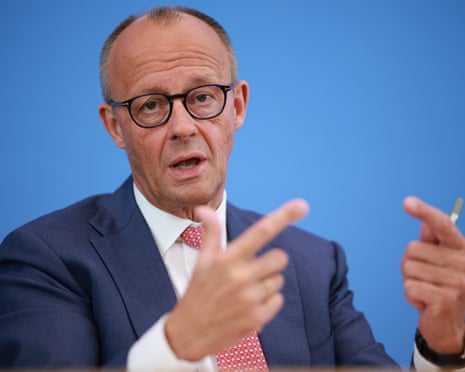
He said he always wanted Germany to be “play a stronger role” in the bloc, and thinks this has worked out well with Berlin already influencing the bloc’s positions on the European single market and restoring competitiveness.
He said that these reforms were desperately needed to put the EU in the best possible position as “the entire liberal global order is still under pressure.”
“I keep pointing out: we have 100 million inhabitants more in the European Union than the United States of America, so we could be much stronger if we worked better together. I want to promote that. I want to try to achieve that.”
He also defended himself from criticism for being too focused on foreign policy, saying that its impossible to consider this a separate issue given how interlinked they are with Germany’s domestic situation, be it economically or in terms of national security.
On AfD, he repeated that he could not see a situation in which he would work with the far-right party, and urged voters to look at his government’s actual track record, not the commentary or viral posts on social media.
But Merz said that “the election campaigns are just getting under way,” and that he remained confident “we would succeed in preventing the AfD from securing a majority” in the states.
“And I will maintain this optimism right up to election night.”
Germany's Merz speaks to media at his summer press conference
Jakub Krupa
I am also keeping an eye on lines coming out from German chancellor Friedrich Merz’s summer press conference in Berlin.
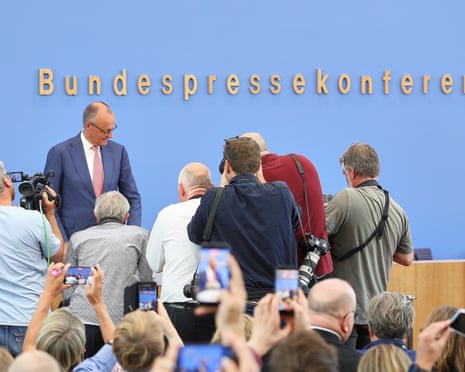
It’s a chance to ask him more questions than usual. Let’s see what he says.
I will bring you any lines of interest.
Latvia's president backs Lithuania's warnings on Russia's sabotage, attack plans
Meanwhile, Latvia’s president Edgars Rinkēvičs has backed up Lithuania’s Gitanas Nausėda warnings about Russian plans for a potential attack or sabotage attempt on the EU and Nato’s eastern flank (10:06).
Speaking alongside Nausėda during his visit to Vilnius, Rinkēvičs said:
“Information we are getting from Lithuanian, Latvian and other Nato states, from various agencies there, shows various attempts to do sabotage and to lower the security in our states.”
He also warned that as Russia will be unable to make progress on its war against Ukraine, it could try to test Nato’s resolve instead, LRT reported.
Jakub Krupa
The ceremony in Kyiv continues (or, more accurately, the delayed re-broadcast of the ceremony), with Moldova’s president Maia Sandu speaking next.
I will keep an eye on these speeches and bring you any lines of interest.
Von der Leyen says that Europeans tends to forgot about the value of the European flag, but “here in Ukraine you have not forgotten; you are the ones fighting for everything.”
She uses a Ukrainian word for resilience and invincibility of Ukraine, even during the war.
“So in accepting this order of Europe, it is not me bringing Europe or this EU flag to Kyiv on this Statehood Day, because Europe is already here and it always will be. This is our common dream. This is our common destiny, and together we will make it happen.”
And she ends on that note.
Von der Leyen continues:
“We need to combine our strength together. We can work on joint production, on making all of the components of the system work, and we can provide both defence industrial bases with the impetus needed to decisively step up investment and production.
This deal will bring together Ukrainian ingenuity and Europe’s industrial scale.
And with this, our message is clear: now is the time to invest in Ukraine, because this means to invest in Europe and to invest in our common security and our common future.”
She says how much it means that the European flag is here, on one of Kyiv’s main squares, “a symbol of hope.”
“During a war of despair and darkness across Europe, we see this flag flying proudly in thousands of cities and villages from Gdańsk, just across our border to Ghent, from Cork to Copenhagen, from Tallinn to Torino.
We sometimes forget how miraculous that is, how improbable it would have been to most people only a handful of decades ago. And we sometimes do not talk enough about what that European flag really means to us:
Peace. Prosperity. Liberty. Democracy. Solidarity.”
'Europe has so much to learn from you,' von der Leyen says as she announces new defence partnership with Ukraine
Von der Leyen continues highlighting Ukraine’s struggle for freedom and fight against Russia, paying tribute to the Ukrainian philosopher, Hryhorii Skovoroda, whose museum was attacked by Russia in 2022.
“It was a direct attack on Ukraine’s culture and history, an attempt to destroy its soul, its identity and the very idea of its existence. And above all, it was an attempt to subdue the fight for freedom.
As the sun rose after the destruction of the night, almost nothing was left of the museum, only one item survived: the statue of the great writer himself. Among the rubble and ashes there stood the giant Skovoroda, tall and proud, a defiant symbol that Ukraine’s freedom will never be diminished, let alone vanquished.”
She says “Europe has so much to learn from you,” in particular on “the ingenuity of your defence industry; about the speed with which innovation moves from the frontline to production; about your ability under the most difficult circumstances to adapt, innovate and build the capabilities that modern warfare demands.”
She says that Ukraine has “gone from being a buyer to a net security provider in Europe,” as she sets out a new EU-Ukraine Defence Industrial Partnership deal to make the most of Ukraine’s frontline experiences.
“What we are signing today is our very own drone deal,” she says.
'Ukraine is an integral part of European story,' von der Leyen tells as she gets top award from Ukraine
von der Leyen thanks for the award, and says it is “an unspeakable honour” for her.
She says:
“There is nowhere else in the world I would rather be for this occasion than here in Saint Michael’s Square, because this square is the living testament to this great nation and its unbreakable spirit.
From the golden dome of the monastery behind me to the monument of Princess Olga, it symbolises Ukraine’s iconic and central place in Europe’s culture and history.
From the memorial to the victims of Holodomor to the wall of Remembrance for the fallen, it speaks to Ukraine’s struggle and sacrifice, its eternal fight for freedom and liberty. This yearning for freedom runs deep in the history and in the very soul of Ukraine.”
She says that “Ukraine is an integral part of that [European] story. In that sense. In fact, in every sense, Ukraine is Europe and Europe is Ukraine.”
She adds that “today Ukraine’s fight is not only a fight for your own freedom, but an existential fight for self-determination.”
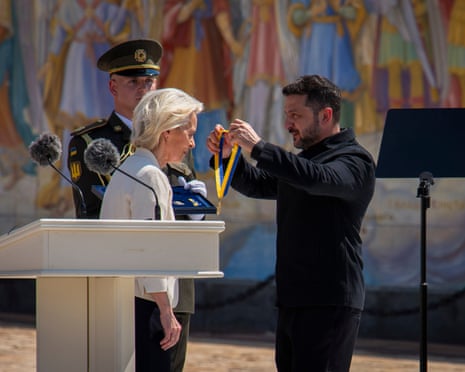
Zelenskyy awards EU's von der Leyen with Ukraine's first Order of Europe
Zelenskyy now turns to EU’s Ursula von der Leyen, who is also taking part in the ceremony.
He says Ukraine’s future “must be peaceful and European,” as he recalls that amid Russian attacks on Kyiv, he formally applied for Ukraine to join the EU in late February 2022.
“I remember well who was a sceptic, and who truly never doubted Ukraine and our people,” he says, thanking her for her continuous support.
“We are sure in that because Ukraine and Europe are one and … Ukraine is not alone, and everybody who helps us walk this road is especially valued by Ukraine.”
He awards von der Leyen the first inaugural Ukrainian Order of Europe for “outstanding personal merit in supporting Ukraine’s strategic course towards full membership in the European Union.”
In what could be seen as a swipe on Poland – where a bitter historical dispute saw the Polish president strip Zelenskyy of Poland’s highest civilian award – he adds “this is an award that no one and nothing can ever revoke or take away, because Ukraine’s word is solid.”
EU’s von der Leyen will speak next.
In closing paragraphs of his speech, Zelenskyy praises everyday heroism of the people of Ukraine, with a number of awards to Ukrainian soldiers and, when they died in service, to their families.
Zelenskyy continues:
“Today, even Russian state propagandists admit that Ukraine is a strong state, that Russia cannot defeat and will never defeat; a state that Europe needs, that Nato needs; a state that does not wait, but creates, that does not ask, but offers unique … technologies and capabilities, a unique security and political partnership.”
Zelenskyy says that “unlike Russia, which wages war against residential buildings, schools and churches, Ukraine strikes at the sponsors of Putin in this war and at the tools that help him kill people.”
He says that even as Ukraine strikes Russian petrol plants, Kyiv’s ambition is not “Russia without petrol, but Ukraine without Russia,” and “a Ukraine without war, a Ukraine with Europe and a Ukraine and Europe without the Moscow threat.”
As he marks both occassions, Zelenskyy tells leaders that “what’s important on the human level, we are all fighting for the same thing: for a Europe without war, which is impossible without a strong and peaceful Ukraine.”
He says Ukraine fights for the right to be “the kind of state that has enough strength and self-respect to equally preserve its heritage and implement ambitious plans.”
Zelenskyy also mentions the participation of Ukrainian troops in yesterday’s Bastille Day parade in Paris.
He also stresses Ukraine’s role in building Europe’s anti-ballistic system, saying:
“I am certain Ukraine has fully earned by right through its courage, its struggle and its readiness to take on leadership in processes that will define Europe’s future.”
He also stresses the importance of Donald Trump’s pledge to let Ukraine product Patriot missiles locally.
Jakub Krupa
The European Commission is now broadcasting a Ukrainian ceremony marking its statehood day and the Day of the Baptism of Kyivan Rus, which took place earlier today in Kyiv, and involved several European leaders from the EU and south-eastern Europe.
We are only seeing it now because of security concerns, which is also the reason why we don’t know anything about von der Leyen’s plans while in Kyiv.
I will follow the speeches and bring you the highlights.