3 months ago
98
3 months ago
98
In 1972, the great German novelist Heinrich Böll described the campaign of violence launched by the Red Army Faction (RAF) since its foundation two years earlier as a war of “six against 60 million”. The writer was vilified for the phrase, accused of sympathy for bombers and murderers. But Böll had highlighted the most important factor in the eventual defeat of the group, of whom one of the last surviving alleged members, a 67-year-old called Daniela Klette, was sentenced last week to 13 years in prison for armed robberies.
At the time Böll was writing, the RAF’s bombings, abductions and shootings had brought about the most acute crisis of West German democracy since the second world war. Dozens were killed, more injured, wanted posters and police checkpoints went up all over the country, huge state resources were devoted to counter-terrorism. Sporty small BMW cars were so favoured by the group that they were dubbed Baader-Meinhof Wagen, a reference to the RAF’s most famous founder leaders, Andreas Baader and Ulrike Meinhof.
Yet, less than a decade later, the Guardian’s correspondent in West Germany was writing of a new “atmosphere of peace and relaxation”. The RAF’s violent campaign to bring radical, revolutionary transformation to the country was over, they wrote. It was “the terror that died more with a whimper than a bang”.
This verdict was premature, but not by much. Meinhof had taken her own life in jail in 1976, Baader died similarly a year later. A “second generation” of the Red Army Faction committed ever more indiscriminate attacks that aimed more to free its members from prison than advance the global struggle against imperialism and capitalism. In the event, most joined their incarcerated comrades behind bars. A “third generation” would continue a desultory campaign for another decade or so. Among its alleged members was Klette.
Activists across Europe and beyond have portrayed Klette as a hero of the battle for global and local social justice. She is “a kind of grandmother heroine for the extreme left”, Dr Hans-Jakob Schindler, a German expert on terrorism, told the BBC. In court, Klette claimed her trial was politically motivated and said she remained committed to the fight against “capitalism and the patriarchy”. Supporters in the public gallery shouted slogans. Others debated whether the sentence was too harsh, or the trial intended not only to condemn a self-proclaimed leftwing extremist, but an entire leftwing movement?
On the right, Klette’s sentence has been deemed too lenient, even though she also faces trial for alleged involvement in three attacks in 1990 and 1994: a failed bombing in front of a bank, a shooting at the US embassy in Bonn and a 1993 bombing at a prison.
Much criticism has been directed at the inability of courts to try Klette for membership of the RAF because any alleged offences occurred too long ago, and at authorities for somehow allowing her to live apparently undisturbed in a bohemian neighbourhood in Berlin for 30 years. That German laws prevent police from using the facial recognition technology that a journalist deployed to eventually identify Klette has prompted incredulity.
Such concerns echo issues raised in the 1970s, a similarly polarised decade to our own. They are understandable, but now they miss the point. The conviction of Klette marks an endpoint in the Germany state’s successful battle with the RAF. This may have taken more than half a century, but it’s worth examination, because it offers important lessons in how the fight against terrorist networks can and should be dealt with.
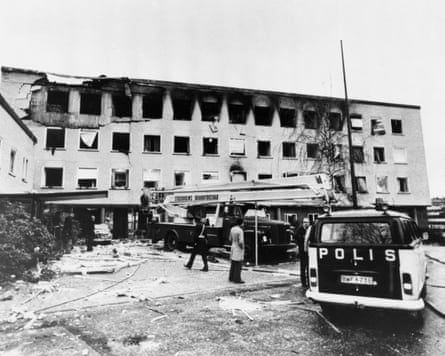
One reason for the eventual defeat of the RAF was that senior officials finally realised that to give way to its blackmail would simply encourage more terrorist attacks. A new specialist police unit trained and equipped to resolve hostage takings and hijackings raised the stakes for putative attackers and gave decision-makers a vital tactical option.
A second was that, though there were instances of unconstitutional and illegal repression, the state’s response remained broadly within the law and successive governments made sure terrorist offences were dealt with through the criminal justice system.
The legacy of this decision remains evident today. Prosecutors have carefully and sensibly insulated Klette’s alleged offences from any political background. This contrasts dramatically with the treatment of Palestine Action in the UK, where the unjustified and politicised deployment of terrorism laws is entirely counterproductive.
The RAF was primarily defeated by popular revulsion at its violence. Disillusionment was rapid and widespread, even among supporters. A poll in 1971 found that about a fifth of West Germans saw the group’s actions as political not criminal. A year later Meinhof was betrayed while hiding out in an apartment she thought was safe. Defections and internecine arguments proliferated as the RAF turned in on itself.
The reality was that by the 1980s it had become an anachronism. The group’s roots lay in the mass protest movement of the late 1960s. Its members had decided that marches and votes were insufficient to achieve the radical revolutionary transformation they sought, so turned to violence. But they were wrong. Their bombs and bullets did nothing to advance progressive causes.
Like elsewhere in western Europe, eventually many of the demands raised by those who took to the streets were partly met. Abortion and divorce laws were reformed or passed, voting ages lowered, funds funnelled into further education, sclerotic hierarchies questioned for the first time and youthful celebrities in music, sport, even politics, gained new prominence.
Together, these factors meant that well before Klette became involved in radical activism, activists were looking to win change within the democratic system, not to destroy it. This, they believed, was the way to secure nuclear disarmament, the protection of the environment or to pursue new more narrow interests of specific communities. Those that continued to pursue “revolution” attracted satire – think Rick from The Young Ones (1982-4) – not a mass following.
In short, democracy worked, defusing violence, addressing grievances and channelling mobilisations into more productive, less divisive, less damaging forms. The robberies for which Klette will go to prison had nothing to do with the struggle for social justice or the battle against imperialism or capitalism.
Böll’s portrayal of six against 60 million was exaggerated, but perceptive nonetheless. The RAF were a handful of individuals, the most extreme element of a radical fringe. Their actions did great harm to progressive causes in West Germany and internationally. Far from romanticising its supposed armed struggle, Böll was exposing its fundamental failing.
-
Jason Burke is the author of The Revolutionists: The Story of the Extremists who Hijacked the 1970s, and the Guardian’s international security correspondent
-
Do you have an opinion on the issues raised in this article? If you would like to submit a response of up to 300 words by email to be considered for publication in our letters section, please click here.