3 months ago
91
3 months ago
91
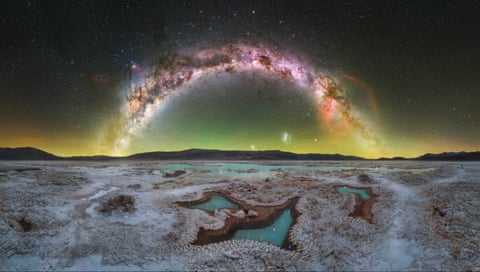
Photographers search for dark skies in the most remote landscapes to find places where the galaxy shines with extraordinary clarity. They share not only their breathtaking results but also their methods, trials and adventures
My Perfect Night
Reaching this location required travelling deep into the Puna de Atacama, a remote region in Argentina accessible only by 4×4 vehicles along rough dirt tracks, far from any source of light pollution. The nearest settlement was Antofalla, a small village of around 60 inhabitants, where electricity is generated locally and turned off at night. I had never seen photographs of this salt flat before, and its untouched character and minimalist landscape immediately stood out. Photograph: Daniel Viñé GarciaWed 13 May 2026 01.25 CEST
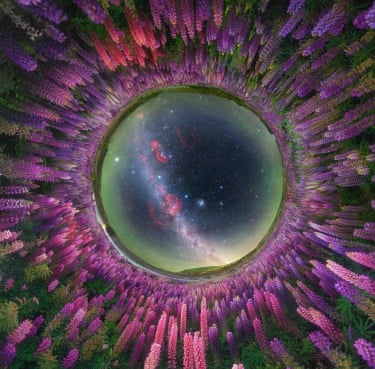
The Milky Way Over a Field of Lupines
The Milky Way rising above a blooming field of lupines in New Zealand during November, when spring wildflowers transform the landscape beneath the night sky. Using a fisheye perspective, the flowers encircle the scene, forming a natural frame that draws the viewer into the celestial sphere above.Photograph: Alvin Wu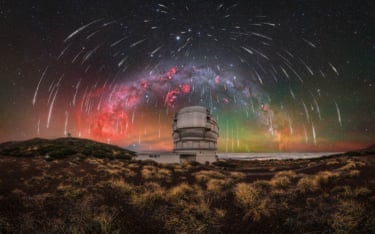
Geminid Symphony Over La Palma’s Guardian of the Sky
This winter Milky Way panorama captures a sky filled with Geminid meteors above the Gran Telescopio Canarias, the largest optical telescope in the world, on the island of La Palma, Spain.The final image is the result of an extensive post-processing workflow, combining meteor data registered using Auriga RegiStar from six cameras over five nights on La Palma. All RGB frames were captured using the Capture the Night Astro filter by Capture the Atlas. Photograph: Uroš Fink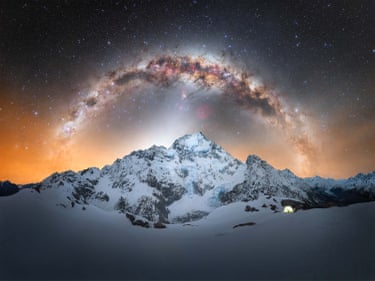
Aoraki Mount Cook
The Milky Way arch above Aoraki/Mount Cook in New Zealand. Reaching this location required drawing on my experience as a mountaineer, navigating steep rocky terrain and snow-covered slopes under winter conditions. The route presented constant challenges, including large washouts along the mountainside, unstable snow affected by solar radiation, and the demands of winter camping at altitude. As night fell, the Milky Way and zodiacal light appeared with exceptional clarity, enhanced by the cold, stable air at elevation. Photograph: Owain Scullion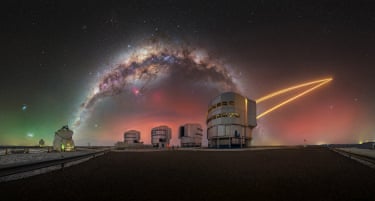
Sodium Milky Way
This scene was captured at the Very Large Telescope (VLT) on Cerro Paranal, in Chile’s Atacama desert, under exceptionally pure observing conditions where the boundary between Earth and sky feels almost seamless. Situated at 2,635 metres above sea level, the site benefits from extremely dry conditions, stable atmospheric layers and minimal light pollution, resulting in more than 300 clear nights each year.Photograph: Julien Looten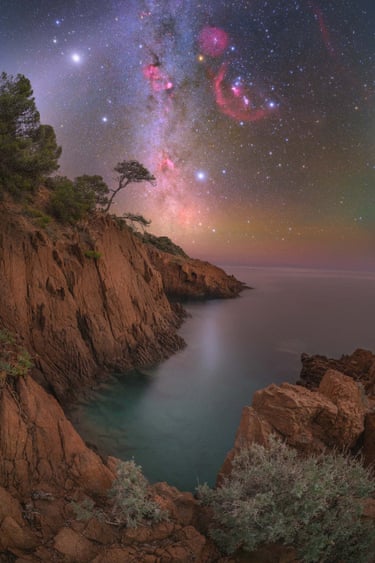
Celestial Light Over Sea Cliffs
This image was captured by sea cliffs in the south of France. The night sky takes on a distinctly different character during this time of year, especially with the arrival of the winter constellations. The tones feel cooler, the air sharper, and Orion rises prominently above the horizon, becoming the centrepiece of the scene. It is a season that brings a quiet, almost meditative atmosphere to nightscape photography. Photograph: Anthony Lopez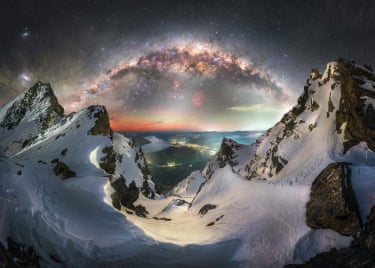
Night at the Remarkables
The galactic centre of the Milky Way, composed of billions of stars, gas and dust, rises above an icy, ancient landscape deep within Aoraki/Mount Cook national park in New Zealand, part of the largest Gold Tier Dark Sky Reserve in the world. This was one of the most remarkable scenes I have experienced in over seven years of astrophotography. The stillness, clarity and calm of the night stood in stark contrast to a place more often defined by its wild and unpredictable nature.Photograph: Tom Rae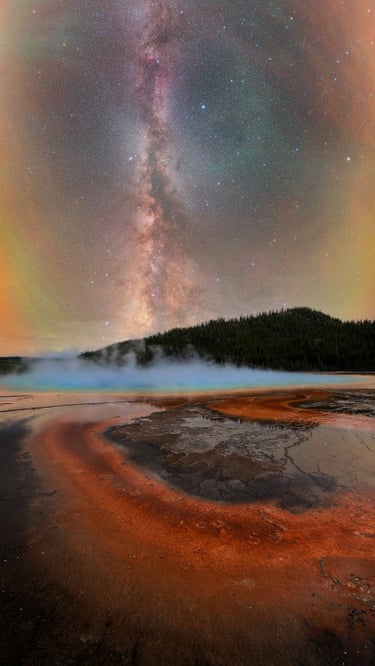
Firewater
At the Grand Prismatic Spring in Yellowstone national park, US, the raw energy of the planet meets the quiet vastness of the night sky. The constantly shifting steam transformed the scene from one moment to the next, briefly revealing the stars before concealing them again.Photograph: Baillie Farley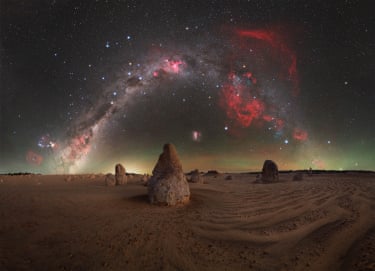
Lost in the Ripples of Space and Time
There is something uniquely powerful about a calm, windless night in the Pinnacles desert, and Western Australia offers some of the finest night skies in the world. In this composition, the main limestone pillar aligns almost perfectly with the south celestial pole, anchoring the image beneath the rotating sky. To the right, the faint but unmistakable red glow of the Gum Nebula, a vast supernova remnant, adds depth and scale to the scene. Photograph: Leonel Padrón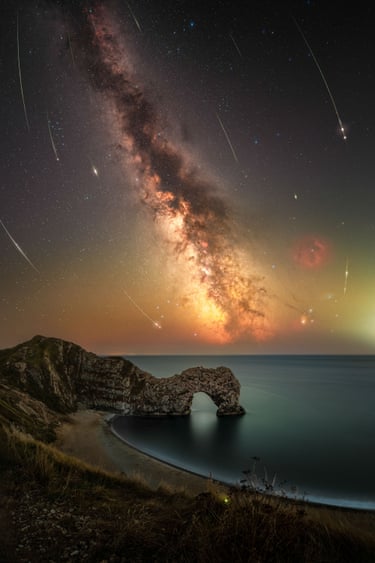
Perseid Meteors Over Durdle Door
‘Ancient fireworks’ from Comet Swift-Tuttle hurtled through the atmosphere with an ultra-wide angle lens. The natural limestone arch of Durdle Door, Dorset, UK is included. In the foreground, a singular glow worm was documented among reeds along the sea cliff edge. As the subject of astrophotography grows by demand, beauty hotspots and world heritage sites including Durdle Door are getting busy. With good reason that is why as astrophotographers, we need to set an example in protecting beauty hotspots and local ecology.Photograph: Josh Dury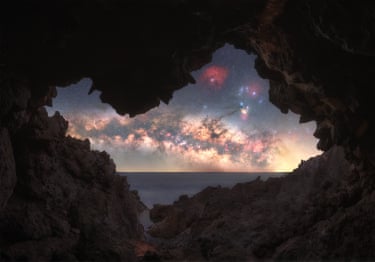
Galaxy on the Rise
Although it was only a few minutes from the parking area, it took me nearly four hours of scouting to finally locate this cave in Tenerife, Canary Islands, Spain. Capturing the image proved just as challenging. Composing and shooting the panoramic foreground required careful positioning, while properly illuminating the upper section of the cave was particularly difficult. To manage this, I used focus stacking across different planes, including the upper edge, the horizon, and the lower foreground, all in near-total darkness, where the brief blue hour offered little assistance.Photograph: Anastasia Gulova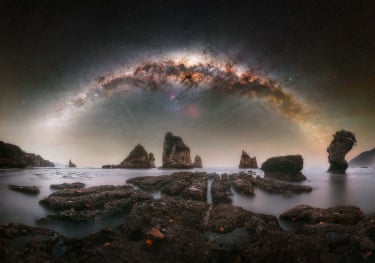
Divinity
Capturing a setting Milky Way core from this beach on the west coast of New Zealand had been on my list for a long time, with the starfish-covered reef offering a distinctive and compelling foreground. The terrain is hazardous, with gaps between the rocks posing a real risk, and the rapidly rising tide added constant pressure throughout the shoot. Despite these challenges, I was able to capture the necessary frames, returning to shore just in time. Due to the changing tide, the upper rows of the sky panorama were photographed from the beach, while the lowest row was captured from the reef to maintain proper alignment and perspective in the final composition.Photograph: Kavan Chay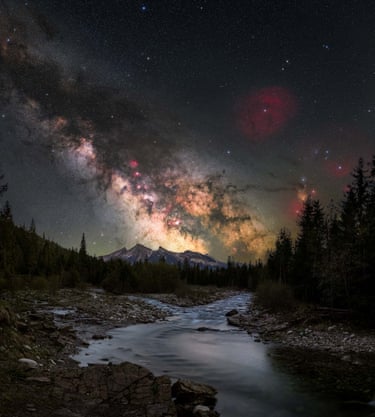
Milky Way Over Tatra Mountains
This image is taken in the Białka Gorge in Jurgów, Poland. In the foreground, the river creates a natural leading line, guiding the eye from the Earth towards the mountains and into the night sky, visually connecting the terrestrial and the cosmic. Beyond the final image, astrophotography is equally about the experience in the field, often shared with others who are drawn to the same conditions and moments, united by a common appreciation for the night sky.Photograph: Łukasz Remkowicz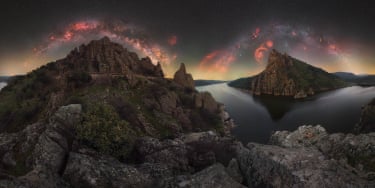
Double Milky Way Over Monfragüe national park
This image was taken Monfragüe national park, Spain during one of the few nights of the year when both the winter and summer Milky Way can be seen in the same sky. The scene does not appear this way to the naked eye. It is a composite that captures the transition of the Milky Way over several hours, combining the winter Milky Way visible after dusk with the summer Milky Way rising before dawn.Photograph: Luis Cajete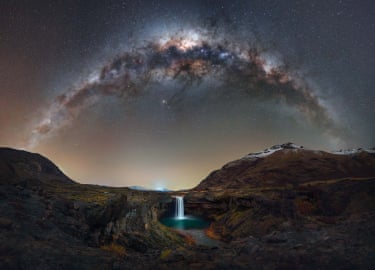
Salto del Agrio
This image was captured at Salto del Agrio, in the province of Neuquén, Argentina.The 45-metre waterfall plunges into a canyon carved by ancient lava flows from the Copahue volcano. Surrounded by basalt, the scene is enriched by the vivid colours left behind by minerals, particularly iron and sulfur carried by the Agrio River. Working with the tripod close to the ground and repeating exposures, I was finally able to capture the scene I had envisioned for so long.Photograph: Alejandra Heis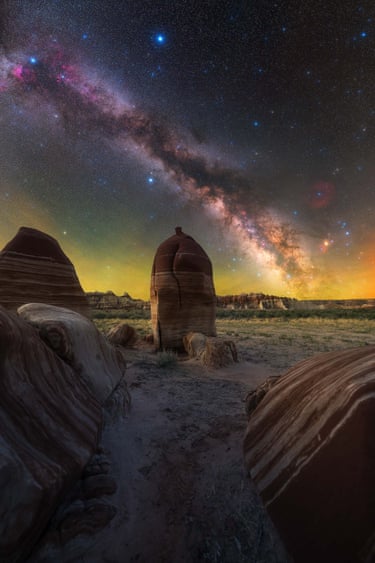
Galactic Spine
I am drawn to Milky Way photography because of its ability to spark curiosity. It offers a perspective that feels entirely different from other forms of photography, often revealing a world that many people have never experienced. With my images, my goal is to inspire that same sense of curiosity, encouraging others to imagine what it feels like to stand beneath a sky like this and witness it with their own eyes. That sense of wonder is what first drew me to the Milky Way, and it continues to shape the way I approach each image.Photograph: Andrew Imhoff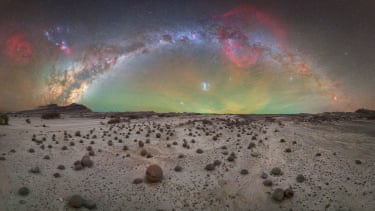
Valle de la Luna, Universo Triassico Ischigualasto
This photograph was captured in Argentina, in a Unesco world heritage site. Cancha de bochas has geological importance as the only place on Earth where the complete sequence of the Triassic period can be observed, preserving key fossils from the earliest dinosaurs. Guided by local experts, accessing the site required extreme care. Every movement had to be deliberate to avoid damaging this irreplaceable environment. Places like this remind us that beyond appreciating them, we also share the responsibility of preserving them.Photograph: Gonzalo Javier Santile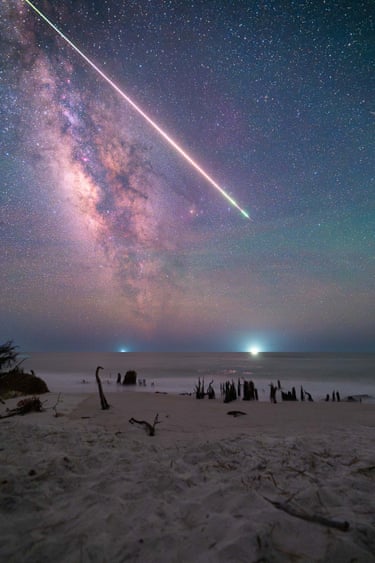
Fireball in Paradise
This single-exposure image became a reminder to always expect the unexpected in astrophotography. The capture was part of a larger day-to-night time-lapse that I began shooting at golden hour, working through biting insects and the intense tropical humidity of Florida. After setting up the sequence, I left the camera running and returned to my vehicle. Several hours later, shortly after midnight, I noticed the ground around me suddenly illuminated by a green glow, prompting me to look up. What followed was the largest meteor I have ever witnessed. Photograph: Jason Rice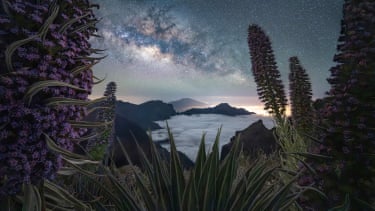
Caldera Galaxy Panorama
This panorama was captured at the highest point of the volcanic island of La Palma, a location defined by its unique terrain and exceptional night sky conditions. The lack of ambient light made the process more demanding, requiring extensive focus stacking to achieve sharpness across the entire scene, but it also provided ideal conditions for astrophotography.Photograph: Max Terwindt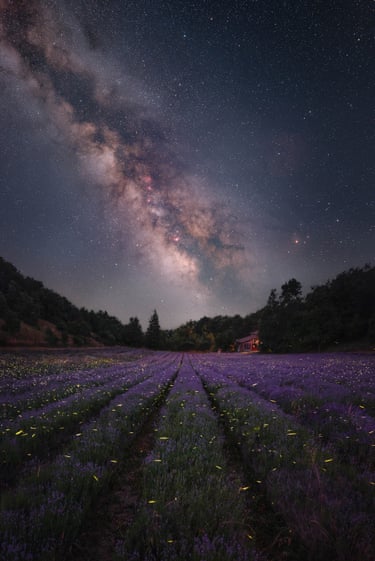
Il giardino delle stelle
Among rows of blooming lavender, the air filled with fragrance, fireflies appeared like small lanterns beneath a sky dominated by the summer Milky Way, a perfect meeting between the wonders of Earth and the night sky above.Photograph: Luca Fornaciari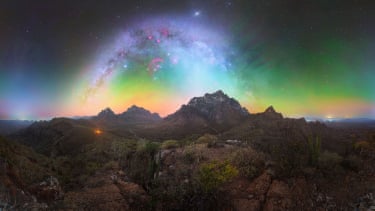
Standing on the Shoulders of Giants
This photograph comes from the heart of the Sierra La Giganta in Baja California Sur, Mexico, following a two-day expedition from the small village of San Juan Londo. The final approach required an ascent of more than 800 metres by mule along a long-forgotten section of the historic Camino Real, once used by vaqueros and their donkeys to transport goods between remote settlements. This path has remained largely untouched for nearly 80 years. The image is part of a project focused on documenting and promoting the dark skies of Baja California Sur for astrotourism.Photograph: Nacho Peláez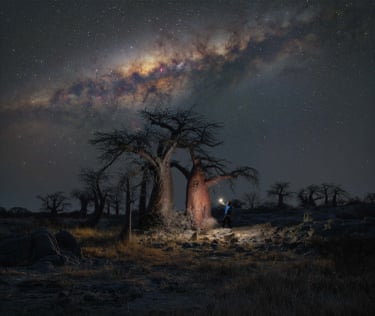
Botswana Baobabs by Night
I spent 10 days travelling through Botswana, living out of my car and moving through remote desert landscapes in complete isolation, focused entirely on photographing the night sky. This location became the highlight of the trip: a small, ancient island rising from the middle of a vast salt pan.Photograph: Stefano Pellegrini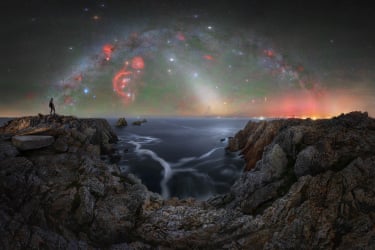
Where Earth Meets the Cosmos
A two-week camper trip along the coasts of Normandy and Brittany became a continuous struggle against wind and cloud cover, until a single clear night transformed the entire experience. While reviewing one of the final frames, I noticed an unexpected red glow in the sky – aurora. Within a single composition, the sky revealed an exceptional combination of phenomena: airglow, the winter arc of the Milky Way, Orion with Barnard’s Loop, the Pleiades, the Rosette and California nebulae, Andromeda, Jupiter, zodiacal light and aurora borealis. Photograph: Andrea Curzi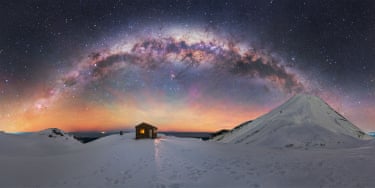
Milky Way Over Syme Hut and Mount Taranaki
Reaching Mount Taranaki, New Zealand involving over five hours of hiking through deep snow and ice in extreme conditions, with windchill dropping to around -15C and a heavy 20kg pack, progress was slow and physically taxing. This image is the result of a large-scale panorama composed of 78 individual frames, captured over the course of approximately one hour and 15 minutes in those harsh conditions. Photograph: Brendan LarsenExplore more on these topics