3 months ago
75
3 months ago
75
Post-war triumph led to 'dangerous delusion' on end of history, Rubio says
Rubio is now speaking, drawing on the history of the Munich Security Conference, dating back to 1963.
“We gather here today as members of a historic alliance, an alliance that saved and changed the world. When this conference began in 1963 it was in a nation, actually, it was on a continent that was divided against itself. The line between communism and freedom ran through the heart of Germany,” he says.
He says that “at the time of that first gathering, Soviet communism was on the march,” and “thosuands of years of western civilisation hung in the balance”.
“At that time, victory was far from certain, but we were driven by a common purpose. We were unified not just by what we were fighting against, we were unified by what we were fighting for,” he says.
But he adds:
“The euphoria of this triumph led us to a dangerous delusion that we entered ‘the end of history’ and every nation would now be a ldiberal democracy, that the ties formed by trade and by commerce alone would now replace nationhood, that the rules based global order, an overused term, would now replace the national interest, and that we would now live in a world without borders, where everyone became a citizen of the world.”
“This was a foolish idea that ignored both human nature and it ignored the lessons of over 5000 years of recorded human history, and it has cost us dearly,” he says.
Key events Show key events only Please turn on JavaScript to use this feature
End of transatlantic era 'not our goal nor our wish,' Rubio says
In another attempt to win over the European audience, Rubio says “in a time of headlines heralding the end of the transatlantic era, let it be known and clear to all that this is neither our goal nor our wish, because for us Americans, our home may be in the western hemisphere, but we will always be a child of Europe.”
He then lists close connections between Europe and the US, drawing on shared history – with the US story beginning with an Italian explorer, first colonies built by English settlers, and shaped by Scots and Irish, and German farmers, who he jokes “dramatically upgraded the quality of American beer.”
He also draws on his personal story, saying that he is “reminded … that both our histories and our fates will always be linked together.”
He also references Nato troops, saying “we have bled and died side by side.”
He says the US is “charting the path for a new century of prosperity,” but wants to do it with Europe.
And we go into the Q&A.
US does not want allies to 'rationalise broken status quo' but face it and fix it, Rubio says
Rubio insists that the US “do not seek to separate, but to revitalise an old friendship.”
He says “we do not want allies to rationalise the broken status quo rather than reckon with what is necessary to fix it.”
He says the US wants “a reinvigorated alliance that recognises that what has ailed our societies is not just a set of bad policies, but a malaise of hopelessness and complacency.”
US not interested in being 'caretakers of west's managed decline', Rubio says in urgent call to reject 'decline'
Rubio goes back to his historic parallel of Europe immediately after the second world war, as he says back “then – as now – many came to believe that the west’s age of dominance had come to an end and that our future was destined to be a faint and feeble echo of our past.”
But he rejects that and says “decline is a choice” – rejected after 1945 and should be rejected now too.
In an urgent passage explaining the US criticism of Europe, he says:
“We do not want our allies to be weak, because that makes us weaker.
We want allies who can defend themselves, so that no adversary will ever be tempted to test our collective strength. This is why we do not want our allies to be shackled by guilt and shame.
We want allies who are proud of their culture and of their heritage, who understand that we are heirs to the same great and noble civilization, and who, together with us, are willing and able to defend it, and this is why we do not want allies to rationalise the broken status quo rather than reckon with what is necessary to fix it.
For we in America have no interest in being polite and orderly caretakers of the west’s managed decline.”
UN, international bodies need to be urgently reformed as 'we do not live in perfect world,' Rubio says
Rubio also says that while the old international organisation do not need to be dismantled, they need to be urgently rebuilt and reformed to meet the new challenges.
He says the UN has “tremendous potential,” but could not solve the war in Gaza or Ukraine, proving to be “powerless” time and time again – contrasting this with decisive US decisions to move the dial.
“In a perfect world, all of these problems and more would be solved by diplomats and strongly worded resolutions.
But we do not live in a perfect world, and we cannot continue to allow those who blatantly and openly threaten our citizens and endanger our global stability to shield themselves behind abstractions of international law which they themselves routinely violate.”
Rubio takes aim at deindustrialisation, mass migration as risks to Europe
Rubio says that deindustrialisation was “not inevitable,” and a “foolish” result of that post-war “delusion,” as he called it.
He also says that “mass migration is not, was not, some fringe concern of little consequences,” as he warns it is “transforming and destabilising societies all across the west.”
He says the need “to gain control of our national borders” is needed as part of that.
“This is not an expression of xenophobia. It is not hate. It is a fundamental act of national sovereignty, and the failure to do so is not just an abdication of one of our most basic duties owed to our people.
It is an urgent threat to the fabric of our societies and the survival of our civilization itself.”
US 'little direct and urgent in counsel,' because 'we care deeply,' Rubio says
Rubio says that under Trump, the US “will once again take on the task of renewal and restoration.”
He underlines the close links between the US and Europe, including “shared history, Christian faith, culture, heritage, languagre, ancestry and past sacrifices.”
“So this is why we Americans may sometimes come off as a little direct and urgent in our counsel. … The reason why, my friends, is because we care deeply.
We care deeply about your future and ours, and if at times we disagree, our disagreements come from our profound sense of concern about a Europe with which we are connected, not just economically, not just militarily, we are connected spiritually and we are connected culturally.”
He says the US wants Europe to be strong, because “we know that the fate of Europe will never be irrelevant to our national security.”
He then delivers a long list of reason why Europe is special as he hails Mozart, Beethoven, Dante, Shakespeare, Michelangelo, Da Vinci, The Beatles, and the Rolling Stones, as well as the Sistine Chapel and the Cologne Cathedral.
He says “they testify not just to the greatness of our past or to a faith in God that inspired these marvels, they foreshadow the wonders that await us in our future.”
Rubio talks about post-war delusion mistakes made 'together' by Europe and US
Rubio says that “in this delusion, we embraced a dogmatic vision of free and unfettered trade,” while deindustrialising, shipping millions of jobs overseas, and handing control to “adversaries and rivals.”
He also says “we increasingly outsourced our sovereignty to international institutions, while many nations invested in massive welfare states at the cost of maintaining the ability to defend themselves.”
Rubio continues by criticising green policies “to appease a climate cult,” saying it “impoverished our people, even as our competitors exploit oil and coal and natural gas.”
“In a pursuit of a world without borders, we opened our doors to an unprecedented wave of mass migration that threatens the cohesion of our societies, the continuity of our culture and the future of our people.”
These lines are pretty similar to broader criticism from JD Vance last year, but are delivered very differently as he talks of this as a common mistake of the entire west – and not a criticism of Europe alone.
He eventually says:
“We made these mistakes together, and now together, we owe it to our people to face those facts and to move forward.”
Post-war triumph led to 'dangerous delusion' on end of history, Rubio says
Rubio is now speaking, drawing on the history of the Munich Security Conference, dating back to 1963.
“We gather here today as members of a historic alliance, an alliance that saved and changed the world. When this conference began in 1963 it was in a nation, actually, it was on a continent that was divided against itself. The line between communism and freedom ran through the heart of Germany,” he says.
He says that “at the time of that first gathering, Soviet communism was on the march,” and “thosuands of years of western civilisation hung in the balance”.
“At that time, victory was far from certain, but we were driven by a common purpose. We were unified not just by what we were fighting against, we were unified by what we were fighting for,” he says.
But he adds:
“The euphoria of this triumph led us to a dangerous delusion that we entered ‘the end of history’ and every nation would now be a ldiberal democracy, that the ties formed by trade and by commerce alone would now replace nationhood, that the rules based global order, an overused term, would now replace the national interest, and that we would now live in a world without borders, where everyone became a citizen of the world.”
“This was a foolish idea that ignored both human nature and it ignored the lessons of over 5000 years of recorded human history, and it has cost us dearly,” he says.

Jakub Krupa
in Munich
Before today’s proceedings get under way, the Munich Security Conference’s chair Wolfgang Ischinger has asked the audience to rise for a moment of silence to commemorate all civilians who died in conflicts around the world, including in Ukraine, Sudan, Iran, and Gaza.
Rubio is up next.
Starmer's Munich speech alongside EU's von der Leyen part of rapidly evolving post-Brexit relations - snap analysis
Jakub Krupa
in Munich
Starmer’s session is particularly interesting as he will appear on stage together with the European Commission president, Ursula von der Leyen.
On Friday, he was very busy diplomatically as he met in various formats – E3, Berlin – with numerous other European leaders, seeking to assert Britain’s place in the new, emerging global (dis)order.
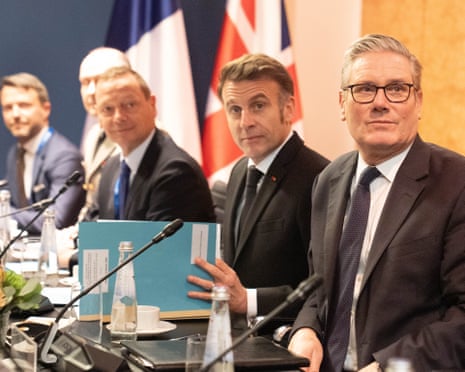
According to Downing Street’s trail of the speech, he will address the obvious Brexit angle directly, saying:
“We are not the Britain of the Brexit years any more. Because we know that, in dangerous times, we would not take control by turning inward – we would surrender it. And I won’t let that happen.”
His intervention comes as the UK hopes to reap greater benefits from a €90bn (£78bn) EU loan for Ukraine by suppying defence equipment to Ukraine funded by the loan. The bloc has indicated it was possible if the UK government agrees a “fair” contribution towards EU borrowing costs.
Starmer also recently signalled he would like to reopen talks with the EU on a defence pact. Negotiations to join the EU’s €150bn Security Action for Europe (Safe) programme collapsed last year.
Let’s see if he makes any of these points while sitting next to von der Leyen.
Morning opening: What will the US say?
Jakub Krupa
in Munich
Guten Tag!
US secretary of state Marco Rubio will open the second day of the Munich Security Conference this morning, presenting the US response to Friday’s speeches by Germany’s Friedrich Merz and France’s Emmanuel Macron on the tricky state of the transatlantic relations.
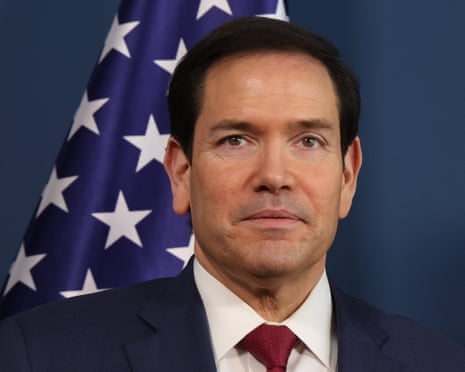
The question on everyone’s minds is whether he will choose to deliver a confrontational speech resembling that by the US vice-president JE Vance last year or will he seek to smoothen the already rocky relationship using some of his diplomatic charm.
The obvious paradox at the heart of his speech is that while Rubio will be speaking to (mostly) Europeans, he will be listened to also back in the US, including by his president, Donald Trump, who wants to see his agenda expressed in clear, even crude, terms. Quite a tightrope to walk for Rubio.
What will it mean in practice? We will know soon.
For what it’s worth, Rubio said before leaving for Munich that while Europeans want and admire honesty, they will also like what he has to say. He is understood to have repeated that declaration to some of the European delegations he met in Munich yesterday. Let see what it means in practice.
But he is not the only big name we are going to hear from the main stage, as he will be followed by China’s foreign minister Wang Yi, European Commission president Ursula Von der Leyen and Britain’s prime minister Keir Starmer.
Starmer is expected to tell the conference that Europe is “a sleeping giant” and must rely less on the United States for its defence.
“I’m talking about a vision of European security and greater European autonomy that does not herald US withdrawal but answers the call for more burden sharing in full and remakes the ties that have served us so well,” he will say, according to his office.
We will bring you all the lines from all the key speeches at the MSC, some colour from behind the scenes, and first analysis to what we hear from global leaders here.
It’s Saturday, 14 February 2026, it’s Jakub Krupa here, and this is Europe Live.
Good morning.