2 months ago
46
2 months ago
46
I began to notice my sight deteriorating in my 40s, but not just in the way that you expect it to with age. I had night blindness and blind spots in my field of view. At 44, I was diagnosed with retinitis pigmentosa, a genetic eye condition that causes the retina cells to die. I had always been a very visually oriented person: I was a practising architect, and someone who loved to read, draw, go to the cinema and visit art exhibitions. So when black text disappeared on a glaring white page, films became impossible to follow and artworks only took shape once explained to me, I questioned who I would be without my vision.
Around the age of 50, I had a particularly stressful year: I got divorced; dissolved my business; started a new job; moved house; and my dad died. As my life fell off a cliff, so did my eyesight, so that by 2015 my field of vision had decreased to only 5-10 degrees (a healthy average person’s is about 200 degrees). I was registered blind, but for a long time I lived in denial, not telling anyone how much vision I had lost. At work, feeling vulnerable and like I could lose my job, I presented as fully sighted, a daily performance that became exhausting. I was in survival mode, focusing on putting one foot in front of the other, hoping I wouldn’t get found out. I refused to see myself as disabled, and resisted using a white stick, but once I eventually did, I found people saw my disability before they saw me. I felt a total loss of identity. And I stopped doing the cultural things that once brought me joy.
Three years after that terrible year, I went to the theatre for the first time since losing most of my sight. It was The Lehman Trilogy at the National Theatre in London, a play about the Lehman Brothers and the 2008 financial crash. I assumed it would be another frustrating exercise of trying to piece together fragments and failing to follow the action that I’d come to expect whenever I went to the cinema or watched TV. But from the darkness of the circle, as the curtain went up and the three characters appeared on stage, I felt as if I’d got my vision back.
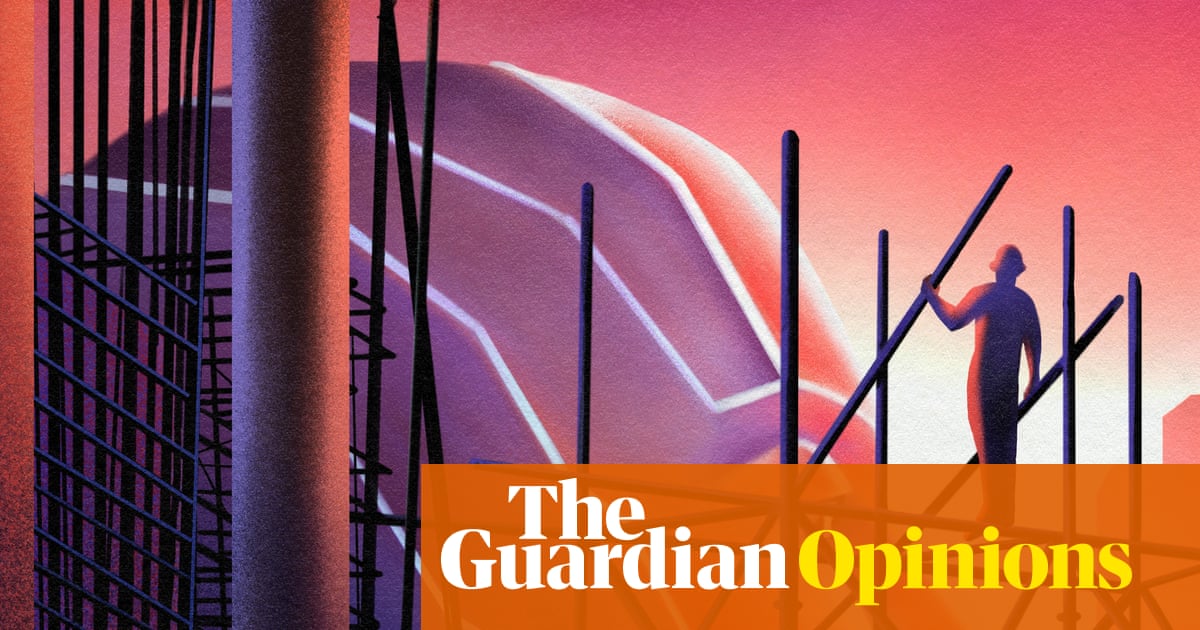
The simplicity of Es Devlin’s high-contrast set design, the lighting, the three-man cast, the actors’ silhouettes, the minimal props and the rotating set was a kind of conjuring trick that meant, for the first time in years, I could actually follow what was happening. The cage-like structure on the rotating set was literally pivotal: thanks to the play’s focusing of all the action within this framing device, I didn’t have to consciously think about where to look, and worry about whether I was missing parts of the narrative. The stripped-back staging laid bare the words, the action, the story, the theatre of it.
It was total immersion with no barriers, which felt freeing. The feeling was so visceral I didn’t even realise it at the time. I was simply back to being me as I used to be. It was only afterwards that I realised how completely absorbed I had been. I’ve now seen The Lehman Trilogy three times, and at each viewing, I have been able to forget that I am partially sighted. For those three hours and 20 minutes, I was myself again.
That first viewing of The Lehman Trilogy was an epiphany, a revelation that the immediacy of live performance gave me the control – I could lock on to the action and follow it in a way that I couldn’t with other visual culture. Not every theatre production manages such complete alchemy as this, but now, pretty much every time I see a play, I become totally connected to the world created on stage. I’ve been given back not just a sense of sight but a sense of self.