3 months ago
67
3 months ago
67
Large numbers of paper restorers and bookbinders were recruited by the Nazis and “contributed directly to genocide” during the second world war, according to research.
A British historian has uncovered a Europe-wide programme in the 1930s and 1940s in which restorers repaired and cleaned historic church and civil records, making them legible so that the Nazis could detect anyone with Jewish ancestry.
Dr Morwenna Blewett, a researcher in conservation history and associate member of Worcester College, University of Oxford, unearthed Nazi letters and other material showing the role played by craftspeople in restoring registers of births, conversions, baptisms and marriages to seek out inherited “racial” status.
In various public institutions including the German federal archives in Berlin, she found documents that show the complicity of these conservators, restorers and paper chemists, who used their skills within Germany and in occupied countries.
“They were creating an accumulated record of who might potentially be killed – a kind of hitlist, really,” she said. “They went above and beyond to enforce their ‘racial’ registration of populations.”
Six million Jews were killed in the Holocaust. “Even though it was known that there was this need to prove your heritage,” Blewett said, she “looked into the actual technical nuts and bolts of how this was achieved through cleaning documents.
“I found in the archives official documents about engaging bookbinders, as well as letters between various officials talking about cleaning documents, in the hope that these records would represent ‘racial purity’.”
Surviving administrative records show that by 1940 a master bookbinder called Franz Krause, from Neisse, a town now in south-west Poland, was among those recruited.
In one passage, a Nazi official wrote: “German church books, which capture the smallest place and every little farmstead in their closely bound mass of more than a hundred thousand volumes, are by far the most important source for the German population history, the proof of descent and the genealogy.”
Manuscripts dating back several centuries were illegible because they had become fragile, dirty and mouldy.
Despite their potential importance as historical papers, the restorers used “quite destructive processes”, Blewett said. “They weren’t ensuring the safety of the historic objects, they were making them readable. It didn’t really matter to them what these objects were.”
For example, manuscript pages were saturated with glycerine to make the entries legible, even though that fell short of accepted conservation practice of the time. “The physical rubbing in of glycerine risked tearing already damaged paper as well as softening the paper fibres by swelling them,” Blewett said. “I also found promotional material from technical companies that made laminating material that was used to preserve very fragile pages to make them more readable.”
Blewett, who previously worked as a paintings conservator at the National Gallery in London, stumbled across the material in researching cultural heritage organisations set up under the Nazis. “I just found all this material and I didn’t understand why they were talking about bookbinding and cleaning church documents. That led me to look further into what the scheme was and what was related to producing proof of Aryan ancestry.”
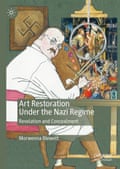
Her research features in her new book, Art Restoration Under the Nazi Regime, published by Palgrave Macmillan this month. “Through their work, restorers conspired with the Nazi regime to aid and abet criminal acts,” Blewett writes in the book. “Their rewards were rich. But their reputations have largely remained unsullied.”
Michael Daley, the director of the ArtWatch UK restoration watchdog, said the research revealed a “shocking abuse of skill”. “How much power accrues to those who control the appearance of things – for good or ill,” he said.