3 months ago
73
3 months ago
73
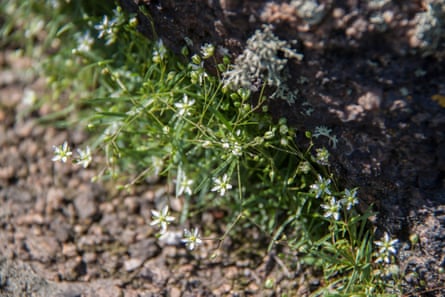
In the basement laboratory of the National Dendrological Park Sofiyivka, Larisa Kolder tends to dozens of specimens of Moehringia hypanica between power outages. Just months earlier, she and her team at this microclonal plant propagation laboratory in Uman, Ukraine, received 23 seeds of the rare flower.
Listed as threatened in Ukraine’s Red Book of endangered species, Moehringia grows nowhere else in the wild but the Mykolaiv region of Ukraine. Of those 23 seeds, only two grew into plants that Kolder and her colleagues could clone in their laboratory, but now her lab is home to a small grove of Moehringia seedlings, including 80 that have put down roots in a small but vital win for biodiversity conservation amid Russia’s war with Ukraine.
Before Russia annexed Crimea in 2014 and then invaded Ukraine in 2022, researchers at Kolder’s lab collaborated with Ukraine’s leading experts at the Nikitsy Botanical Garden in Crimea and the Nova Kakhovka experimental research station in Kherson. But over the past decade, those sites of key biodiversity research have been lost.
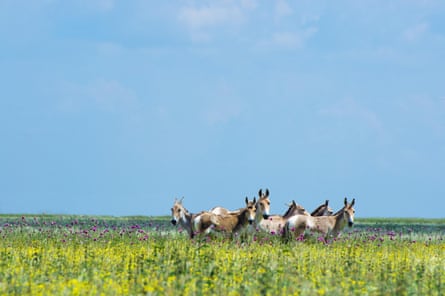
While the country’s eastern regions now under Russian occupation are primarily industrial areas, the southern expanse of Crimea and Kherson has historically been central to agriculture, botany and biodiversity. Although Ukraine covers less than 6% of Europe’s landmass, it is home to about 35% of the continent’s biodiversity. Many of the country’s rare and endemic species are located in the steppe zone and along Crimea’s coasts and mountains.
“This territory that is taken, it’s almost 40% of all the agricultural land of Ukraine,” says Oleksii Vasyliuk, a zoologist and member of the Ukraine War Environmental Consequences Work Group. He adds that the country’s largest national parks and reserves, including one of the world’s oldest steppe reserves, Askania-Nova, are primarily in that zone and have fallen under occupation. “This territory will be inaccessible to us for many decades, or maybe even centuries” because it has been heavily mined, he says.
For that reason, he adds, Ukraine is documenting instances of “ecocide”, in the hope that the international criminal court will recognise Russian crimes against the environment as war crimes when the conflict concludes.
The Nikitsky Botanical Garden was long considered the leading botanical research site in Ukraine, according to Volodymyr Hrabovyi, the acting director of the Sofiyivka. The garden housed large collections of rare plants and conducted research to adapt species to changing climates. The first site in Ukraine to grow persimmons, beginning in 1819, the botanical garden had become home to more than 50 varieties of the fruit.
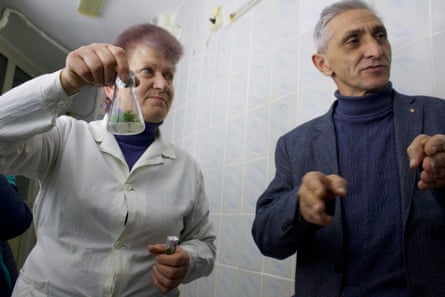
Today, Hrabovyi and his colleagues in Uman have no contact with that research site, or another in Kherson. They believe all of the Ukrainian researchers in Crimea and all but one in Kherson have left.
“It’s worse than the Berlin Wall,” says fellow scientist Iryna Denysko, describing the black hole that exists in trying to communicate with the occupied territories.
But when they consider the devastation that Russian forces have wreaked on the environment across Ukraine, including now-occupied national parks such as Askania-Nova – where Russia dug trenches on virgin steppe and transferred endangered animals to other reserves – they can only imagine that the botanical gardens are no exception. “Nothing is sacred to them,” Hrabovyi says, fearing that many rare plant species may have been destroyed or sold.
The botanist Anatoliy Opalko says that when he last spoke to a colleague at the former Nova Kakhovka station in Kherson in 2023, the researcher was taking persimmon seedlings from the lab. “It became very difficult to work there,” Opalko says. “He had to move some species from the research centre to his own vegetable garden.”
In this climate, the Sofiyivka researchers have emerged as leaders among Ukraine’s remaining botanists. Founded in 1796 as an English landscape garden by a Polish noble, Sofiyivka Park is located just a few minutes’ drive from the grave of Rebbe Nachman, an important site for Hassidic Jews that makes the town of Uman home to one of the world’s largest Rosh Hashanah pilgrimages each year. Today, Sofiyivka is a research institute of the National Academy of Sciences of Ukraine, though visitors can still wander the cypress- and pine-lined pathways of the park, which is known as one of the Seven Wonders of Ukraine.
With some of their colleagues enlisted and serving on the frontlines, and power outages lasting 15 hours a day, researchers at the park inevitably struggle to complete their lab work.
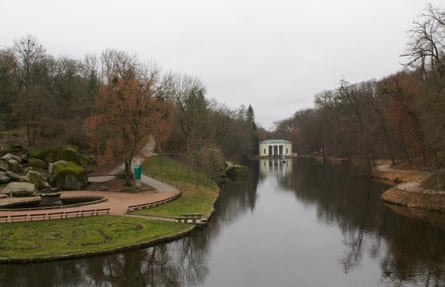
One of the leading researchers at the laboratory is turning 60, “which means that he can resign from the army”, says Hrabovyi. “He was on the frontline for all these years,” working as a commander of a tank crew, and now “he is happy to return back in a couple of months”.
Despite the difficulties, researchers such as Kolder continue vital work to preserve endangered plants in the Sofiyivka laboratory.
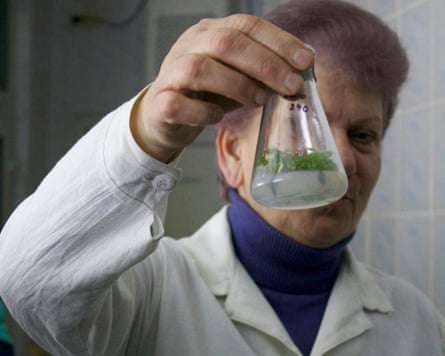
In the microclonal plant lab, she fills test tubes with an agar scaffold and transfers seeds to grow in sterile living conditions under a hood fitted with bactericidal filters. When the plants have developed, she returns to the laboratory to transfer them into peat discs – a step she says is the most difficult because of the transition from sterile to non-sterile conditions.
In a separate room, the plants continue developing until they are ready to be planted. Today, one of the 80 Moehringia seedlings that put down roots in the Sofiyivka lab is being transferred to the park’s arboretum – the first time the flower will grow in land outside its native region.
The significance is not lost on the team. “If the people who do this research disappear, and that material disappears, then the Earth will lose,” Hrabovyi says.
Tetiana Burianova and Olha Kotiuzhanska contributed reporting and translation support.
This story was supported by the International Women’s Media Foundation’s Women on the Ground: Reporting from Ukraine’s Unseen Frontlines initiative.