3 months ago
87
3 months ago
87
Pope Leo has denounced the “culture of power” driving the rapid rise of artificial intelligence while warning that the technology must be subject to the “most rigorous” ethical constraints as it infiltrates everything from work to war.
In his encyclical – the first major text on safeguarding humankind of his papacy – he also apologised for the Catholic church’s long delay in condemning slavery, describing it as “a wound in Christian memory”, and spoke of the “new forms of slavery” due to the digital economy.
In a break from tradition, Leo, who soon after being elected in May last year said he considered AI to be the biggest threat to humanity today, presented the document himself on Monday during an event at the Vatican. Among those in attendance was Christopher Olah, a co-founder of Anthropic, a US-based AI firm thatis embroiled in a lawsuit with Donald Trump’s administration over the ethics of AI.
Encyclicals are one of the highest forms of teaching from a pope to the Catholic church’s 1.4 billion members, and typically outline his priorities while highlighting the major issues in society.
In the document, called Magnifica Humanitas (Magnificent Humanity), Leo, who was born in Chicago and is the first US-born pope, referred to “a troubling revival of war as an instrument of international politics” and said AI was helping to facilitate the “normalisation of war”.
“For this reason, the development and use of AI in warfare must be subject to the most rigorous ethical constraints, to guarantee respect for human dignity and the sanctity of life and to avoid a race to develop such arms,” he wrote.
Leo urged the “disarming” of AI, while stating that some autonomous weapons systems are “practically beyond any human reach” to control.
“Disarming AI means freeing it from the mentality of ‘armed’ competition,” he wrote. “To disarm does not mean rejecting technology, but preventing it from dominating humanity,” adding that the technology should be “human-friendly”, accessible to all and opened to discussion and debate.
In a passage that appeared to be targeted at Silicon Valley, the pope warned that power over digital systems, infrastructure and data “does not rest with states but with major economic and technological actors”, and that when such power was concentrated “in the hands of the few” it tended to “become opaque and evade public oversight, increasing the risk of distorted forms of development that give rise to new dependencies, exclusions, manipulations and inequalities”.
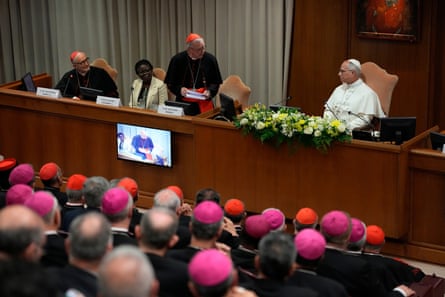
Olah said on Monday that the development of AI cannot be left solely to technology companies, urging greater oversight from religious leaders, governments and civil society.
Olah, who was sitting alongside the pope, said there was “a real possibility” that AI would displace human labour “at very large scale”.
“If that happens, supporting those displaced will be a moral imperative of historic proportions,” he said.
Companies like his operated “inside a set of incentives and constraints”, such as under strong commercial, geopolitical and personal pressures, that can sometimes conflict with “doing the right thing” for the broader interests of society, therefore making outside scrutiny essential.
Leo, whose family history includes both enslaved people and enslavers, wrote on slavery: “It is impossible not to feel deep sorrow when contemplating the immense suffering and humiliation endured by so many in stark contrast to their immeasurable dignity as persons infinitely loved by the Lord … For this, in the name of the church, I sincerely ask for pardon.”
Past popes have apologised for Christians’ involvement in the transatlantic slave trade. But no pope has ever publicly acknowledged, much less apologised for, the role that popes themselves played in giving European sovereigns explicit authority to subjugate and enslave “infidels”.
Alongside two of his cardinals, others at the presentation included the theologians Anna Rowlands and Léocadie Lushombo.
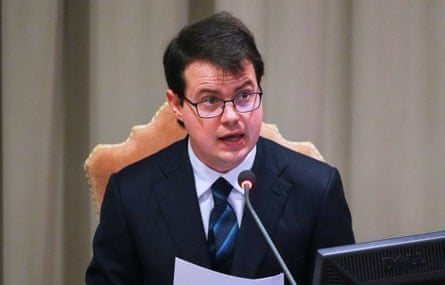
Rowlands, professor of Catholic social thought at Durham University, said the encyclical “brings the vision of the Gospel to bear on the cultures of AI”, and in doing so “warns of a growing culture of power that is reshaping work, family, education, and political life”.
The Vatican has been seriously engaged on questions surrounding AI for several years now, including having regular dialogues with Microsoft, Google and other big technology firms.
The pope said on Monday that the Catholic church wanted to work with AI developers to discuss proper use of the technology.
“What Leo has done in this document is put the full weight of his office behind the Catholic church’s efforts to be in dialogue with big tech,” said Christopher White, the author of Pope Leo XIV: Inside the Conclave and the Dawn of a New Papacy and a senior fellow at Georgetown University’s Initiative on Catholic Social Thought and Public Life.
“He’s clearly approaching AI from a position of humility and making it clear that the church doesn’t have all of the answers when it comes to what sort of policies are necessary for AI regulation. But he is being clear-eyed that AI development can’t simply be the wild west like some of its advocates would like to see.”
In reaction to the encyclical, Christine Allen, CEO and director of the Catholic aid charity Cafod, said the pope’s message spoke of the “inherent dignity of humankind”.
“We are not simply instruments of production but living beings, entrusted with a moral compass,” she added. “In a world full of imbalances, we have a duty to use AI responsibly. Today’s message is that it should not be used to further exacerbate inequality and suffering.”