1 month ago
66
1 month ago
66
She spoke about indulging in colour, feasting on beauty, feeling a little giddy when drinking in glorious hues and textures – and not searching too deeply for meaning.
So in these gloomy times, a major retrospective of the work of the artist Gillian Ayres in her adopted Devon homeland may be just the job.
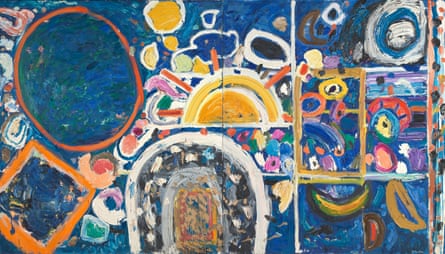
Entitled A Life in Colour, the show at The Box in Plymouth, which has just won the prestigious Art Fund museum of the year award, is billed as a re-examination of one of Britain’s most radical female artists.
Hannah Hooks, contemporary art curator at The Box, described Ayres, who died in 2018 aged 88, as formidable and brilliant.
“Her fearless commitment to painting is something to be celebrated,” she said. “She came of age in a postwar British art world dominated by men and remained entirely faithful to painting as it went in and out of fashion. Gillian was a painter’s painter. The fact that she isn’t better known by more people is something we hope to change.”
Hooks said installing the paintings had been a privilege.
“The colour knocks you off your feet. It’s incredible to be surrounded by it and to sense the movement of Gillian’s body, the way she’s creating balance and tension. There’s chaos and beauty in this riot of colour. She spoke of how colour made her feel heady; it was almost a spiritual experience for her.
“We’re seeing this exhibition as a chance to think about the power of art and creativity to communicate emotion in a non-verbal way. It comes at a time when the creative subjects are under-funded and underrepresented so we want to champion and celebrate the power of the imagination.”
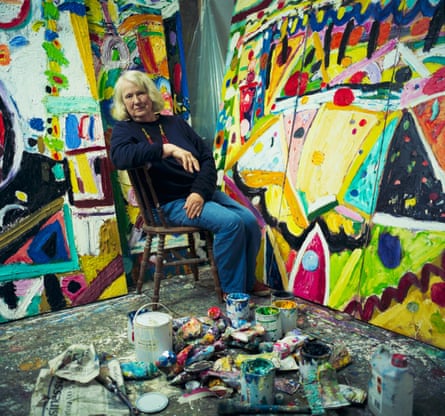
It was not about meaning, Hook continued. Ayres didn’t want people to try to make sense of her work, “intellectualise” it or attempt to find the representation within it.
“I think it’s really important in the world at the moment to find the space and time to look, to observe, to enjoy using your eyes, not to try to make sense of things but to really delight in a visual experience.”
Ayres was born in London in 1930. Inspired by Turner, Picasso and Pollock, she became a significant figure in arts education as well as an artist in her own right.
She moved from London and spent time living and working in north Wales but for the last 30 years of her life hunkered down in north Devon, her studio described by one visitor as a “cheery muddle of paint-spatter, house plants, stepladders, tins of colour and canvasses”.
after newsletter promotion
Work on display at The Box spans seven decades. It includes a landscape Ayres painted when she in her teens and murals created in the 1950s to decorate a dining hall at a school in north London. The murals were covered over within a few years – luckily, only with wallpaper – and were later rediscovered in almost perfect condition.
The show also features later, vibrant works created at her home tucked away in rural north Devon.
Some of the pieces are vast and the colours applied so thickly that the scent of oil paint lingers around them.
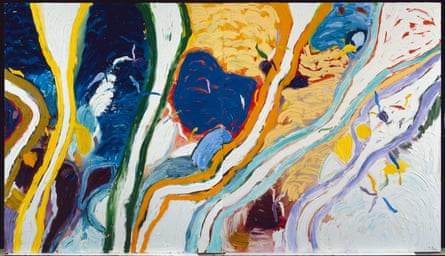
Ayres’ son, Sam Mundy, said they sometimes struggled to get large pieces out of and away from the cottage. “We used to have to borrow an old pickup truck and two people would sit in the back holding on to the paintings. We’d drive up the very steep hill with hairpin bends and meet a lorry at the top.”
Mundy said Ayres had had a deep connection with the English West Country. “She liked western Britain,” he said. “She liked the drama of the landscape and the coast. She liked the sunset over the water. She would be pleased that this exhibition is being staged here.”
-
Gillian Ayres: A Life in Colour opens at The Box in Plymouth on Saturday until 20 September.