2 months ago
47
2 months ago
47
Big-wall climber Sasha DiGiulian had spent the last three years preparing for a career-defining ascent of one of the most challenging routes up the face of the famed granite cliff known as El Capitán in Yosemite national park. All she and her partner needed was a two-week window of favorable weather. They appeared to get one on 3 November.
DiGiulian felt jolts of fear during her training, she said, induced by the sudden 2,600ft of exposure she felt as she rappelled down to practice on the most challenging sections of the iconic California peak. But her nerves calmed when ascending from the base, allowing her to focus more intently on the moves and completing each pitch – a measurement that references a length of the rope that climbers use to secure themselves to the rock.
“There’s something about starting from the bottom and being exposed for so long,” she said. “I stopped being so fearful. It became my normal.”
When DiGiulian and her climbing partner, Elliot Faber, took off, they expected mild rain toward the end of the ascent. The night it came, their 10th on the climb, DiGiulian was dead tired and happy just to curl up into the sleeping bag on her portaledge, a suspended shelter that allows climbers to camp on the wall. “Then I looked at the forecast, and I was like: ‘Oh, no,’” she said.
A light rain turned into a downpour that sopped the shelter. DiGiulian guarded her sleeping bag as best she could, while mopping up the moisture with her clothes, then wrapping herself in them to dry them off with her body heat. Her 4ftx6ft portaledge was an ultralight marvel, packing neatly into a 2lb sack that she could strap to her climbing harness. But as the wind picked up, whipping them with 50mph gusts, her shelter flopped back and forth, its poles bending with such force that she worried they’d break.
Now, she and her partner once again waited for a weather window – this time hoping to bail off the wall to safety. In the meantime, they dangled next to one another for days, waiting out the storm mostly in silence.
“We would do these check-ins,” DiGiulian said. “I’d be like: ‘Elliot, I’m scared.’ And he’d be like: ‘You’ll be fine.’ And I’d be like: ‘Elliot, my pole is at my chest, I’m so afraid it’s going to snap.’ And he’d say: ‘Just let it go. It’s going to be OK.’ At one point, I said we could combine our ledges and it would be so much warmer and we could keep each other company. And he was like: ‘No. Then we can’t shit in our own tents.’”
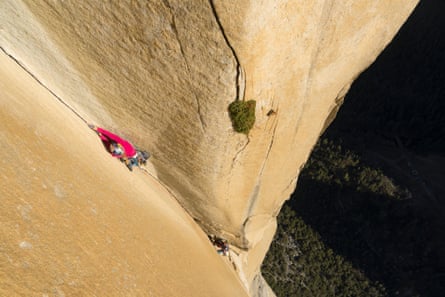
A competitive rock climber since childhood, DiGiulian, 33, set her sights three years ago on climbing Platinum, one of the routes up the face of El Cap. It’s the longest, at 39 pitches. It’s also one of the most challenging and among the least traversed. While most routes blend tough sections with easier ones that give the climber a chance to relax, virtually all of Platinum is graded as difficult.
“Every pitch is a knife fight and no pitch is guaranteed,” DiGiulian said. “This climb just struck me as this crazy, audacious goal that really excited me.”
Only a handful of climbers have ascended it from bottom to top since a group led by Rob Miller mapped and bolted it a decade ago. Even Faber himself, despite helping establish the route, had yet to “free climb” it – insider-speak for climbing the whole route with safety gear, but without mechanical assistance. DiGiulian would become the first woman if she succeeded.
To prepare, she spent the previous three springs and falls in Yosemite, rehearsing the most difficult sections, usually by dropping in from the top instead of climbing toward them. Using an aid called an “ascender”, she would scale part of the way up the face, then continue hiking on foot, before rappelling back down to practice climbing a strenuous stretch of rock standing 2,600ft high.
Despite a long career and several big-wall ascents, she found the seemingly endless empty space beneath her unnerving at times. During one practice session, she led a challenging pitch known as “the dog head”, following a series of underclings that forced her to smear her feet into tiny footholds while holding tension above her head with the force of her biceps, “kind of like an accordion”, she said. DiGiulian slipped off, plunging 30ft before the slack pulled out and her partner arrested her fall.
“And it was actually OK,” she said. “I knew what the consequence felt like and the consequence felt safe, so I was actually able to focus on performance.”
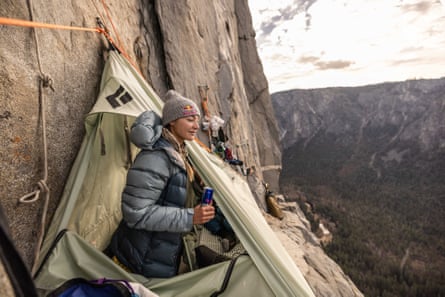
When their opportunity came to free-climb Platinum last month, DiGiulian and Faber, along with their support team and film crew, cached 30 gallons of water at the summit, established fixed lines running the length of the route and set up two camps along the wall. DiGiulian and Faber would climb during the day, then ascend the fixed ropes to sleep in spots that shielded them from the elements and falling rock, before rappelling back down to resume the climb the next morning. They packed enough food for about two weeks, which they viewed as a generous estimate at the time.
The storm undermined their math. As the first couple of days passed, the forecast kept getting grimmer. The precipitation and wind would continue. The temperature would drop. They could easily get stuck up there for more than a week. On the third night of the storm, however, they saw that the forecast called for a lull the next day, giving them an opportunity to escape.
DiGiulian sat in her moist portaledge that night thinking it over. “I just felt super sad,” she said. “We were at the 32nd pitch. We were at the top. I was so pleased with how I was climbing so far. It was all coming together.”
That night she dreamt that she’d gone home, and felt instant regret. When morning came, they decided to stay on the wall.
For the next week, the weather grew more challenging. Deafening thunder cracked overhead, followed by lightning strikes so close that they briefly flooded the camp with bright light. In the distance across the valley, they could hear the sound of falling rock – one of the biggest safety hazards in big-wall climbing. Over the following days, the rain turned to snow, encasing their portaledges in ice. Then a couple more days of rain, followed by a couple more of snow. At one point, ice started falling from the summit all around them, “which was a little terrifying”, she said.
After nine days, the storm finally passed. By then, they’d lived on the wall for almost three weeks. As they resumed the climb, they faced new challenges. They still had to pass the hardest sections, with their minuscule footholds – and now they had to do it on wet rock.
DiGiulian climbed with renewed focus and flow, she said, despite the conditions and a nagging numbness in one of her big toes, where she appeared to have developed a case of frostbite.
Three pitches from the top, Faber got word that he had a family emergency, and had to leave for home. DiGiulian, already accustomed to killing time at camp, waited another two days, hoping for his return. When it became clear he couldn’t come back, her friend Ryan Sheridan from the support crew belayed her to the summit.
“It was bittersweet,” she said. “Elliot was this amazing partner who waited out this storm with me. We got to have so many awesome memories. I was sad that Elliot couldn’t come to the top and finish what we started together, but I was also grateful I had this network of support around me. I got the best of both worlds. I got to enjoy this experience with two people instead of one.”
After 23 days on the wall, DiGiulian’s legs trembled when she finally walked again across flat ground, becoming the first woman to ascend Platinum. Climbing is less marked by gender disparity than many other athletic endeavors, she says, but she still values making first ascents as a woman.
“It’s a milestone for the sport,” she said. “When I see a woman do something, I can put myself in her shoes more. I think: ‘Hey, if she can do it, I can do it too.’”
In the end, the rain, the snow and the heavy winds that left them stranded on the wall and slickened the rock on their way to the top became an integral part of the achievement.
“The mental component of what I learned from the climb and the resilience I didn’t know I had within me was a really empowering feeling – it left me with a sense of inner confidence,” she said. “The mind is really powerful. When you’re really focused on what you want to achieve, your body can get through a lot.”