2 months ago
62
2 months ago
62
Israel’s army has become a vehicle for violent settlers to escalate their campaign against Palestinians across the occupied West Bank, with reserve units drawn from settlements functioning as vigilante militias, according to Israeli soldiers and activists, and the United Nations.
Hagmar, or regional defence units, were set up across the West Bank from October 2023, as conscripts and the standing army deployed there prepared to move to Gaza.
The system handed weapons and authority to thousands of settlers, who formed military units in their own communities, with few checks on how these powers would be used. The state pays hagmar salaries, but in effect they operate in parallel to regular battalions.
Yaakov*, who served as a reservist in the occupied West Bank in 2024, described the hagmar as “armed militias doing what they want”.
“Formally they are under the battalion commander and his deputy, but on the ground they are given a free hand,” he said, speaking on condition of anonymity. “The senior command looks the other way when incidents happen. They don’t respond to any command.”
His unit was often called to incidents by Israeli activists supporting Palestinians. When they arrived, they usually found settler reservists already at the scene, sometimes joining attacks on Palestinians.
“Most of the time, when something happened the hagmar would arrive ahead of us … Sometimes we arrived together with them, it was very rare we preceded them,” Yaakov said. “When they do arrive, in the best case, the hagmar do not participate. In the worst case, they are together with the settlers.”
He said he witnessed daily violence including vandalism of houses, trees, fruit, and agricultural produce, theft of livestock, intimidation and careless weapons handling.
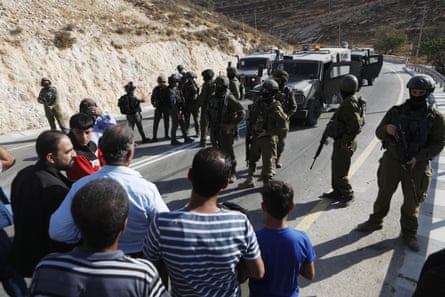
In other areas hagmar forces have been implicated in more extreme violence, including last year killing an elderly Palestinian man, and running over another Palestinian with an all-terrain vehicle.
The hagmar system had led to “the establishment of what are effectively settler militias within the IDF’s own ranks”, said Nadav Weiman, the executive director of Breaking the Silence, an advocacy group for former Israeli soldiers. “These soldier-settlers are driven by a violent, zero-sum ideology, and have all the authority of regular IDF soldiers to put that ideology into action.”
The Israeli military said there had been “a few incidents in which regional defence unit reservists acted in ways that did not meet expected standards”, but they “do not represent the majority of regional defence unit reservists”.
Some reservists have been removed from duty, and in other cases criminal investigations have been opened, a spokesperson said.
Since October 2023, Israeli soldiers have been indicted in connection with three violent offences and three property offences in the occupied West Bank, rights group Yesh Din said. Israeli forces have killed over 1000 Palestinians in that period. The last attack that led to a homicide indictment was a 2019 shooting.
There is a long history of close collaboration between settlers and the Israeli military. Units in the West Bank regularly killed and injured civilians, including children, and failed to enforce laws protecting Palestinians from settler violence.
But the widespread deployment of settler units marked a profound structural change. “Post 7 October [2023] the military and settler are unified,” said Yehuda Shaul, co-director of the Ofek thinktank, which campaigns against Israel’s occupation, and a co-founder of Breaking the Silence.
“The settlers are the IDF, the IDF are settlers, there’s no pretence of a buffer,” he said. “It is not any more about a situation where the IDF are standing idly by while settlers attack, it’s not even just one or two soldiers joining settler attacks.
“It’s a level of complicity that goes beyond anything we have seen before. You can see the impact if you look at how many Palestinian communities were forcibly transferred by settler violence before 7 October, and how many after.”
Settler attacks have completely displaced 29 Palestinian communities since October 2023, more than one a month on average, UN data shows. In 2022 and the first nine months of 2023, four communities were displaced, or one every five months.
The UN warned this month that the “growing phenomenon of ‘settler-soldiers’ … is further blurring the line between state and settler violence”. Settlers had killed, destroyed property and livelihoods, forced Palestinians from their homes and ripped communities apart, a report from the office of the high commissioner for human rights found.
The creation of hagmar units enabled these attacks and “further cemented” impunity for perpetrators, the report noted. A shifting mix of military uniform and civilian clothes meant “there is no clarity on whether Israeli attackers are acting as part of the army or in their private capacity”.
A second Israeli soldier deployed to the occupied West Bank in 2025 described an irregular dress code that amplified the “vigilante feel” of hagmar units. Moshe* spoke to the Guardian in an interview arranged by Breaking the Silence and also asked to remain anonymous.
“When you see the hagmar with uniform, they’re quite identifiable because this is the only people out there that aren’t us.” But they did not always wear uniforms, even when going on military missions, he added. “In the West Bank [there] is a very confusing mix of people, some in full uniform, some in part uniform but with long-barrel weapons, or wearing something like cargo pants that are military-esque but not necessarily a proper uniform.”
Nahum, who is driving a car with a civilian license plate, changes into Israeli military uniform – videoIn September last year, a hagmar member, Elyashiv Nahum, approached international activists in Masafer Yatta, demanding to see their passports. He was driving a civilian vehicle, and wearing civilian clothes so the activists asked what legal authority he had to demand documents, video of the incident showed. Nahum then changed into uniform and called a commander who told the women: “It doesn’t matter what he looks like. He’s a soldier and he has the authority.”
Even serving Israeli soldiers often struggle to identify the chain of command for armed settlers because of the irregular approach to uniforms and a proliferation of weapons in the West Bank since October 2023.
'He’s a soldier and he has the authority': soldier and commander on phone confront activist – videoAssault rifles are issued to hagmar and members of “first defender” security groups at settlements, and the government has also loosened gun licensing laws.
In the first year of the war, about 120,000 weapons were handed out to “Israeli citizens”, the far-right security minister, Itamar Ben-Gvir, said in a post on X.
Yaakov described being called to an incident where a well-known settler wearing military trousers was waving a military-issue weapon with dangerous aggression and carelessness. He did not know whether the man was a fellow soldier from a hagmar unit, a first responder with an assault rifle, or a civilian with a borrowed gun.
The Israeli military said hagmar reservists “are required to operate in uniform and follow clear procedures under the supervision of regional units”. They are also required to follow all IDF orders and rules of engagement. “Any deviation from these rules is investigated and addressed,” a military spokesperson said.
Regular forces deployed to the West Bank were not briefed on the hagmar’s membership or division of military roles between units in the area, both reservists who spoke to the Guardian said. That was “very unusual when there are other forces in the same area as you”, Moshe said.
They came to recognise many serving settlers over months of deployment, however, as the two groups built relationships that Yaakov described as “transgressing the operational”.
All settlements keep a “warm corner” with coffee and biscuits for soldiers far from home. Hagmar soldiers often invite other reservists, who are often bored and lonely, to watch football or join Friday night dinner, creating close bonds.
The hagmar units are not new. The structure was created decades ago, envisaged as a backup line of defence in border kibbutzim and communities to be activated in wars or at times of heightened threat.
But after the 7 October 2023 Hamas-led attacks, as Israel prepared to send the conscripts and career officers of the standing army to fight in Gaza, hagmar reservists were activated at a scale and for a duration that was unprecedented in Israel’s history.
Thousands were called up to units in border communities, an Israeli military spokesperson said. The number of serving hagmar reservists has been cut by 85% since then but hundreds are still deployed, most of them in the occupied West Bank. The military declined to give exact figures, but Israeli media reported that 7,000 settlers were initially mobilised to the units, and in December 2025 at least 500 were still based at illegal farm outposts.
Conventional reservist units outnumbered the hagmar in the West Bank, but the settlers’ presence was felt much more strongly on the ground, both soldiers said.
Their familiarity with local terrain often means soldiers on temporary deployments seek their advice or defer to their decisions. “Even the senior officers don’t really know what’s going on, so they treat the hagmar as the people that know the area and know how to deal with stuff,” Moshe said.
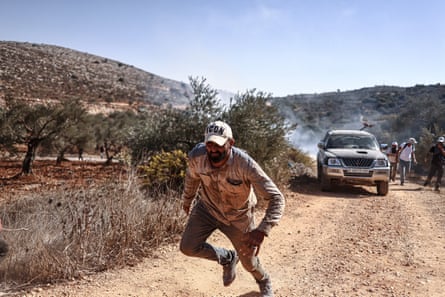
At times this extends to hagmar having effective command authority over uniformed reservists on the ground. In August, Nahum, the settler filmed changing into a uniform, drove to a small Bedouin community with several regular reservists in his pickup, although travelling in a civilian vehicle while on duty would usually violate Israeli military regulations.
When the group arrived Nahum, who was in civilian clothes, began directing the reservists to search Palestinian property and look for international activists, according to an Israeli activist present at the time and a soldier serving in the area. “I wouldn’t say he was giving orders like an army commander, but he was in charge,” the activist said, speaking on condition of anonymity over fears of professional repercussions for work protecting Palestinians.
“You saw that he would talk with the soldiers, he would talk with the officers, and then in the end what he wanted, that would happen.”
Even when a higher-ranking officer, a lieutenant colonel, arrived on the scene, it was “obvious that this guy was telling the soldiers what to do and what to say. Even the lieutenant colonel.”
Yaakov, who had served in the West Bank before, said the presence of hagmar units caused an obvious escalation in attacks on Palestinians and their homes and property. “It was very clear that the friction is higher, and the friction between specifically those hagmar units which are new after 7 October and the Palestinians was much more intense,” he said. It was also clear the escalation was caused by Israelis.
“It’s not that Palestinians came to the settlement, the settlement came to them,” he said. “The settlers were bringing their sheep to graze at the area of the [Palestinian] village. It was very obvious that the Palestinians were the side that could not fight back.”
He did not know at the time that Israeli soldiers had the authority to arrest Israelis, and only witnessed the detention of Palestinians.
“The violent conduct came only from one side. Arresting them would have stopped the pogroms, the Palestinians were not armed or violent and the risk to life came from the settlers.”
Hagmar recruits include men with a criminal record for violence, who now conduct their campaigns backed by the authority of the Israeli state, Shaul said.
“Israel has taken some of the most extreme settlers, in some cases people who are even convicted of assault against Palestinians, and made them the IDF.
“They have been given the power to run the show in the area where they live, to carry out their plans, dreams, fantasies – depending on how far they went – through formal service in the IDF.”
* Names have been changed